BYD
Tang
BYD Tang: years registered new in Europe, fault code help, warning lights and maintenance guides.
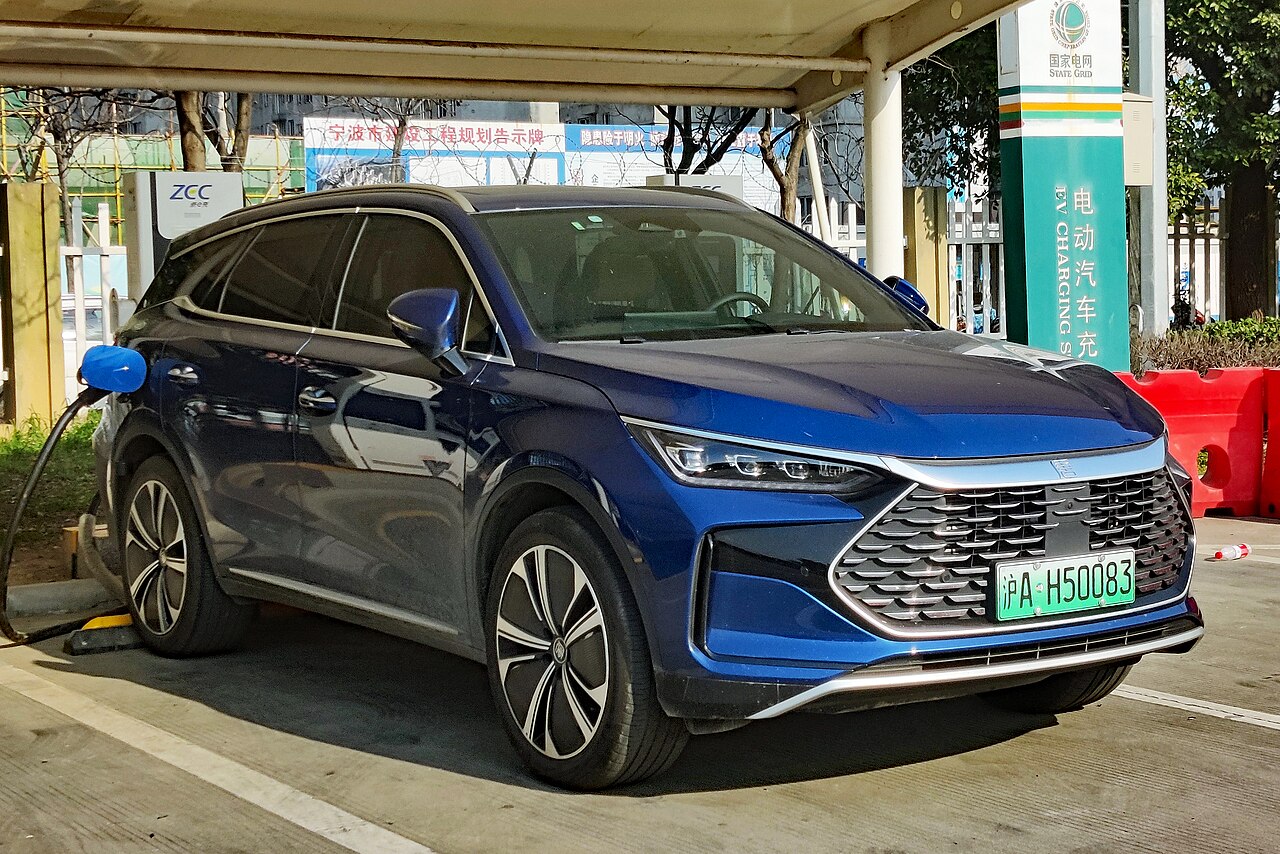 Licensed photo · Photo credit
MakeBYD
New registrations (EU)2021–2026
Generations and technical specifications
BYD Tang – Third generation2026
| Specification | Value |
|---|---|
| Production | 2026 (to commence) |
| Body styles | 5-door crossover SUV |
| Platform | e-Platform 3.0 (Electric) |
| Wheelbase | 2,950 mm |
| Length | 5,045 mm |
| Width | 1,980 mm |
| Designer | Under the lead of Wolfgang Egger |
BYD Tang – Second generation2018–present
| Specification | Value |
|---|---|
| Production | 2018–present (DM Series) 2018–2021 (ICE) 2019–2025 (EV) |
| Body styles | 5-door crossover SUV |
| Layout | Plug-in hybrid Front-engine, front-wheel drive Front-engine, full-time electric all-wheel-drive Battery electric Front-motor, FWD Dual-motor, 4WD |
| Platform | e-Platform 3.0 (Electric) |
| Engines | Petrol 1.5 L I4 turbo (DM-i) 2.0 L BYD487ZQA I4 turbo |
| Electric motor | 110 kW front AC permanent magnet synchronous 180 kW AC permanent magnet synchronous |
| Transmissions | 6-speed DCT E-CVT (DM-i) 1-speed A/T (BEV) |
| Battery | LFP battery 17.1, 18.5, 22.3 kWh (DM) 9.98, 21.5 kWh (DM-i) 86.4 kWh (EV) 108.8 kWh (EV) |
| Wheelbase | 2,820 mm |
| Length | 4,870 mm |
| Width | 1,950 mm |
| Height | 1,725 mm |
| Designer | Under the lead of Wolfgang Egger |
BYD Tang – First generation2015–2018
| Specification | Value |
|---|---|
| Production | 2015–2018 |
| Layout | Front-engine, front-wheel-drive |
| Engines | 2.0 L BYD487ZQA I4 turbo petrol |
| Electric motor | 2×110 kW |
| Battery | 18.4 kWh LFP |
| Electric range | 80 km |
| Wheelbase | 2,720 mm |
| Length | 4,815 mm |
| Width | 1,855 mm |
| Height | 1,720 mm |
EU type-approval data
| Years | Powertrain | Power | Mass | Electric range |
|---|---|---|---|---|
| 2023–2025 | Electric | 130 kW (177 PS) | 2564–2705 kg | 400–530 km · 238–240 Wh/km |
| 2022–2025 | Electric | 180 kW (245 PS) | 2564 kg | 400 km · 238–240 Wh/km |
| 2021, 2023–2025 | Electric | 200 kW (272 PS) | 2564–2705 kg | 400–530 km · 238–240 Wh/km |
| 2022–2025 | Electric | 380 kW (517 PS) | 2564–2705 kg | 400–530 km · 238–240 Wh/km |
Years are registration years. Each range runs from the 10th to the 90th percentile of the values reported for new registrations; it is not an average. Mass is the mass in running order. For electric cars the power is the type-approval net power, which can be lower than the peak power in brochures.
Key specifications
| Specification | Value |
|---|---|
| Powertrains (EU) | Electric |
| Power (EU) | 130–380 kW (177–517 PS) |
| Mass in running order (EU) | 2,564–2,705 kg |
| Wheelbase (EU) | 2,820 mm |
Years and markets
| Specification | Value |
|---|---|
| New registrations (EU) | 2021–2026 |