Accent
Hyundai Accent: official NHTSA recalls, fault code help and maintenance guides.
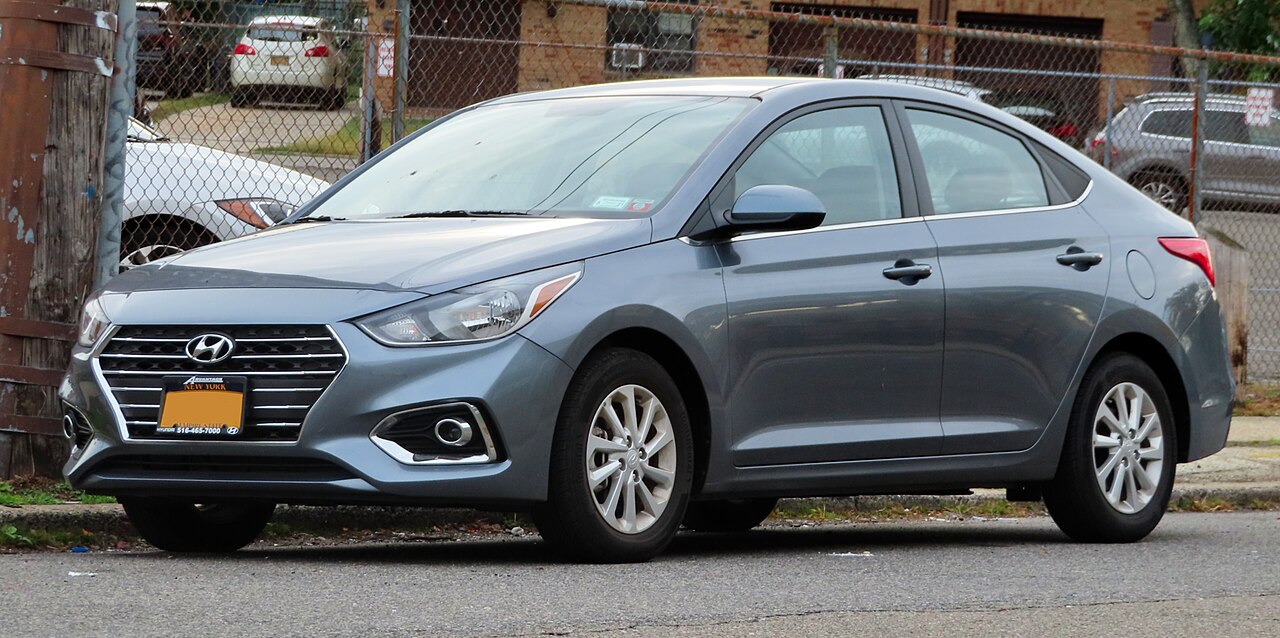 Licensed photo · Photo credit
Generations and technical specifications
Hyundai Accent – Sixth generation2023–present
| Specification | Value |
|---|---|
| Model code | BN7 |
| Production | 2023–present |
| Body styles | 4-door sedan |
| Engines | Petrol 1.5 L Smartstream G1.5 MPi I4 1.5 L Smartstream G1.5 T-GDi I4 |
| Transmissions | 6-speed manual 7-speed DCT CVT |
| Wheelbase | 2,670 mm |
| Length | 4,535 mm |
| Width | 1,765 mm |
| Height | 1,475 mm |
| Assembly | India: Chennai (HMIL) Vietnam: Ninh Bình (HTMV) |
| Designer | Min-chul Koo |
Hyundai Accent – Fifth generation2016–2026
| Specification | Value |
|---|---|
| Model code | HC / YC (China) |
| Production | 2016–2022 (China) 2017–2022 (Mexico) 2017–2022, 2024–2026 (Russia) 2017–2023 (India) 2019–2022 (Philippines) |
| Model years | 2018–2022 (North America) 2018–2023 (Middle East) |
| Body styles | 4-door sedan 5-door hatchback |
| Platform | Hyundai-Kia K2 |
| Engines | Petrol 1.0 L Kappa II T-GDi I3 1.4 L Kappa MPi I4 1.5 L Smartstream G1.5 MPi I4 1.6 L Gamma MPi I4 1.6 L Smartstream G1.6 DPi I4 Diesel 1.4 L U II CRDi I4 1.5 L U II CRDi I4 1.6 L U II CRDi I4 |
| Transmissions | 6-speed manual 6-speed automatic 7-speed DCT C0GF1 CVT |
| Wheelbase | 2,580 mm 2,600 mm (HCi/HCr/YC) |
| Length | 4,190 mm (hatchback) 4,385 mm (HC sedan) 4,405 mm (HCr/YC) 4,440 mm (HCi) |
| Width | 1,729 mm |
| Kerb weight | 1,060–1,225 kg |
| Assembly | Mexico: Pesquería (KMMX) India: Chennai (HMIL) Russia: St. Petersburg (HMMR) China: Beijing (Beijing Hyundai) Philippines: Santa Rosa, Laguna (Hyundai Asia Resources Inc.) Vietnam: Ninh Bình (HTMV) Algeria: Tiaret (Tahkout Manufacturing Company) |
| Designer | Chanhee Lee |
Hyundai Accent – Fourth generation2010–2026
| Specification | Value |
|---|---|
| Model code | RB / RC (China) |
| Production | 2010–2019 2012–2026 (Egypt) |
| Model years | 2012–2017 (North America) |
| Body styles | 4-door sedan 5-door hatchback |
| Platform | Hyundai-Kia PB |
| Engines | Petrol 1.4 L Gamma MPi I4 1.4 L Kappa MPi I4 1.6 L Gamma MPi I4 1.6 L Gamma II MPi I4 1.6 L Gamma II GDi I4 Diesel 1.4 L U II CRDi I4 1.6 L U II CRDi I4 |
| Transmissions | 5-speed manual 6-speed M6CF1 manual 4-speed automatic 6-speed A6GF1 automatic 7-speed DCT CVT |
| Wheelbase | 2,570 mm |
| Length | 4,115 mm (hatchback) 4,370 mm (sedan) |
| Width | 1,705 mm |
| Height | 1,455 mm |
| Assembly | South Korea: Ulsan Egypt: Cairo (GB Auto) Algeria: Tiaret (Tahkout Manufacturing Company) China: Beijing (Beijing Hyundai) India: Chennai (HMIL) Indonesia: Bekasi (Hyundai Indonesia Motor) Iran: Bam, Kerman (Kerman Motor Co) Mozambique: Matola (Somyoung Motors) Nigeria: Lagos (Hyundai Motors Nigeria Limited) Russia: St. Petersburg (HMMR) Taiwan: Hukou, Hsinchu (SYM Motors) |
Hyundai Accent – Third generation2005–2012
| Specification | Value |
|---|---|
| Model code | MC |
| Production | 2005–2010 (South Korea) 2006–2010 (China) 2006–2011 (India) 2006–2012 (Turkey) |
| Model years | 2006–2011 (North America) 2006–2012 (China) |
| Body styles | 4-door sedan 3-door hatchback |
| Engines | Petrol 1.4 L Alpha II I4 1.6 L Alpha II I4 Diesel 1.5 L U I4 |
| Transmissions | 5-speed manual 4-speed automatic |
| Wheelbase | 2,500 mm |
| Length | 4,045 mm (hatchback) 4,280 mm (sedan) 4,300 mm (Verna Transform and 2006–2009 Chinese variants) 4,310 mm (2011 Chinese variants) |
| Width | 1,695 mm |
| Height | 1,470–1,480 mm |
| Kerb weight | 1,073–1,149 kg |
| Assembly | South Korea: Ulsan China: Beijing (Beijing Hyundai) India: Chennai (HMIL) Malaysia: Kulim (Inokom) Turkey: Alikahy, İzmit, Kocaeli Province (HAOS) Ukraine: Cherkasy (Bogdan Motors) |
Hyundai Accent – Second generation1999–2019
| Specification | Value |
|---|---|
| Model code | LC |
| Production | 1999–2005 (South Korea) 1999–2016 (India) 2001–2012 (Russia) 2001–2012 (Indonesia) 2006–2019 (Egypt) |
| Model years | 2000–2005 (North America) 2000–2006 (Liftback, Canada) |
| Body styles | 4-door sedan 3- and 5-door liftback |
| Platform | Hyundai-Kia TB |
| Engines | Petrol 1.3 L Alpha 12V I4 1.5 L Alpha 12V I4 1.5 L Alpha II DOHC 16V I4 1.6 L Alpha II DOHC 16V I4 Diesel 1.5 L D 12V I3 CRDi turbo-diesel |
| Transmissions | 5-speed manual 4-speed automatic |
| Wheelbase | 2,440 mm |
| Length | 4,235 mm (1999–02 sedan) 4,260 mm (2002–05 sedan) 4,215 mm (liftback) |
| Width | 1,670 mm (1999–02) 1,680 mm (2002–05) |
| Height | 1,395 mm |
| Kerb weight | 990–1,140 kg |
| Assembly | South Korea: Ulsan, South Korea Malaysia: Johor Bahru (OSAB) India: Chennai (HMIL) Turkey: Alikahya, İzmit, Kocaeli Province (HAOS) Russia: Taganrog (TagAZ) Egypt: Cairo (Ghabbour Group) Sudan: Khartoum (Giad Auto) Iran: Kerman (RVMCO) Indonesia: Bekasi (Hyundai Indonesia Motor) |
Engines and transmissions
| Model years | Engine | Transmission | Drive | Fuel |
|---|---|---|---|---|
| 2020–2022 | 1.6 L, 4 cyl | CVT (continuously variable) | Front-wheel drive | Petrol (regular) |
| 2012–2021 | 1.6 L, 4 cyl | 6-speed manual | Front-wheel drive | Petrol (regular) |
| 2012–2019 | 1.6 L, 4 cyl | 6-speed automatic | Front-wheel drive | Petrol (regular) |
| 2001–2011 | 1.6 L, 4 cyl | 4-speed automatic | Front-wheel drive | Petrol (regular) |
| 2001–2011 | 1.6 L, 4 cyl | 5-speed manual | Front-wheel drive | Petrol (regular) |
| 2000–2005 | 1.5 L, 4 cyl | 4-speed automatic | Front-wheel drive | Petrol (regular) |
| 2000–2005 | 1.5 L, 4 cyl | 5-speed manual | Front-wheel drive | Petrol (regular) |
Fuel economy (EPA)
| Model years | Configuration | Combined | City | Highway |
|---|---|---|---|---|
| 2020–2022 | 1.6 L, 4 cyl · CVT (continuously variable) · Front-wheel drive | 6.5 L/100 km | 7.1 L/100 km | 5.7 L/100 km |
| 2012–2021 | 1.6 L, 4 cyl · 6-speed manual · Front-wheel drive | 7.1–7.6 L/100 km | 8.1–8.7 L/100 km | 6.0–6.4 L/100 km |
| 2012–2019 | 1.6 L, 4 cyl · 6-speed automatic · Front-wheel drive | 7.4–7.8 L/100 km | 8.4–9.0 L/100 km | 6.2–6.5 L/100 km |
| 2001–2011 | 1.6 L, 4 cyl · 4-speed automatic · Front-wheel drive | 7.8–9.4 L/100 km | 8.7–10.7 L/100 km | 6.5–7.4 L/100 km |
| 2001–2011 | 1.6 L, 4 cyl · 5-speed manual · Front-wheel drive | 7.6–8.7 L/100 km | 8.4–10.2 L/100 km | 6.5–7.8 L/100 km |
| 2000–2005 | 1.5 L, 4 cyl · 4-speed automatic · Front-wheel drive | 9.0–9.4 L/100 km | 10.2–10.7 L/100 km | 7.4–7.6 L/100 km |
| 2000–2005 | 1.5 L, 4 cyl · 5-speed manual · Front-wheel drive | 8.4 L/100 km | 9.8 L/100 km | 7.1 L/100 km |
Values are the official EPA label figures for each model year, shown as the lowest and highest value for the configuration. Electric models show energy use per 100 km. Real-world consumption depends on driving style, weather and load. Luggage and passenger volumes follow the EPA measuring method and can differ from the VDA figures used in Europe.
EU type-approval data
| Years | Powertrain | Engine | Power | Mass | CO₂ |
|---|---|---|---|---|---|
| 2011 | Petrol | 1399 cm³ | 71 kW (97 PS) | 1133–1241 kg | 146 g/km (NEDC) |
| 2010 | Petrol | 1599 cm³ | – | 1133–1241 kg | 152 g/km (NEDC) |
| 2010 | Diesel | 1493 cm³ | – | 1227–1313 kg | 120 g/km (NEDC) |
Years are registration years. Each range runs from the 10th to the 90th percentile of the values reported for new registrations; it is not an average. Mass is the mass in running order. For electric cars the power is the type-approval net power, which can be lower than the peak power in brochures.
Key specifications
| Specification | Value |
|---|---|
| EPA size class | Compact car |
| Model years in EPA data | 2000–2022 |
| Powertrains | Petrol |
| Engine displacement | 1.5–1.6 L |
| Cylinders | 4 |
| Transmission types | CVT, Manual, Automatic |
| Drive | Front-wheel drive |
| Fuel | Petrol (regular) |
| Configurations listed | 57 |
| Luggage volume (EPA) | 340–623 L |
| Passenger volume (EPA) | 2,520–2,605 L |
| Powertrains (EU) | Petrol, Diesel |
| Engine displacement (EU) | 1,399–1,599 cm³ |
| Power (EU) | 71 kW (97 PS) |
| Mass in running order (EU) | 1,133–1,313 kg |
| Wheelbase (EU) | 2,500 mm |
Years and markets
| Specification | Value |
|---|---|
| Model years (US) | 2000–2026 |
| New registrations (EU) | 2000–2014, 2016–2018, 2020, 2022 |
Owner complaints (NHTSA)
| Component | Complaints | Most reported model years |
|---|---|---|
| Airbags | 352 | 2007, 2008, 2016 |
| Engine and cooling | 305 | 2012, 2013, 2016 |
| Brakes | 244 | 2012, 2013, 2014 |
| Electrical system | 190 | 2012, 2013, 2016 |
| Transmission and drivetrain | 148 | 2000, 2001, 2002 |
| Visibility and wipers | 126 | 2008, 2009, 2010 |
| Speed control and cruise | 97 | 2001, 2002, 2012 |
| Lights | 90 | 2005, 2007, 2010 |
| Fuel and propulsion | 89 | 2001, 2002, 2012 |
| Body and structure | 78 | 2001, 2012, 2013 |
Source: complaints filed by owners with the U.S. National Highway Traffic Safety Administration (NHTSA) for model years 2000–2022: 1651 complaints, 210 with a crash and 69 with a fire. Complaints are owner reports that NHTSA has not verified, and one complaint can name more than one component. More complaints can also mean more cars sold.