Elantra
Hyundai Elantra: official NHTSA recalls, fault code help and maintenance guides.
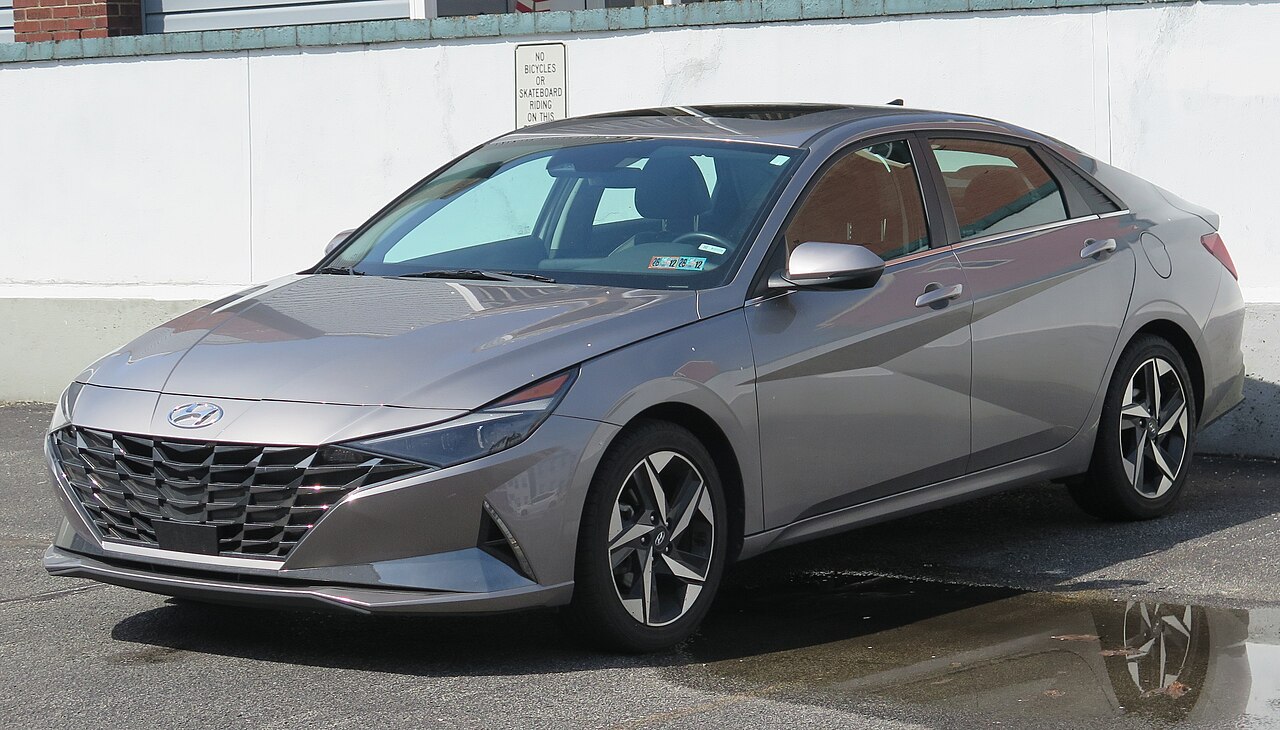 Licensed photo · Photo credit
Generations and technical specifications
Hyundai Elantra – Eighth generation2026–present
| Specification | Value |
|---|---|
| Model code | CN8 |
| Production | 2026–present |
| Model years | 2027 |
| Body styles | 4-door sedan |
| Platform | Hyundai-Kia K3 |
| Engines | Petrol 2.0 L Smartstream G2.0 MPi I4 Petrol hybrid 1.6 L Smartstream G1.6 Hybrid I4 |
| Drivetrain | Parallel hybrid (Elantra Hybrid) |
| Wheelbase | 2,750 mm |
| Length | 4,765 mm |
| Width | 1,855 mm |
| Height | 1,425 mm |
| Assembly | South Korea: Ulsan (Ulsan Plant 3) China: Beijing (Beijing Hyundai) |
Hyundai Elantra – Seventh generation2020–present
| Specification | Value |
|---|---|
| Model code | CN7 |
| Production | 2020–2026 2021–present (China) |
| Model years | 2021–2026 |
| Body styles | 4-door sedan |
| Platform | Hyundai-Kia K3 |
| Engines | Petrol 1.4 L Smartstream G1.4 T-GDi I4 1.5 L Smartstream G1.5 MPi I4 1.6 L Gamma MPi I4 1.6 L Smartstream G1.6 MPi I4 1.6 L Smartstream G1.6 T-GDi I4 2.0 L Smartstream G2.0 MPi I4 2.0 L Theta II T-GDi I4 Petrol LPG 1.6 L Gamma LPi I4 Petrol hybrid 1.6 L Smartstream G1.6 Hybrid I4 |
| Electric motor | 32 kW Interior-permanent magnet synchronous |
| Transmissions | 6-speed manual 6-speed automatic 6-speed D6KF1 DCT 7-speed D7UF1 DCT 8-speed D8LF1 DCT CVT |
| Drivetrain | Parallel hybrid (Elantra Hybrid) |
| Wheelbase | 2,720 mm |
| Width | 1,825 mm 1,810 mm (China) |
| Kerb weight | 1,160–1,340 kg 1,445–1,495 kg (N) |
| Assembly | South Korea: Ulsan (Ulsan Plant 3) United States: Montgomery, Alabama (HMMA, 2020–2023) China: Beijing (Beijing Hyundai) Vietnam: Ninh Bình (HTMV) Pakistan: Faisalabad (Hyundai Nishat) |
| Designer | Luc Donckerwolke Kangmin Yeh (interior) |
Hyundai Elantra – Sixth generation2015–present
| Specification | Value |
|---|---|
| Model code | AD |
| Production | 2015–2020 2016–2021 (China) 2021–2024, 2025-present (Pakistan) 2024-present (Egypt) |
| Model years | 2017–2020 |
| Body styles | 4-door sedan |
| Engines | Petrol 1.4 L Kappa II T-GDi I4 1.5 L Smartstream G1.5 MPi I4 (China) 1.6 L Gamma II MPi I4 1.6 L Smartstream G1.6 MPi I4 1.6 L Gamma II T-GDi I4 2.0 L Nu MPi I4 LPG 1.6 L Gamma LPi I4 Petrol hybrid 1.6 L Smartstream G1.6 Hybrid I4 (China) Diesel 1.6 L U II CRDi I4 |
| Transmissions | 6-speed manual 6-speed automatic 7-speed DCT CVT (Hyundai Intelligent Variable Transmission) |
| Wheelbase | 2,700 mm |
| Width | 1,800 mm |
| Height | 1,435 mm |
| Kerb weight | 1,185–1,340 kg (1.6L) 1,215–1,350 kg (2.0L) 1,315–1,433 kg (1.6T Diesel) 1,296 kg (1.4T) 1,350–1,430 kg (1.6T) |
| Assembly | South Korea: Ulsan Plant 3 United States: Montgomery, Alabama (HMMA) China: Beijing (Beijing Hyundai) Taiwan: Hukou, Hsinchu (SYM) India: Chennai (HMIL) Russia: Kaliningrad (Avtotor) Malaysia: Kulim, Kedah (Inokom) Iran: Bam, Kerman (Kerman Motor Co) Algeria: Tiaret (Tahkout Manufacturing Company) Pakistan: Faisalabad (Hyundai Nishat) Vietnam: Ninh Bình (HTMV) Egypt: Cairo (GB Corp) |
| Designer | Peter Schreyer |
Hyundai Elantra – Fifth generation2010–2018
| Specification | Value |
|---|---|
| Model code | MD/UD / JK (coupe) |
| Production | 2010–2015 2012–2018 (China) 2011–2016 (Malaysia) |
| Model years | 2011–2016 |
| Body styles | 4-door sedan 2-door coupé (2012–2014) |
| Platform | Hyundai-Kia J5 platform |
| Engines | Petrol 1.6 L Gamma MPi CVVT I4 1.6 L Gamma GDi I4 1.8 L Nu MPi CVVT I4 2.0 L Nu MPi CVVT I4 2.0 L Nu GDi I4 Diesel 1.6 L U II CRDi-VGT I4 |
| Transmissions | 6-speed manual 6-speed automatic |
| Wheelbase | 2,700 mm |
| Length | 4,530–4,540 mm |
| Width | 1,775 mm |
| Height | 1,435–1,445 mm |
| Kerb weight | 1,160–1,335 kg |
| Assembly | South Korea: Ulsan United States: Montgomery, Alabama (HMMA) Malaysia: Kulim, Kedah (Inokom) India: Chennai (HMIL) Taiwan: Hukou, Hsinchu (SYM) China: Beijing (Beijing Hyundai) Russia: Kaliningrad (Avtotor) Algeria: Tiaret (Tahkout Manufacturing Company) |
| Designer | Kim In-Seop (2008) |
Hyundai Elantra – Fourth generation2006–2023
| Specification | Value |
|---|---|
| Model code | HD |
| Production | 2006–2010 (South Korea) 2008–2020 (China) 2016–2023 (Egypt) |
| Model years | 2007–2010 |
| Body styles | 4-door sedan |
| Platform | Hyundai-Kia J5 platform |
| Engines | Petrol 1.6 L Alpha II I4 (China) 1.6 L Gamma MPi I4 1.8 L Beta II I4 (China) 2.0 L Beta II I4 Petrol hybrid LPG 1.6 L Gamma LPi I4 Diesel 1.6 L U CRDi-VGT I4 |
| Transmissions | 5-speed manual 4-speed automatic CVT |
| Wheelbase | 2,650 mm |
| Length | 4,505 mm 4,542 mm (Elantra Yuedong) |
| Width | 1,775 mm |
| Height | 1,480 mm 1,490 mm (Elantra Yuedong) |
| Assembly | South Korea: Ulsan China: Beijing (Beijing Hyundai) Malaysia: Kulim, Kedah (Inokom) Algeria: Tiaret Egypt: Cairo Taiwan: Hukou, Hsinchu (SYM) |
| Designer | Eric Stoddard |
Hyundai Elantra – Third generation2000–2014
| Specification | Value |
|---|---|
| Model code | XD |
| Production | 2000–2006 (South Korea) 2001–2012 (Venezuela) 2003–2014 (China) 2004–2010 (India) 2005–2012 (Iran) 2008–2009 (Russia) |
| Model years | 2001–2006 |
| Body styles | 4-door sedan 5-door Liftback |
| Engines | Petrol 1.5 L Alpha II I4 1.6 L Alpha II I4 1.6 L Beta I4 1.8 L Beta II I4 2.0 L Beta II I4 Diesel 1.5 L U CRDi turbo I4 2.0 L D CRDi turbo I4 |
| Transmissions | 5-speed manual 4-speed automatic |
| Wheelbase | 2,610 mm |
| Length | 4,510 mm (2000–2003 Sedan) 4,495 mm (2000–2003 Liftback) 4,525 mm (2004–2006 Sedan) 4,520 mm (2004–2006 Liftback) |
| Width | 1,720 mm (2000–2003 Sedan) 1,725 mm (2004–2006 Sedan) 1,720 mm (Liftback) |
| Height | 1,425 mm |
| Kerb weight | 1,195 kg |
| Assembly | South Korea: Ulsan China: Beijing (Beijing Hyundai) Iran: Kerman (RVMCO) Malaysia: Johor Bahru (OASB) Russia: Taganrog (TagAZ) Taiwan: Hukou, Hsinchu (SYM Motors) Ukraine: Cherkasy (Bogdan) Venezuela: Barcelona (MMC Automotriz) |
Hyundai Elantra – Second generation1995–2000
| Specification | Value |
|---|---|
| Model code | J2 / RD |
| Production | 1995–2000 |
| Model years | 1996–2000 |
| Body styles | 4-door sedan 5-door station wagon |
| Engines | Petrol 1.5 L G4EK/G4FK I4 1.6 L G4GR I4 1.8 L G4GM I4 2.0 L G4GF I4 Diesel 1.9 L PSA XUD9 I4 |
| Transmissions | 5-speed manual 4-speed automatic |
| Wheelbase | 2,550 mm |
| Length | 4,420 mm (1995–1998 sedan) 4,450 mm (1995–1998 wagon) 4,450 mm (1998–2000 sedan) 4,515 mm (1998–2000 wagon) |
| Width | 1,700 mm (1995–1998) 1,735 mm (1998–2000) |
| Height | 1,395 mm 1,460 mm (1998–2000 wagon) |
| Assembly | South Korea: Ulsan Botswana: Gaborone (TMBC) |
| Designer | Choi Jong-Min |
Engines and transmissions
| Model years | Engine | Transmission | Drive | Fuel |
|---|---|---|---|---|
| 2017–2026 | 1.6 L, 4 cyl | 7-speed automated manual | Front-wheel drive | Petrol (regular) |
| 2021–2026 | 1.6 L, 4 cyl hybrid | 6-speed automated manual | Front-wheel drive | Petrol (regular) |
| 2020–2026 | 2.0 L, 4 cyl | CVT (continuously variable) | Front-wheel drive | Petrol (regular) |
| 2017–2022 | 1.6 L, 4 cyl | 6-speed manual | Front-wheel drive | Petrol (regular) |
| 2017–2020 | 1.4 L, 4 cyl | 7-speed automated manual | Front-wheel drive | Petrol (regular) |
| 2014–2020 | 2.0 L, 4 cyl | 6-speed automatic | Front-wheel drive | Petrol (regular) |
| 2014–2020 | 2.0 L, 4 cyl | 6-speed manual | Front-wheel drive | Petrol (regular) |
| 2011–2016 | 1.8 L, 4 cyl | 6-speed automatic | Front-wheel drive | Petrol (regular) |
| 2011–2016 | 1.8 L, 4 cyl | 6-speed manual | Front-wheel drive | Petrol (regular) |
| 2000–2012 | 2.0 L, 4 cyl | 4-speed automatic | Front-wheel drive | Petrol (regular) |
| 2000–2012 | 2.0 L, 4 cyl | 5-speed manual | Front-wheel drive | Petrol (regular) |
Fuel economy (EPA)
| Model years | Configuration | Combined | City | Highway |
|---|---|---|---|---|
| 2017–2026 | 1.6 L, 4 cyl · 7-speed automated manual · Front-wheel drive | 7.6–8.4 L/100 km | 8.4–9.4 L/100 km | 6.5–7.4 L/100 km |
| 2021–2026 | 1.6 L, 4 cyl hybrid · 6-speed automated manual · Front-wheel drive | 4.4–4.7 L/100 km | 4.4–4.8 L/100 km | 4.1–4.5 L/100 km |
| 2020–2026 | 2.0 L, 4 cyl · CVT (continuously variable) · Front-wheel drive | 6.4–6.9 L/100 km | 7.1–7.8 L/100 km | 5.5–6.0 L/100 km |
| 2017–2022 | 1.6 L, 4 cyl · 6-speed manual · Front-wheel drive | 8.4–9.4 L/100 km | 9.4–10.7 L/100 km | 6.9–8.1 L/100 km |
| 2017–2020 | 1.4 L, 4 cyl · 7-speed automated manual · Front-wheel drive | 6.5–6.7 L/100 km | 7.1–7.4 L/100 km | 5.7–5.9 L/100 km |
| 2014–2020 | 2.0 L, 4 cyl · 6-speed automatic · Front-wheel drive | 7.1–8.7 L/100 km | 8.1–9.8 L/100 km | 6.2–7.4 L/100 km |
| 2014–2020 | 2.0 L, 4 cyl · 6-speed manual · Front-wheel drive | 7.8–9.0 L/100 km | 9.0–10.2 L/100 km | 6.4–7.6 L/100 km |
| 2011–2016 | 1.8 L, 4 cyl · 6-speed automatic · Front-wheel drive | 7.4–7.8 L/100 km | 8.4–8.7 L/100 km | 6.2–6.5 L/100 km |
| 2011–2016 | 1.8 L, 4 cyl · 6-speed manual · Front-wheel drive | 7.4–7.8 L/100 km | 8.4–9.0 L/100 km | 6.2–6.5 L/100 km |
| 2000–2012 | 2.0 L, 4 cyl · 4-speed automatic · Front-wheel drive | 8.1–10.7 L/100 km | 9.0–12.4 L/100 km | 6.9–8.7 L/100 km |
| 2000–2012 | 2.0 L, 4 cyl · 5-speed manual · Front-wheel drive | 8.1–9.8 L/100 km | 9.0–11.2 L/100 km | 6.7–8.1 L/100 km |
Values are the official EPA label figures for each model year, shown as the lowest and highest value for the configuration. Electric models show energy use per 100 km. Real-world consumption depends on driving style, weather and load. Luggage and passenger volumes follow the EPA measuring method and can differ from the VDA figures used in Europe.
EU type-approval data
| Years | Powertrain | Engine | Power | Mass | CO₂ |
|---|---|---|---|---|---|
| 2021–2024 | Petrol | 1598 cm³ | 90 kW (122 PS) | 1265–1290 kg | 134–144 g/km (WLTP) |
| 2023 | Petrol | 1598 cm³ | 67 kW (91 PS) | 1265–1285 kg | 134–142 g/km (WLTP) |
| 2016–2020 | Petrol | 1591 cm³ | 93 kW (126 PS) | 1295–1325 kg | 153–163 g/km (WLTP) |
| 2016–2018, 2020 | Petrol | 1591 cm³ | 94 kW (128 PS) | 1268–1411 kg | 153–159 g/km (WLTP) |
| 2016–2019 | Diesel | 1582 cm³ | 100 kW (136 PS) | 1390–1434 kg | 109–118 g/km (NEDC) |
| 2017 | Petrol | 1591 cm³ | 141 kW (192 PS) | 1295–1373 kg | 153–161 g/km (NEDC) |
| 2011–2016 | Petrol | 1591 cm³ | 97 kW (132 PS) | 1236–1301 kg | 148–149 g/km (NEDC) |
| 2016 | LPG (bi-fuel) | 1591 cm³ | 94 kW (128 PS) | 1343 kg | 153 g/km (NEDC) |
Years are registration years. Each range runs from the 10th to the 90th percentile of the values reported for new registrations; it is not an average. Mass is the mass in running order. For electric cars the power is the type-approval net power, which can be lower than the peak power in brochures.
Key specifications
| Specification | Value |
|---|---|
| EPA size class | Midsize car, Large car, Small estate, Compact car |
| Model years in EPA data | 2000–2026 |
| Powertrains | Petrol, Hybrid |
| Engine displacement | 1.4–2.0 L |
| Cylinders | 4 |
| Transmission types | CVT, Automated manual, Manual, Automatic |
| Drive | Front-wheel drive |
| Fuel | Petrol (regular) |
| Configurations listed | 139 |
| Forced induction | Turbocharged (on some versions) |
| Start-stop system | On some versions |
| Luggage volume (EPA) | 340–906 L |
| Passenger volume (EPA) | 2,633–2,860 L |
| Powertrains (EU) | Petrol, Diesel, LPG (bi-fuel) |
| Engine displacement (EU) | 1,582–1,598 cm³ |
| Power (EU) | 90–141 kW (122–192 PS) |
| Mass in running order (EU) | 1,236–1,434 kg |
| Wheelbase (EU) | 2,331–2,720 mm |
Years and markets
| Specification | Value |
|---|---|
| Model years (US) | 2000–2027 |
| New registrations (EU) | 2000–2007, 2010–2025 |
Owner complaints (NHTSA)
| Component | Complaints | Most reported model years |
|---|---|---|
| Engine and cooling | 1843 | 2013, 2014, 2017 |
| Airbags | 1230 | 2001, 2012, 2013 |
| Steering | 1185 | 2009, 2010, 2013 |
| Brakes | 1014 | 2012, 2013, 2014 |
| Electrical system | 999 | 2012, 2013, 2017 |
| Suspension | 591 | 2001, 2002, 2013 |
| Transmission and drivetrain | 541 | 2013, 2017, 2020 |
| Body and structure | 464 | 2003, 2013, 2017 |
| Lights | 420 | 2006, 2013, 2019 |
| Speed control and cruise | 395 | 2012, 2013, 2014 |
Source: complaints filed by owners with the U.S. National Highway Traffic Safety Administration (NHTSA) for model years 2000–2025: 8295 complaints, 790 with a crash and 182 with a fire. Complaints are owner reports that NHTSA has not verified, and one complaint can name more than one component. More complaints can also mean more cars sold.