McLaren
Senna
McLaren Senna: official NHTSA recalls, fault code help and maintenance guides.
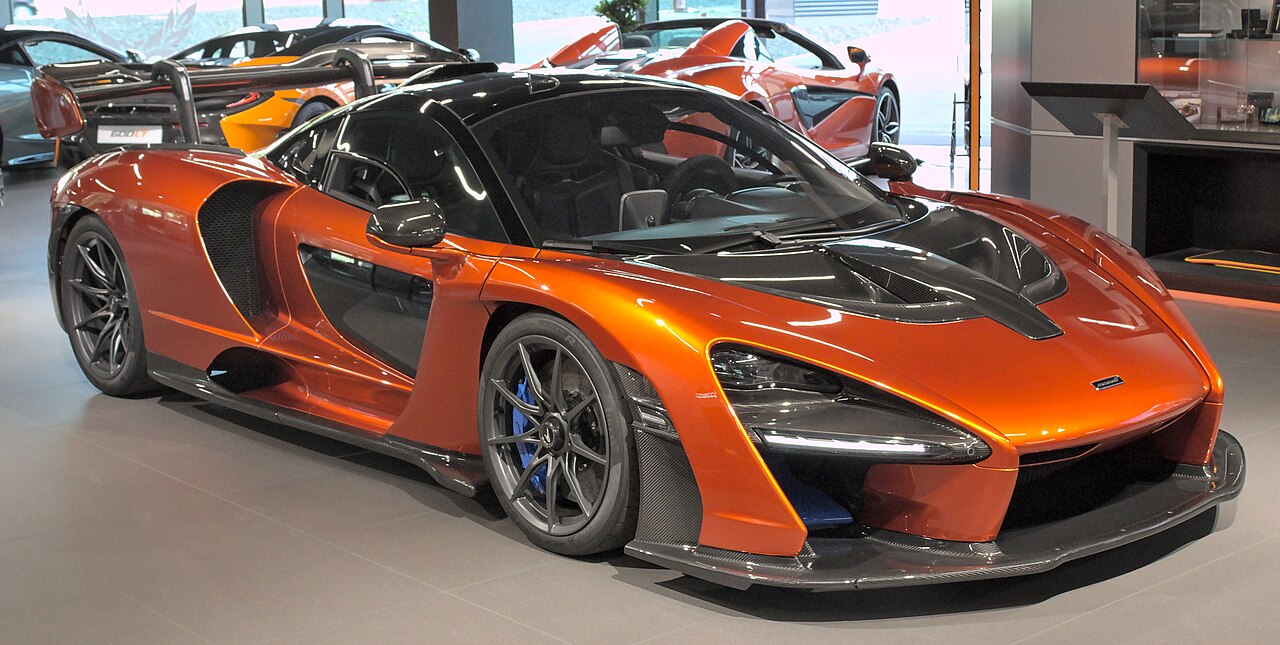 Licensed photo · Photo credit
MakeMcLaren
ClassTwo-seater
Model years (US)2017–2021
New registrations (EU)2018–2023
Recall dataNHTSA (United States)
Generations and technical specifications
McLaren Senna2018–2020
| Specification | Value |
|---|---|
| Production | 2018-2019 500 Senna made 75 Senna GTR made 35 Senna LM made 5 Senna GTR LM made |
| Model years | 2019-2020 |
| Body styles | 2-door coupé |
| Layout | Rear mid-engine, rear-wheel-drive |
| Platform | MonoCage III carbon fiber monocoque |
| Engines | 4.0 L Ricardo-built and assembled McLaren M840TR twin-turbocharged V8 |
| Transmissions | In-house 7-speed dual-clutch |
| Wheelbase | 2,670 mm |
| Length | 4,744 mm |
| Width | 2,153 mm |
| Height | 1,195 mm |
| Kerb weight | 1,374 kg |
| Class | Sports Car (S) |
| Assembly | United Kingdom: Woking, Surrey, England |
| Designer | Rob Melville |
Engines and transmissions
| Model years | Engine | Transmission | Drive | Fuel |
|---|---|---|---|---|
| 2019 | 4.0 L, 8 cyl | 7-speed automatic | Rear-wheel drive | Petrol (premium) |
Fuel economy (EPA)
| Model years | Configuration | Combined | City | Highway |
|---|---|---|---|---|
| 2019 | 4.0 L, 8 cyl · 7-speed automatic · Rear-wheel drive | 14.7 L/100 km | 16.8 L/100 km | 13.1 L/100 km |
Values are the official EPA label figures for each model year, shown as the lowest and highest value for the configuration. Electric models show energy use per 100 km. Real-world consumption depends on driving style, weather and load. Luggage and passenger volumes follow the EPA measuring method and can differ from the VDA figures used in Europe.
EU type-approval data
| Years | Powertrain | Engine | Power | Mass | CO₂ |
|---|---|---|---|---|---|
| 2018–2021 | Petrol | 3994 cm³ | 588 kW (799 PS) | 1384 kg | 280 g/km (WLTP) |
Years are registration years. Each range runs from the 10th to the 90th percentile of the values reported for new registrations; it is not an average. Mass is the mass in running order. For electric cars the power is the type-approval net power, which can be lower than the peak power in brochures.
Key specifications
| Specification | Value |
|---|---|
| EPA size class | Two-seater |
| Model years in EPA data | 2019 |
| Powertrains | Petrol |
| Engine displacement | 4.0 L |
| Cylinders | 8 |
| Transmission types | Automatic |
| Drive | Rear-wheel drive |
| Fuel | Petrol (premium) |
| Configurations listed | 1 |
| Forced induction | Turbocharged |
| Powertrains (EU) | Petrol |
| Engine displacement (EU) | 3,994 cm³ |
| Power (EU) | 588 kW (799 PS) |
| Mass in running order (EU) | 1,384 kg |
| Wheelbase (EU) | 2,670 mm |
Years and markets
| Specification | Value |
|---|---|
| Model years (US) | 2017–2021 |
| New registrations (EU) | 2018–2023 |