Mitsubishi
ASX
Mitsubishi ASX: years registered new in Europe, fault code help, warning lights and maintenance guides.
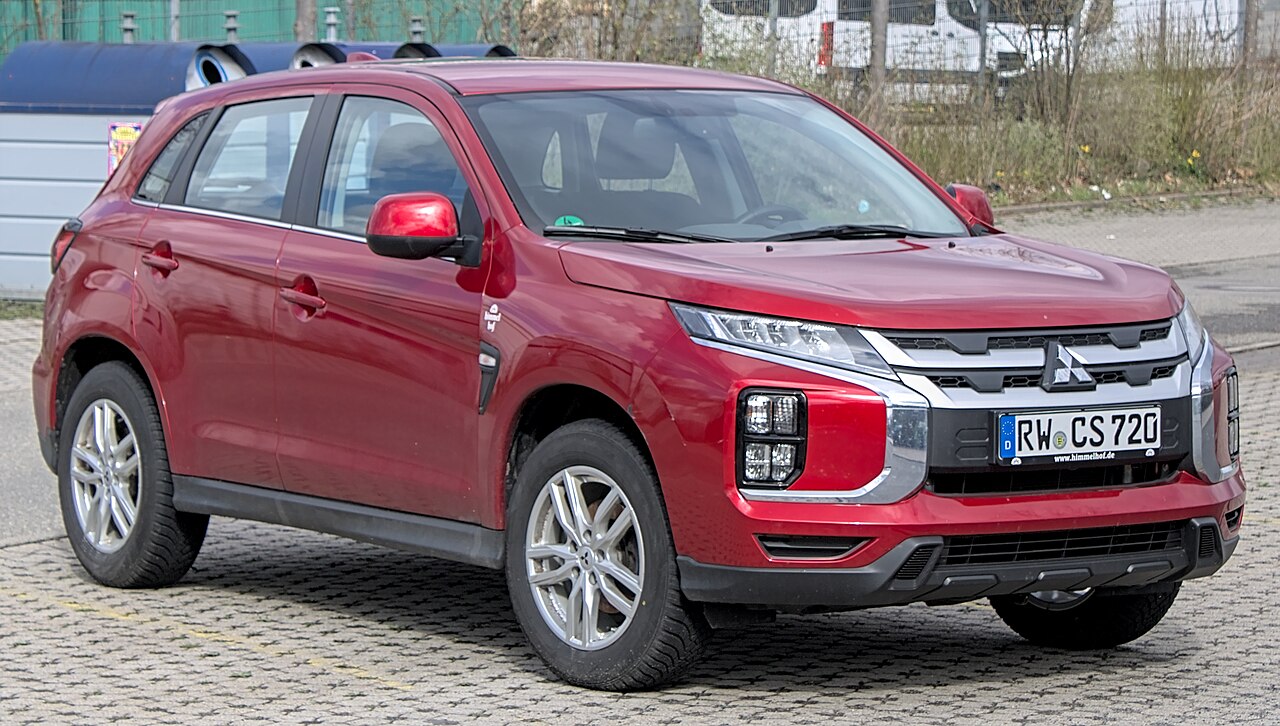 Licensed photo · Photo credit
MakeMitsubishi
New registrations (EU)2010–2026
Generations and technical specifications
Mitsubishi ASX – First generation2010–present
| Specification | Value |
|---|---|
| Model code | GA / XA / XB / XC / XD |
| Production | 2010–present |
| Model years | 2011–present |
| Layout | Front-engine, front-wheel-drive Front-engine, all-wheel-drive |
| Platform | Mitsubishi GS platform |
| Engines | Petrol 1.6 L 4A92 I4 1.8 L 4B10 I4 1.8 L 4J10 I4 2.0 L 4B11 I4 2.0 L 4J11 I4 2.4 L 4B12 I4 Diesel 1.6 L PSA DV6C turbo I4 1.8 L 4N13 turbo I4 2.2 L 4N14 turbo I4 |
| Transmissions | 5/6-speed manual 6-speed automatic 6-speed INVECS-III CVT |
| Wheelbase | 2,670 mm |
| Length | 4,295–4,366 mm |
| Width | 1,770–1,810 mm |
| Height | 1,625–1,641 mm |
| Assembly | Japan: Okazaki, Aichi (Okazaki Plant, until 2017); Kurashiki, Okayama (Mizushima Plant, since 2017) Brazil: Catalão (HPE Automotores, until 2022) China: Changsha, Hunan (GMMC, until 2023) Indonesia: East Jakarta (KRM, until 2018) Malaysia: Kuala Lumpur (TCMA, until 2021) United States: Normal, Illinois (MMNA, until 2015) |
| Designer | Norihiko Yoshihime |
EU type-approval data
| Years | Powertrain | Engine | Power | Mass | CO₂ |
|---|---|---|---|---|---|
| 2023–2025 | Petrol | 999 cm³ | 67 kW (91 PS) | 1289–1294 kg | 130–134 g/km (WLTP) |
| 2023–2025 | Petrol hybrid | 1332 cm³ | 103 kW (140 PS) | 1333–1341 kg | 130–134 g/km (WLTP) |
| 2023–2025 | Petrol hybrid | 1332 cm³ | 116 kW (158 PS) | 1373–1382 kg | 132–135 g/km (WLTP) |
| 2023–2025 | Petrol hybrid | 1598 cm³ | 69 kW (94 PS) | 1440–1451 kg | 105–108 g/km (WLTP) |
| 2019–2021 | Petrol | 1998 cm³ | 110 kW (150 PS) | 1430–1545 kg | 161–185 g/km (WLTP) |
| 2011–2020 | Petrol | 1590 cm³ | 86 kW (117 PS) | 1335–1360 kg | 151–165 g/km (WLTP) |
| 2011–2020 | LPG (bi-fuel) | 1590 cm³ | 86 kW (117 PS) | 1335–1363 kg | 142–155 g/km (WLTP) |
| 2011–2019 | Petrol | 1590 cm³ | 85 kW (116 PS) | 1335–1377 kg | 151–165 g/km (WLTP) |
| 2015–2019 | Diesel | 1560 cm³ | 84 kW (114 PS) | 1395–1495 kg | 119–132 g/km (NEDC) |
| 2013–2019 | Diesel | 2268 cm³ | 110 kW (150 PS) | 1595 kg | 153–193 g/km (WLTP) |
| 2017 | Petrol | 1590 cm³ | 129 kW (175 PS) | 1335 kg | 135–136 g/km (NEDC) |
| 2011–2015 | Diesel | 1798 cm³ | 85 kW (116 PS) | 1490–1585 kg | 119–134 g/km (NEDC) |
| 2011–2015 | Diesel | 1798 cm³ | 110 kW (150 PS) | 1495–1600 kg | 141–150 g/km (NEDC) |
Years are registration years. Each range runs from the 10th to the 90th percentile of the values reported for new registrations; it is not an average. Mass is the mass in running order. For electric cars the power is the type-approval net power, which can be lower than the peak power in brochures.
Key specifications
| Specification | Value |
|---|---|
| Powertrains (EU) | Petrol, Diesel, LPG (bi-fuel) |
| Engine displacement (EU) | 1,560–2,268 cm³ |
| Power (EU) | 84–110 kW (114–150 PS) |
| Mass in running order (EU) | 1,335–1,600 kg |
| Wheelbase (EU) | 2,670 mm |
Years and markets
| Specification | Value |
|---|---|
| New registrations (EU) | 2010–2026 |