Hyundai
i10
Hyundai i10: years registered new in Europe, fault code help, warning lights and maintenance guides.
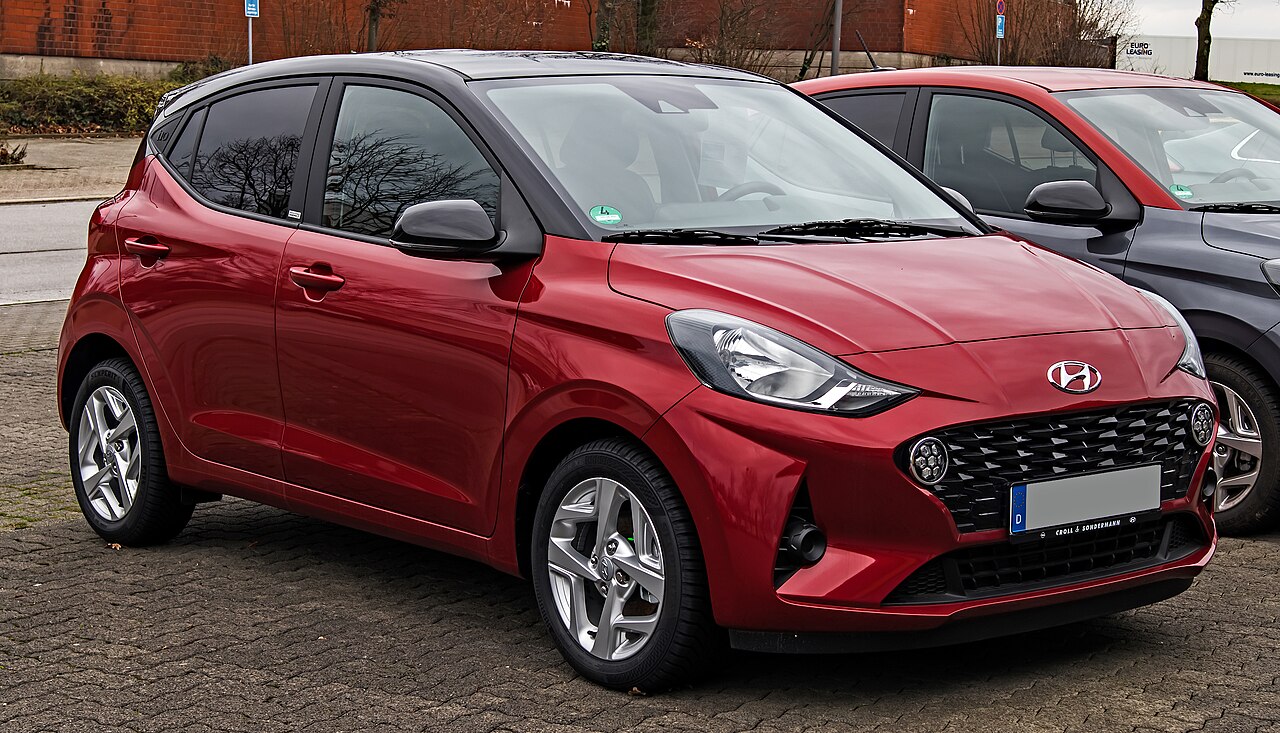 Licensed photo · Photo credit
MakeHyundai
New registrations (EU)2008–2026
Generations and technical specifications
Hyundai i10 – Third generation2019–present
| Specification | Value |
|---|---|
| Model code | AC3 / AI3 (Grand i10) |
| Production | 2019–present (AI3) 2020–2026 (AC3) |
| Body styles | 5-door hatchback 4-door sedan |
| Platform | Hyundai-Kia BA/K1 |
| Engines | Petrol 1.0 L Kappa II MPI I3 1.0 L Kappa II T-GDI I3 1.0 L Smartstream G1.0 MPI I3 1.0 L Smartstream G1.0 T-GDI I3 1.2 L Kappa II MPI I4 Diesel 1.2 L U II CRDI I3 |
| Transmissions | 5-speed manual 5-speed AMT 4-speed automatic (AI3, except India) |
| Wheelbase | AC3: 2,425 mm AI3: 2,450 mm |
| Length | AC3 AI3: 3,815 mm |
| Width | 1,680 mm |
| Height | AC3 AI3: 1,520 mm |
| Kerb weight | 921–1,045 kg |
| Assembly | Turkey: Izmit (HAOS, AC3) India: Chennai (HMIL, AI3) Vietnam: Ninh Bình (HTMV, AI3) Sri Lanka: Colombo (Abans, AI3) |
| Designer | Sungno Kim & Hyeryun Sohn (Exterior) Youngwook Kang (Interior) |
Hyundai i10 – Second generation2013–2022
| Specification | Value |
|---|---|
| Model code | IA / BA (Grand i10) |
| Production | 2013–2022 |
| Body styles | 5-door hatchback 4-door sedan |
| Platform | Hyundai-Kia BA |
| Engines | Petrol 1.0 L Kappa II MPi I3 1.2 L Kappa II MPi I4 Petrol/LPG 1.0 L Kappa II LPi I3 Diesel 1.1 L U II CRDi I3 |
| Transmissions | 5-speed manual 4-speed automatic |
| Wheelbase | 2,385 mm 2,425 mm (BA) |
| Length | 3,645 mm 3,765 mm (BA) |
| Width | 1,660 mm |
| Height | 1,500 mm BA: 1,520 mm Grand i10X: 1,655 mm |
| Kerb weight | 933–961 kg |
| Assembly | Turkey: Izmit (Hyundai Assan Otomotiv) India: Chennai (HMIL) Ecuador: Quito (Aymesa) Vietnam: Ninh Bình (HTMV) Algeria: Tiaret (Tahkout Manufacturing Company) Iran: Bam, Kerman (Kerman Motor Co) Mozambique: Matola (Somyoung Motors) |
| Designer | Thomas Bürkle |
EU type-approval data
| Years | Powertrain | Engine | Power | Mass | CO₂ |
|---|---|---|---|---|---|
| 2024–2025 | Petrol | 998 cm³ | 46 kW (63 PS) | 996–999 kg | 109–121 g/km (WLTP) |
| 2024–2025 | Petrol | 1197 cm³ | 58 kW (79 PS) | 1007–1010 kg | 119–129 g/km (WLTP) |
| 2014–2024 | Petrol | 998 cm³ | 49 kW (67 PS) | 996–1022 kg | 110–129 g/km (WLTP) |
| 2020–2024 | Petrol | 998 cm³ | 74 kW (101 PS) | 1099 kg | 123 g/km (WLTP) |
| 2020–2024 | Petrol | 1197 cm³ | 61 kW (83 PS) | 1005–1010 kg | 117–130 g/km (WLTP) |
| 2020–2024 | Petrol | 1197 cm³ | 62 kW (84 PS) | 1007–1010 kg | 119–130 g/km (WLTP) |
| 2019–2021 | LPG (bi-fuel) | 998 cm³ | 48 kW (65 PS) | 1051–1058 kg | 110–133 g/km (WLTP) |
| 2013–2020 | Petrol | 1248 cm³ | 64 kW (87 PS) | 1016–1036 kg | 138–156 g/km (WLTP) |
| 2014–2018 | Petrol | 998 cm³ | 48 kW (65 PS) | 1008–1027 kg | 108 g/km (NEDC) |
| 2014–2018 | LPG (bi-fuel) | 998 cm³ | 51 kW (69 PS) | 1064 kg | 104–116 g/km (NEDC) |
| 2011–2014 | Petrol | 998 cm³ | 51 kW (69 PS) | 963 kg | 99 g/km (NEDC) |
| 2012–2014 | LPG (bi-fuel) | 1086 cm³ | 51 kW (69 PS) | 1017–1100 kg | 109–110 g/km (NEDC) |
| 2011–2013 | Petrol | 1086 cm³ | 51 kW (69 PS) | 980–1066 kg | 110 g/km (NEDC) |
| 2011–2013 | Petrol | 1248 cm³ | 63 kW (86 PS) | 985–1071 kg | 108–129 g/km (NEDC) |
Years are registration years. Each range runs from the 10th to the 90th percentile of the values reported for new registrations; it is not an average. Mass is the mass in running order. For electric cars the power is the type-approval net power, which can be lower than the peak power in brochures.
Key specifications
| Specification | Value |
|---|---|
| Powertrains (EU) | Petrol, LPG (bi-fuel) |
| Engine displacement (EU) | 998–1,248 cm³ |
| Power (EU) | 46–64 kW (63–87 PS) |
| Mass in running order (EU) | 980–1,071 kg |
| Wheelbase (EU) | 2,380–2,425 mm |
Years and markets
| Specification | Value |
|---|---|
| New registrations (EU) | 2008–2026 |