Hyundai
i30
Hyundai i30: years registered new in Europe, fault code help, warning lights and maintenance guides.
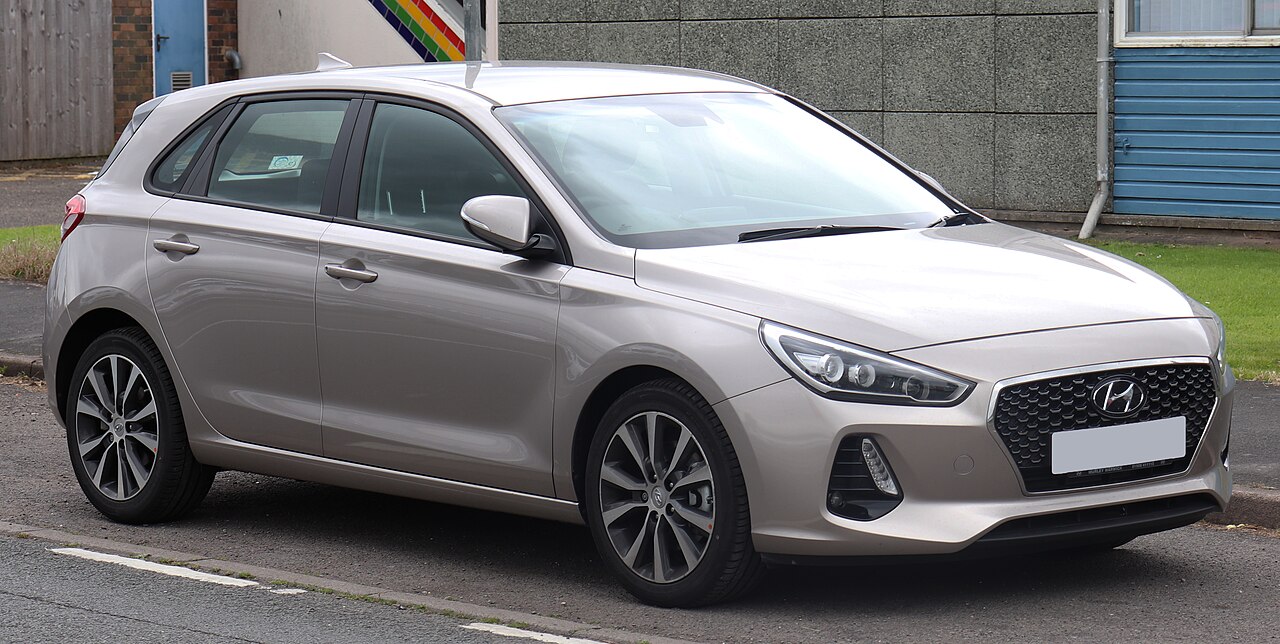 Licensed photo · Photo credit
MakeHyundai
New registrations (EU)2007–2026
Generations and technical specifications
Hyundai i30 – Third generation2016–present
| Specification | Value |
|---|---|
| Model code | PD |
| Production | December 2016–present |
| Model years | 2018–2020 (North America) |
| Body styles | 5-door hatchback 5-door estate (i30 Wagon) 5-door liftback (i30 Fastback) |
| Platform | Hyundai-Kia K2 platform |
| Engines | Petrol 1.0 L Kappa II T-GDi I3 1.0 L Smartstream G1.0 T-GDI I3 1.4 L Kappa II MPi I4 1.4 L Kappa II T-GDi I4 1.5 L Smartstream G1.5 DPi I4 1.6 L Gamma MPi I4 1.6 L Gamma T-GDi I4 2.0 L Nu GDi I4 2.0 L Theta II T-GDi I4 Petrol Mild hybrid 1.0 L Smartstream G1.0 T-GDI I3 1.5 L Smartstream G1.5 T-GDI I4 Diesel 1.6 L U II CRDi I4 1.6 L Smartstream D1.6 CRDi I4 |
| Electric motor | 48v Starter Generator (MHSG) |
| Transmissions | 6-Speed manual 6-Speed automatic 7/8-Speed DCT |
| Drivetrain | Mild hybrid (i30 MHEV) |
| Wheelbase | 2,650 mm |
| Length | 4,340 mm (hatchback) 4,585 mm (wagon) 4,455 mm (liftback) |
| Width | 1,795 mm |
| Height | 1,450–1,455 mm (hatchback) 1,475 mm (wagon) 1,425 mm (liftback) |
| Kerb weight | 1,197–1,520 kg |
| Assembly | South Korea: Ulsan (2016–2023) Czech Republic: Nošovice Algeria: Tiaret |
| Designer | Peter Schreyer |
Hyundai i30 – Second generation2011–2018
| Specification | Value |
|---|---|
| Model code | GD |
| Production | 2011–2017 2012–2018 (South Africa) |
| Model years | 2013–2017 (North America) 2013–2018 (South Africa) |
| Body styles | 3-door hatchback (i30 Coupe) 5-door hatchback 5-door estate (i30 Wagon) |
| Platform | Hyundai-Kia J5 platform |
| Engines | Petrol 1.4 L Gamma MPi D-CVVT DOHC 16v I4 1.6 L Gamma MPi D-CVVT DOHC 16v I4 1.6 L Gamma MPi FLEX DOHC D-CVVT 16v I4 1.6 L Gamma GDi DOHC D-CVVT 16v I4 1.6 L Gamma T-GDi DOHC D-CVVT 16v I4 1.8 L Nu MPi D-CVVT DOHC 16v I4 2.0 L Nu GDi D-CVVT DOHC 16v I4 Diesel 1.4 L U CRDi-VGT DOHC 16v I4 1.6 L U CRDi-VGT DOHC 16v I4 |
| Transmissions | 6-speed manual 6-speed Shiftronic automatic 7-speed DCT automatic |
| Wheelbase | 2,650 mm |
| Length | 4,300 mm (hatchback) 4,485 mm (wagon) |
| Width | 1,780 mm |
| Height | 1,470 mm |
| Kerb weight | 1,210–1,495 kg |
| Assembly | South Korea: Ulsan Czech Republic: Nošovice |
| Designer | Thomas Bürkle |
Hyundai i30 – First generation2007–2012
| Specification | Value |
|---|---|
| Model code | FD |
| Production | 2007–2012 |
| Model years | 2009–2012 (North America) |
| Body styles | 5-door hatchback 5-door estate (i30cw) |
| Platform | Hyundai-Kia J4 platform |
| Engines | Petrol 1.4 L Gamma CVVT DOHC 16v I4 1.6 L Gamma CVVT DOHC 16v I4 2.0 L Beta II CVVT DOHC 16v I4 Diesel 1.6 L U CRDi-VGT DOHC 16v I4 (turbo) 2.0 L D CRDi-VGT SOHC 16v I4 |
| Transmissions | 5-speed manual 6-speed manual 4-speed automatic |
| Wheelbase | 2,650 mm (hatchback) 2,700 mm (wagon) |
| Length | 4,245 mm (hatchback) 4,475 mm (wagon) |
| Width | 1,775 mm |
| Height | 1,480 mm (hatchback) 1,565 mm (wagon) |
| Assembly | South Korea: Ulsan Czech Republic: Nošovice China: Beijing (Beijing Hyundai) Egypt: Cairo (Ghabbour Group) |
| Designer | Thomas Bürkle |
EU type-approval data
| Years | Powertrain | Engine | Power | Mass | CO₂ |
|---|---|---|---|---|---|
| 2024–2025 | Petrol | 998 cm³ | 74 kW (101 PS) | 1291–1346 kg | 124–136 g/km (WLTP) |
| 2024–2025 | Petrol hybrid | 1482 cm³ | 103 kW (140 PS) | 1382–1461 kg | 126–150 g/km (WLTP) |
| 2017–2024 | Petrol | 998 cm³ | 88 kW (120 PS) | 1269–1357 kg | 121–140 g/km (WLTP) |
| 2020–2024 | Petrol | 1498 cm³ | 80 kW (109 PS) | 1251–1340 kg | 134–140 g/km (WLTP) |
| 2020–2024 | Petrol | 1498 cm³ | 81 kW (110 PS) | 1251–1316 kg | 134–141 g/km (WLTP) |
| 2020–2024 | Petrol hybrid | 998 cm³ | 88 kW (120 PS) | 1321–1384 kg | 118–128 g/km (WLTP) |
| 2020–2024 | Petrol hybrid | 1482 cm³ | 117 kW (159 PS) | 1355–1461 kg | 124–143 g/km (WLTP) |
| 2021–2024 | Petrol hybrid | 1482 cm³ | 118 kW (160 PS) | 1355–1457 kg | 124–144 g/km (WLTP) |
| 2018–2022 | Diesel | 1598 cm³ | 85 kW (116 PS) | 1388–1462 kg | 115–128 g/km (WLTP) |
| 2020–2021 | Petrol | 1482 cm³ | 117 kW (159 PS) | 1376–1457 kg | 125–142 g/km (WLTP) |
| 2018–2021 | Diesel | 1598 cm³ | 100 kW (136 PS) | 1410–1507 kg | 121–134 g/km (WLTP) |
| 2017–2020 | Petrol | 1353 cm³ | 103 kW (140 PS) | 1310–1414 kg | 139–151 g/km (WLTP) |
| 2015–2020 | Petrol | 1368 cm³ | 73 kW (99 PS) | 1244–1314 kg | 146–157 g/km (WLTP) |
| 2015–2019 | Diesel | 1582 cm³ | 100 kW (136 PS) | 1364–1509 kg | 125–127 g/km (WLTP) |
| 2012–2018 | Diesel | 1582 cm³ | 81 kW (110 PS) | 1364–1504 kg | 96–117 g/km (NEDC) |
| 2015–2017 | Petrol | 1368 cm³ | 74 kW (101 PS) | 1254–1331 kg | 129–138 g/km (NEDC) |
| 2012–2017 | Petrol | 1591 cm³ | 88 kW (120 PS) | 1262–1373 kg | 146–154 g/km (NEDC) |
| 2012–2017 | Petrol | 1591 cm³ | 99 kW (135 PS) | 1268–1382 kg | 118–145 g/km (NEDC) |
| 2012–2017 | Diesel | 1396 cm³ | 66 kW (90 PS) | 1355–1526 kg | 109–114 g/km (NEDC) |
| 2011–2017 | Diesel | 1582 cm³ | 94 kW (128 PS) | 1365–1517 kg | 108–149 g/km (NEDC) |
| 2012–2015 | Petrol | 1396 cm³ | 73 kW (99 PS) | 1260–1381 kg | 139–145 g/km (NEDC) |
| 2011–2013 | Petrol | 1591 cm³ | 93 kW (126 PS) | 1268–1321 kg | 142–162 g/km (NEDC) |
| 2011–2013 | Diesel | 1582 cm³ | 85 kW (116 PS) | 1366–1478 kg | 115–150 g/km (NEDC) |
| 2011–2012 | Petrol | 1396 cm³ | 80 kW (109 PS) | 1268–1368 kg | 138–147 g/km (NEDC) |
| 2011–2012 | Diesel | 1582 cm³ | 66 kW (90 PS) | 1366–1517 kg | 103–124 g/km (NEDC) |
Years are registration years. Each range runs from the 10th to the 90th percentile of the values reported for new registrations; it is not an average. Mass is the mass in running order. For electric cars the power is the type-approval net power, which can be lower than the peak power in brochures.
Key specifications
| Specification | Value |
|---|---|
| Powertrains (EU) | Petrol, Diesel |
| Engine displacement (EU) | 998–1,598 cm³ |
| Power (EU) | 66–103 kW (90–140 PS) |
| Mass in running order (EU) | 1,244–1,526 kg |
| Wheelbase (EU) | 2,650–2,700 mm |
Years and markets
| Specification | Value |
|---|---|
| New registrations (EU) | 2007–2026 |