Armada
Nissan Armada: official NHTSA recalls, fault code help and maintenance guides.
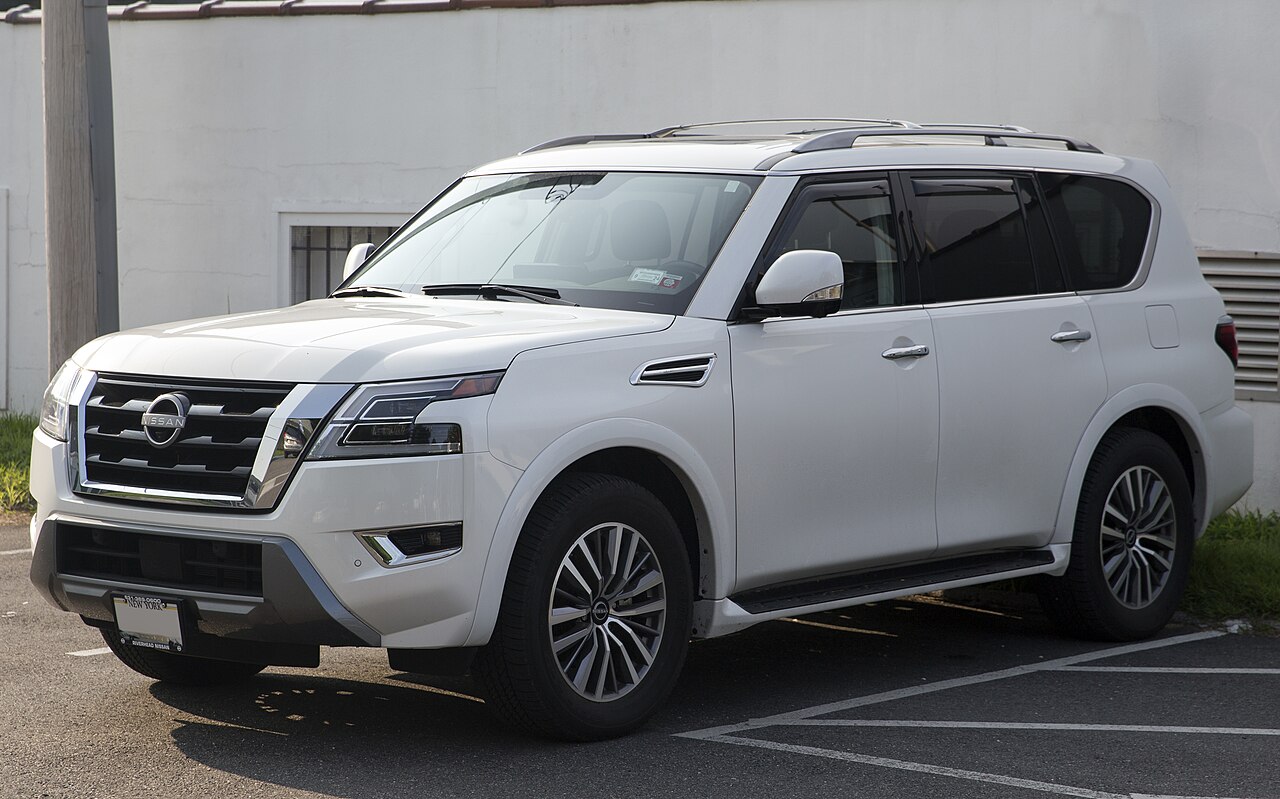 Licensed photo · Photo credit
Generations and technical specifications
Nissan Armada – Third generation2024–present
| Specification | Value |
|---|---|
| Model code | Y63 |
| Production | November 2024 – present |
| Model years | 2025–present |
| Engines | Gasoline 3.5 L VR35DDTT twin-turbo V6 |
| Transmissions | 9-speed automatic |
| Wheelbase | 3,076 mm |
| Length | 5,324 mm |
| Width | 2,116 mm |
| Height | 1,946–1,981 mm |
| Kerb weight | 2,575–2,772 kg |
| Assembly | Japan: Kanda (Nissan Shatai Kyushu Plant) |
| Designer | Ken Lee |
Nissan Armada – Second generation2016–2024
| Specification | Value |
|---|---|
| Model code | Y62 |
| Production | June 2016 – November 2024 |
| Model years | 2017–2024 |
| Platform | Y62 |
| Engines | Gasoline 5.6 L VK56VD V8 |
| Transmissions | 7-speed RE7R01B automatic |
| Wheelbase | 3,075 mm |
| Length | 5,305 mm |
| Width | 2,030 mm |
| Height | 1,925 mm |
| Assembly | Japan: Kanda, Fukuoka (Nissan Shatai Plant) |
| Designer | Taisuke Nakamura, Shinya Momokawa, Minoru Yoshida, Sugita Akihiro |
Nissan Armada – First generation2003–2015
| Specification | Value |
|---|---|
| Model code | TA60 |
| Production | August 2003 – 2015 |
| Model years | 2004–2015 |
| Platform | Nissan F-Alpha platform |
| Engines | Gasoline 5.6 L VK56DE V8 |
| Transmissions | 5-speed RE5R05A automatic |
| Wheelbase | 3,129 mm |
| Length | 2003–2007: 5,255 mm 2007–2015: 5,276 mm |
| Width | 2003–2007: 2,002 mm 2007–2015: 2,014 mm |
| Height | 2003–2007: 1,999 mm 2007–2015 2WD: 1,961 mm 2007–2015 4WD: 1,981 mm |
| Assembly | United States: Canton, Mississippi (Nissan USA) |
| Designer | Toshio Yamashita, Diane Allen, Giovanny Arroba (2001) |
Engines and transmissions
| Model years | Engine | Transmission | Drive | Fuel |
|---|---|---|---|---|
| 2025–2026 | 3.5 L, 6 cyl | 9-speed automatic | Four-wheel drive | Petrol (premium) |
| 2025–2026 | 3.5 L, 6 cyl | 9-speed automatic | Rear-wheel drive | Petrol (premium) |
| 2021–2024 | 5.6 L, 8 cyl | 7-speed automatic | Four-wheel drive | Petrol (premium) |
| 2021–2024 | 5.6 L, 8 cyl | 7-speed automatic | Rear-wheel drive | Petrol (premium) |
| 2017–2020 | 5.6 L, 8 cyl | 7-speed automatic | Four-wheel drive | Petrol (regular) |
| 2017–2020 | 5.6 L, 8 cyl | 7-speed automatic | Rear-wheel drive | Petrol (regular) |
| 2010–2015 | 5.6 L, 8 cyl | 5-speed automatic | Four-wheel drive | Petrol (regular) |
| 2010–2015 | 5.6 L, 8 cyl | 5-speed automatic | Four-wheel drive | Petrol or E85 (flex-fuel) |
| 2005–2015 | 5.6 L, 8 cyl | 5-speed automatic | Rear-wheel drive | Petrol (regular) |
| 2007–2015 | 5.6 L, 8 cyl | 5-speed automatic | Rear-wheel drive | Petrol or E85 (flex-fuel) |
| 2005–2009 | 5.6 L, 8 cyl | 5-speed automatic | Four-wheel or all-wheel drive | Petrol (regular) |
| 2007–2009 | 5.6 L, 8 cyl | 5-speed automatic | Four-wheel or all-wheel drive | Petrol or E85 (flex-fuel) |
Fuel economy (EPA)
| Model years | Configuration | Combined | City | Highway |
|---|---|---|---|---|
| 2025–2026 | 3.5 L, 6 cyl · 9-speed automatic · Four-wheel drive | 13.8–14.7 L/100 km | 14.7–15.7 L/100 km | 12.4–13.1 L/100 km |
| 2025–2026 | 3.5 L, 6 cyl · 9-speed automatic · Rear-wheel drive | 13.1 L/100 km | 14.7 L/100 km | 11.8 L/100 km |
| 2017–2024 | 5.6 L, 8 cyl · 7-speed automatic · Four-wheel drive | 15.7 L/100 km | 18.1 L/100 km | 13.1 L/100 km |
| 2017–2024 | 5.6 L, 8 cyl · 7-speed automatic · Rear-wheel drive | 14.7 L/100 km | 16.8 L/100 km | 12.4 L/100 km |
| 2010–2015 | 5.6 L, 8 cyl · 5-speed automatic · Four-wheel drive | 16.8 L/100 km | 19.6 L/100 km | 13.1 L/100 km |
| 2005–2015 | 5.6 L, 8 cyl · 5-speed automatic · Rear-wheel drive | 15.7–16.8 L/100 km | 18.1–19.6 L/100 km | 12.4–13.8 L/100 km |
| 2005–2009 | 5.6 L, 8 cyl · 5-speed automatic · Four-wheel or all-wheel drive | 16.8 L/100 km | 19.6 L/100 km | 13.1–13.8 L/100 km |
Values are the official EPA label figures for each model year, shown as the lowest and highest value for the configuration. Electric models show energy use per 100 km. Real-world consumption depends on driving style, weather and load. Luggage and passenger volumes follow the EPA measuring method and can differ from the VDA figures used in Europe.
Key specifications
| Specification | Value |
|---|---|
| EPA size class | Standard SUV, SUV |
| Model years in EPA data | 2005–2015, 2017–2026 |
| Powertrains | Petrol, Flex-fuel |
| Engine displacement | 3.5–5.6 L |
| Cylinders | 6, 8 |
| Transmission types | Automatic |
| Drive | Rear-wheel drive, Four-wheel drive, Four-wheel or all-wheel drive |
| Fuel | Petrol (premium), Petrol (regular), Petrol or E85 (flex-fuel) |
| Configurations listed | 65 |
| Forced induction | Turbocharged (on some versions) |
| Start-stop system | On some versions |
Years and markets
| Specification | Value |
|---|---|
| Model years (US) | 2002–2015, 2017–2027 |
Owner complaints (NHTSA)
| Component | Complaints | Most reported model years |
|---|---|---|
| Brakes | 921 | 2004, 2005, 2006 |
| Electrical system | 271 | 2017, 2018, 2019 |
| Fuel and propulsion | 176 | 2004, 2005, 2008 |
| Engine and cooling | 172 | 2004, 2005, 2006 |
| Airbags | 143 | 2004, 2005, 2006 |
| Body and structure | 100 | 2004, 2008, 2009 |
| Transmission and drivetrain | 94 | 2004, 2005, 2017 |
| Suspension | 81 | 2004, 2005, 2008 |
| Driver assistance | 42 | 2017, 2018, 2019 |
| Stability and traction control | 40 | 2004, 2005, 2006 |
Source: complaints filed by owners with the U.S. National Highway Traffic Safety Administration (NHTSA) for model years 2004–2015, 2017–2025: 1824 complaints, 68 with a crash and 29 with a fire. Complaints are owner reports that NHTSA has not verified, and one complaint can name more than one component. More complaints can also mean more cars sold.