Juke
Nissan Juke: official NHTSA recalls, fault code help and maintenance guides.
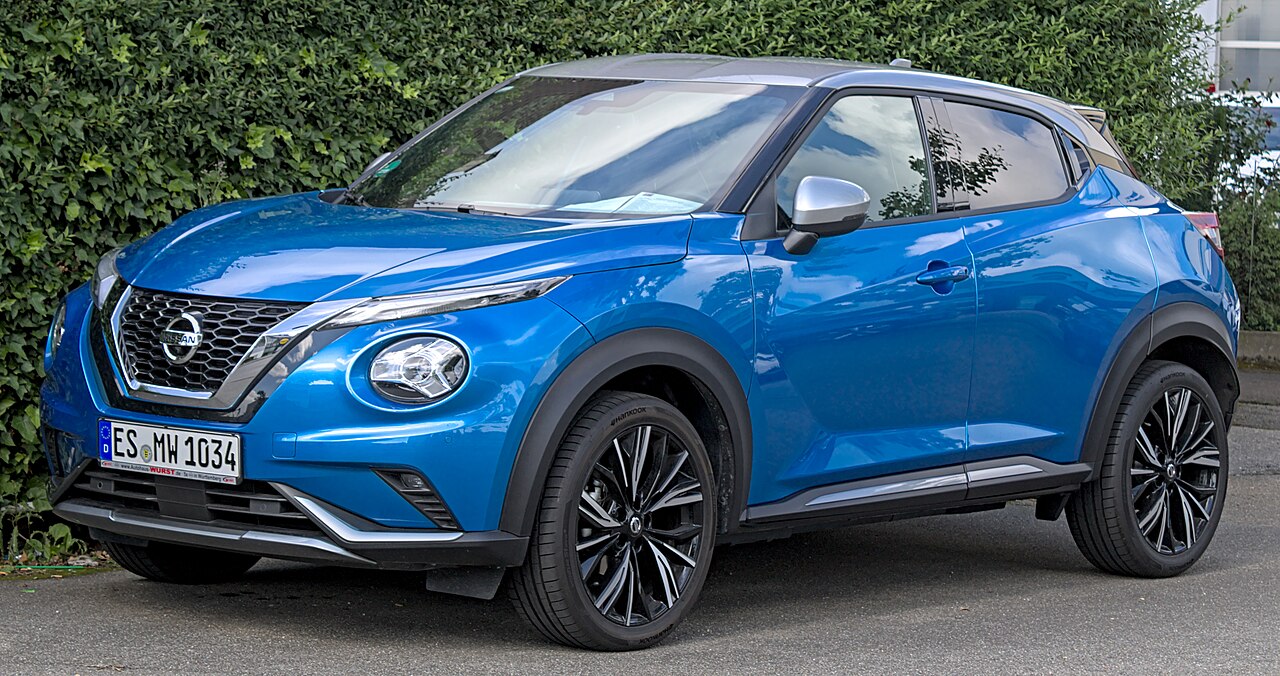 Licensed photo · Photo credit
Generations and technical specifications
Nissan Juke – Second generation2019–present
| Specification | Value |
|---|---|
| Model code | F16 |
| Production | 2019–present |
| Layout | Front-engine, front-wheel-drive |
| Platform | Renault–Nissan CMF-B HS platform |
| Engines | Petrol 1.0 L HR10DDT DIG-T I3 turbo Petrol hybrid 1.6 L HR16DE I4 |
| Electric motor | Permanent magnet synchronous motor (hybrid) |
| Transmissions | 6-speed manual 7-speed dual-clutch automatic eCVT |
| Drivetrain | Power-split (hybrid) |
| Battery | 1.2 kWh lithium-ion (hybrid) |
| Wheelbase | 2,636 mm |
| Length | 4,210 mm |
| Width | 1,800 mm |
| Height | 1,595 mm |
| Assembly | United Kingdom: Sunderland (NMUK) |
| Designer | Koji Wakabayashi, Takashi Utsunomiya and Marten Wallgren |
Nissan Juke – First generation2010–2019
| Specification | Value |
|---|---|
| Model code | F15 |
| Production | June 2010 – 2019 |
| Model years | 2011–2017 (North America) |
| Layout | Front-engine, front-wheel-drive Front-engine, all-wheel-drive |
| Platform | Nissan B platform |
| Engines | Petrol 1.5 L HR15DE I4 1.6 L HR16DE I4 1.6 L MR16DDT I4 turbo 3.8 L VR38DETT V6 twin-turbo (Juke-R) Diesel 1.5 L Renault K9K I4 |
| Transmissions | 5-speed manual 6-speed manual Xtronic CVT 6-speed dual-clutch automatic (Juke-R) |
| Wheelbase | 2,530 mm |
| Width | 1,765 mm |
| Kerb weight | 1,321–1,456 kg |
| Assembly | Japan: Yokosuka, Kanagawa (Oppama Plant) United Kingdom: Sunderland (NMUK) Indonesia: Purwakarta (NMI) |
| Designer | Matthew Weaver Kenji Kawasaki (pre-facelift Juke Nismo) |
Engines and transmissions
| Model years | Engine | Transmission | Drive | Fuel |
|---|---|---|---|---|
| 2011–2017 | 1.6 L, 4 cyl | 6-speed manual | Front-wheel drive | Petrol (premium) |
| 2011–2017 | 1.6 L, 4 cyl | CVT (continuously variable) | All-wheel drive | Petrol (premium) |
| 2011–2017 | 1.6 L, 4 cyl | CVT (continuously variable) | Front-wheel drive | Petrol (premium) |
Fuel economy (EPA)
| Model years | Configuration | Combined | City | Highway |
|---|---|---|---|---|
| 2011–2017 | 1.6 L, 4 cyl · 6-speed manual · Front-wheel drive | 7.8–8.7 L/100 km | 8.4–9.8 L/100 km | 7.1–7.8 L/100 km |
| 2011–2017 | 1.6 L, 4 cyl · CVT (continuously variable) · All-wheel drive | 8.4–9.0 L/100 km | 9.0–9.4 L/100 km | 7.6–8.1 L/100 km |
| 2011–2017 | 1.6 L, 4 cyl · CVT (continuously variable) · Front-wheel drive | 8.1 L/100 km | 8.4–8.7 L/100 km | 7.4–7.6 L/100 km |
Values are the official EPA label figures for each model year, shown as the lowest and highest value for the configuration. Electric models show energy use per 100 km. Real-world consumption depends on driving style, weather and load. Luggage and passenger volumes follow the EPA measuring method and can differ from the VDA figures used in Europe.
EU type-approval data
| Years | Powertrain | Engine | Power | Mass | CO₂ |
|---|---|---|---|---|---|
| 2020–2025 | Petrol | 999 cm³ | 84 kW (114 PS) | 1262–1286 kg | 133–140 g/km (WLTP) |
| 2022–2025 | Petrol hybrid | 1598 cm³ | 69 kW (94 PS) | 1400–1405 kg | 108–114 g/km (WLTP) |
| 2019–2021 | Petrol | 999 cm³ | 86 kW (117 PS) | 1257–1276 kg | 135–144 g/km (WLTP) |
| 2014–2019 | Petrol | 1197 cm³ | 85 kW (116 PS) | 1278 kg | 128–130 g/km (NEDC) |
| 2018–2019 | Petrol | 1598 cm³ | 83 kW (113 PS) | 1248–1278 kg | 180–186 g/km (WLTP) |
| 2011–2019 | Diesel | 1461 cm³ | 81 kW (110 PS) | 1338–1381 kg | 149 g/km (WLTP) |
| 2013–2019 | LPG (bi-fuel) | 1598 cm³ | 86 kW (117 PS) | 1275 kg | 118–120 g/km (NEDC) |
| 2013–2018 | Petrol | 1598 cm³ | 69 kW (94 PS) | 1195–1262 kg | 108–138 g/km (WLTP) |
| 2011–2018 | Petrol | 1598 cm³ | 86 kW (117 PS) | 1215–1290 kg | 190–192 g/km (WLTP) |
| 2011–2018 | Petrol | 1618 cm³ | 140 kW (190 PS) | 1342–1475 kg | 186 g/km (WLTP) |
Years are registration years. Each range runs from the 10th to the 90th percentile of the values reported for new registrations; it is not an average. Mass is the mass in running order. For electric cars the power is the type-approval net power, which can be lower than the peak power in brochures.
Key specifications
| Specification | Value |
|---|---|
| EPA size class | Small estate |
| Model years in EPA data | 2011–2017 |
| Powertrains | Petrol |
| Engine displacement | 1.6 L |
| Cylinders | 4 |
| Transmission types | CVT, Manual |
| Drive | Front-wheel drive, All-wheel drive |
| Fuel | Petrol (premium) |
| Configurations listed | 27 |
| Forced induction | Turbocharged |
| Luggage volume (EPA) | 283 L |
| Passenger volume (EPA) | 2,435–2,464 L |
| Powertrains (EU) | Petrol, Petrol hybrid, Diesel |
| Engine displacement (EU) | 999–1,598 cm³ |
| Power (EU) | 69–86 kW (94–117 PS) |
| Mass in running order (EU) | 1,215–1,405 kg |
| Wheelbase (EU) | 2,530–2,636 mm |
Years and markets
| Specification | Value |
|---|---|
| Model years (US) | 2011–2018 |
| New registrations (EU) | 2010–2026 |
Owner complaints (NHTSA)
| Component | Complaints | Most reported model years |
|---|---|---|
| Engine and cooling | 186 | 2011, 2012, 2013 |
| Fuel and propulsion | 99 | 2011, 2012, 2013 |
| Transmission and drivetrain | 75 | 2011, 2012, 2013 |
| Electrical system | 72 | 2011, 2012, 2014 |
| Speed control and cruise | 29 | 2011, 2012, 2013 |
| Airbags | 26 | 2011, 2012, 2014 |
| Visibility and wipers | 19 | 2011, 2013, 2014 |
| Steering | 17 | 2011, 2013, 2016 |
| Suspension | 15 | 2011, 2013, 2016 |
| Body and structure | 15 | 2011, 2013, 2015 |
Source: complaints filed by owners with the U.S. National Highway Traffic Safety Administration (NHTSA) for model years 2011–2017: 478 complaints, 27 with a crash and 13 with a fire. Complaints are owner reports that NHTSA has not verified, and one complaint can name more than one component. More complaints can also mean more cars sold.