Ford
Puma
Ford Puma: years registered new in Europe, fault code help, warning lights and maintenance guides.
 Licensed photo · Photo credit
MakeFord
New registrations (EU)2000–2004, 2008, 2010–2012, 2018–2026
Generations and technical specifications
Ford Puma (crossover)2019–present
| Specification | Value |
|---|---|
| Production | 2019–present |
| Body styles | 5-door crossover SUV |
| Layout | Front-engine, front-wheel-drive |
| Platform | Ford global B-car platform |
| Engines | Petrol 1.0 L EcoBoost Fox I3-T 1.5 L EcoBoost Dragon I3-T (Puma ST) Petrol mild hybrid 1.0 L EcoBoost Hybrid Fox mHEV I3-T Diesel 1.5 L EcoBlue Panther I4-T |
| Electric motor | 11.5 kW belt-driven integrated starter/generator (BISG) 150 kW Permanent magnet synchronous motor |
| Transmissions | 6-speed manual 7-speed dual-clutch |
| Drivetrain | EcoBoost Hybrid mHEV |
| Battery | 48-volt, 0.48 kWh battery pack (mild hybrid) |
| Wheelbase | 2,588 mm |
| Length | 4,186 mm |
| Width | 1,805 mm |
| Height | 1,537 mm |
| Kerb weight | 1,205 kg |
| Class | Subcompact SUV (B-segment) |
| Assembly | Romania: Craiova (Ford Romania) |
| Designer | Thomas Morel |
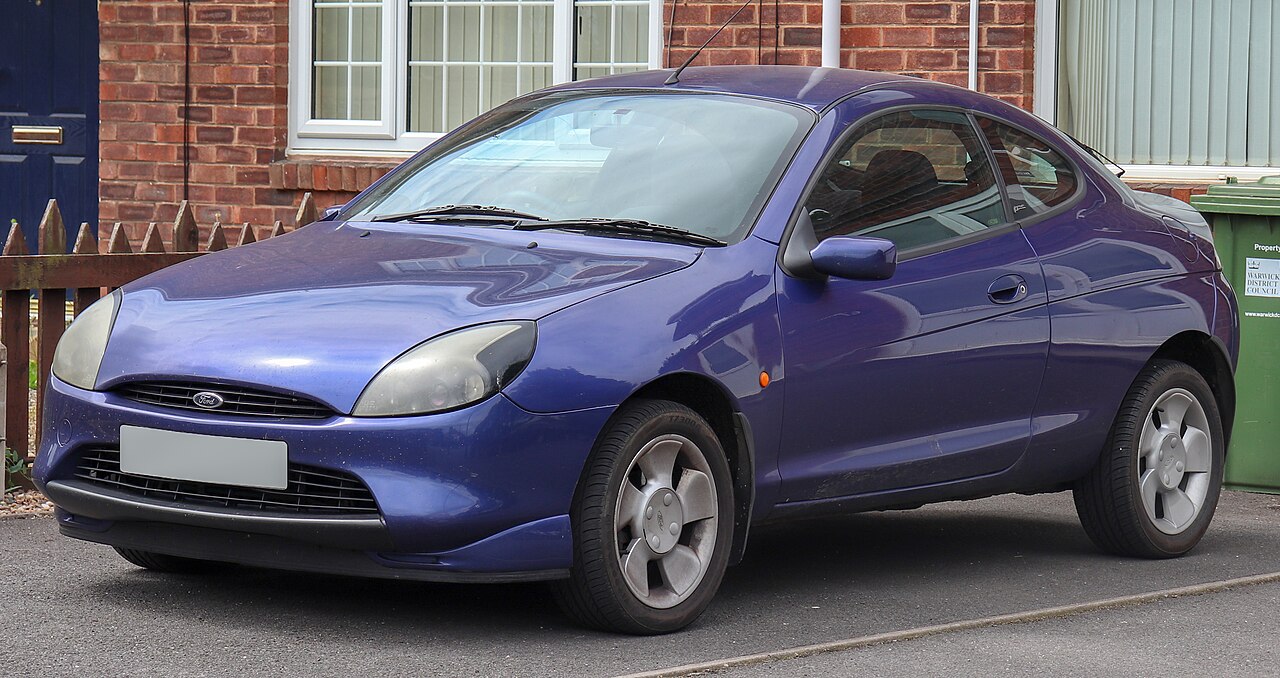
Ford Puma (coupé)1997–2001
| Specification | Value |
|---|---|
| Production | June 1997 – 2001 |
| Body styles | 3-door coupé |
| Layout | Front-engine, front-wheel drive |
| Platform | Ford B platform |
| Engines | 1.4l i4 Zetec (1997–2000) 1.6L I4 Zetec (2000–2002) 1.7L I4 Zetec |
| Transmissions | 5-speed IB5 manual |
| Wheelbase | 2,446 mm |
| Length | 3,984 mm |
| Width | 1,837 mm |
| Height | 1,315 mm |
| Kerb weight | 1,035–1,039 kg |
| Class | Sports car |
| Assembly | Germany: Cologne |
| Designer | Chris Svensson |
EU type-approval data
| Years | Powertrain | Engine | Power | Mass | CO₂ | Electric range |
|---|---|---|---|---|---|---|
| 2020–2022, 2025 | Petrol | 999 cm³ | 91 kW (124 PS) | 1280–1326 kg | 124–139 g/km (WLTP) | – |
| 2019–2022, 2025 | Petrol | 999 cm³ | 114 kW (155 PS) | 1280–1369 kg | 124–135 g/km (WLTP) | – |
| 2020–2025 | Petrol hybrid | 999 cm³ | 91 kW (124 PS) | 1280–1373 kg | 121–130 g/km (WLTP) | – |
| 2020–2025 | Petrol hybrid | 999 cm³ | 92 kW (125 PS) | 1280–1372 kg | 121–130 g/km (WLTP) | – |
| 2020–2025 | Petrol hybrid | 999 cm³ | 114 kW (155 PS) | 1280–1373 kg | 125–135 g/km (WLTP) | – |
| 2025 | Electric | – | 123 kW (167 PS) | 1566–1575 kg | – | 360–376 km · 131–139 Wh/km |
| 2025 | Electric | – | 124 kW (169 PS) | 1566–1575 kg | – | 140–376 km · 131–359 Wh/km |
| 2020–2022, 2024 | Petrol | 999 cm³ | 92 kW (125 PS) | 1280–1326 kg | 130–142 g/km (WLTP) | – |
| 2020–2024 | Petrol | 1496 cm³ | 147 kW (200 PS) | 1358–1363 kg | 150–155 g/km (WLTP) | – |
| 2021–2024 | E85 flex-fuel | 999 cm³ | 91 kW (124 PS) | 1280–1319 kg | 121–127 g/km (WLTP) | – |
| 2020–2023 | Petrol | 999 cm³ | 70 kW (95 PS) | 1280–1298 kg | 128–133 g/km (WLTP) | – |
| 2020–2022 | Diesel | 1499 cm³ | 88 kW (120 PS) | 1348–1383 kg | 118–120 g/km (WLTP) | – |
Years are registration years. Each range runs from the 10th to the 90th percentile of the values reported for new registrations; it is not an average. Mass is the mass in running order. For electric cars the power is the type-approval net power, which can be lower than the peak power in brochures.
Key specifications
| Specification | Value |
|---|---|
| Powertrains (EU) | Petrol, Petrol hybrid, Diesel, E85 flex-fuel |
| Engine displacement (EU) | 999–1,499 cm³ |
| Power (EU) | 88–114 kW (120–155 PS) |
| Mass in running order (EU) | 1,280–1,383 kg |
| Wheelbase (EU) | 2,588 mm |
Years and markets
| Specification | Value |
|---|---|
| New registrations (EU) | 2000–2004, 2008, 2010–2012, 2018–2026 |