C-Max
Ford C-Max: official NHTSA recalls, fault code help and maintenance guides.
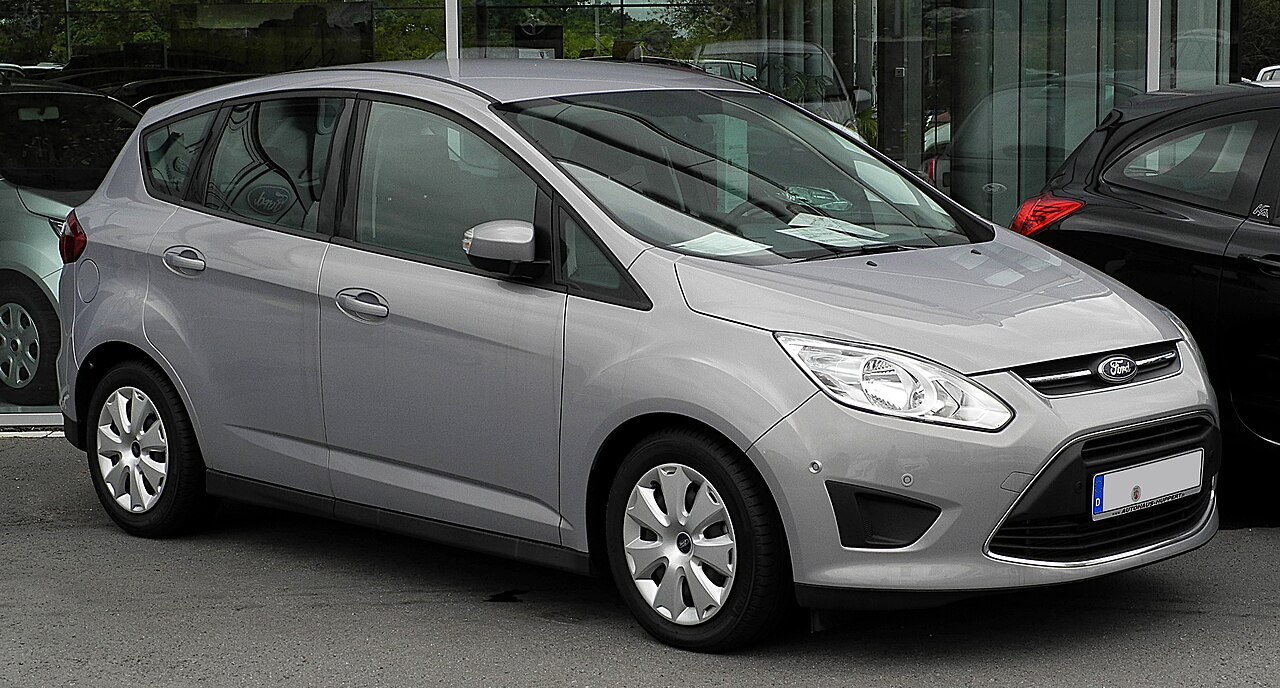 Licensed photo · Photo credit
Generations and technical specifications
Ford C-Max – Second generation2010–2019
| Specification | Value |
|---|---|
| Production | 2010–2019 (Europe) 2012–2018 (United States) |
| Model years | 2013–2018 (US) |
| Platform | Ford Global C platform |
| Engines | Petrol 1.0 L EcoBoost SCTi turbo I3 1.5 L EcoBoost SCTi turbo I4 1.6 L Duratec Ti-VCT I4 1.6 L EcoBoost SCTi turbo I4 Diesel 1.5 L Duratorq TDCi I4 1.6 L Duratorq TDCi I4 2.0 L Duratorq TDCi I4 |
| Transmissions | 5-speed iB5 manual 6-speed B6/MMT6 manual 6-speed Durashift automatic 6-speed PowerShift dual-clutch automatic |
| Wheelbase | C-Max: 2,648 mm Grand C-Max: 2,788 mm |
| Length | C-Max: 4,380 mm Grand C-Max: 4,520 mm |
| Width | 1,828 mm |
| Height | C-Max: 1,626 mm Grand C-Max: 1,684 mm |
| Kerb weight | C-Max: 1,374–1,550 kg Grand C-Max: 1,477–1,697 kg |
| Assembly | Spain: Valencia (Ford Valencia) Germany: Saarlouis (Saarlouis Body & Assembly) United States: Wayne, Michigan (hybrid) |
Ford C-Max – First generation2003–2010
| Specification | Value |
|---|---|
| Production | 2003–2010 |
| Model years | 2004–2010 |
| Platform | Ford C1 platform |
| Engines | petrol 1.6 L Duratec I4 1.6 L Duratec Ti-VCT I4 1.8 L Duratec HE I4 2.0 L Duratec HE I4 diesel 1.6 L Duratorq TDCi I4 1.8 L Duratorq TDCi I4 2.0 L Duratorq TDCi I4 |
| Transmissions | 4-speed 4F27E Durashift automatic 5-speed iB5/MTX-75 Durashift manual transmission 6-speed Durashift manual transmission 6-speed PowerShift dual-clutch automatic Durashift CVT |
| Wheelbase | 2,640 mm |
| Length | 4,371 mm |
| Width | 1,825 mm |
| Height | 1,588 mm |
| Kerb weight | 1,372–1,527 kg |
| Assembly | Saarlouis, Germany (Saarlouis Body & Assembly) |
| Designer | Daniel Paulin |
Engines and transmissions
| Model years | Engine | Transmission | Drive | Fuel |
|---|---|---|---|---|
| 2013–2018 | 2.0 L, 4 cyl hybrid | CVT (continuously variable) | Front-wheel drive | Petrol (regular) |
| 2013–2017 | 2.0 L, 4 cyl plug-in hybrid | CVT (continuously variable) | Front-wheel drive | Petrol (regular) and electricity |
Fuel economy (EPA)
| Model years | Configuration | Combined | City | Highway | Electric range |
|---|---|---|---|---|---|
| 2013–2018 | 2.0 L, 4 cyl hybrid · CVT (continuously variable) · Front-wheel drive | 5.9–6.0 L/100 km | 5.6–5.7 L/100 km | 6.2–6.5 L/100 km | – |
| 2013–2017 | 2.0 L, 4 cyl plug-in hybrid · CVT (continuously variable) · Front-wheel drive | 6.0–6.2 L/100 km | 5.7–5.9 L/100 km | 6.2–6.5 L/100 km | 32 km |
Values are the official EPA label figures for each model year, shown as the lowest and highest value for the configuration. Electric models show energy use per 100 km. Real-world consumption depends on driving style, weather and load. Luggage and passenger volumes follow the EPA measuring method and can differ from the VDA figures used in Europe.
EU type-approval data
| Years | Powertrain | Engine | Power | Mass | CO₂ |
|---|---|---|---|---|---|
| 2015–2019 | Petrol | 999 cm³ | 74 kW (101 PS) | 1391–1473 kg | 148–152 g/km (WLTP) |
| 2015–2019 | Petrol | 999 cm³ | 92 kW (125 PS) | 1391–1473 kg | 151–159 g/km (WLTP) |
| 2015–2019 | Petrol | 1498 cm³ | 110 kW (150 PS) | 1394–1520 kg | 176–194 g/km (WLTP) |
| 2015–2019 | Diesel | 1499 cm³ | 70 kW (95 PS) | 1403–1498 kg | 156–160 g/km (WLTP) |
| 2015–2019 | Diesel | 1499 cm³ | 88 kW (120 PS) | 1403–1498 kg | 151–161 g/km (WLTP) |
| 2015–2019 | Diesel | 1997 cm³ | 110 kW (150 PS) | 1491–1588 kg | 163–169 g/km (WLTP) |
| 2011–2018 | Petrol | 1596 cm³ | 92 kW (125 PS) | 1374 kg | 149–154 g/km (NEDC) |
| 2012–2018 | LPG (bi-fuel) | 1596 cm³ | 88 kW (120 PS) | 1444 kg | 127–132 g/km (NEDC) |
| 2012–2015 | Petrol | 998 cm³ | 74 kW (101 PS) | 1391–1449 kg | 117 g/km (NEDC) |
| 2012–2015 | Petrol | 998 cm³ | 92 kW (125 PS) | 1391–1449 kg | 117 g/km (NEDC) |
| 2011–2015 | Petrol | 1596 cm³ | 110 kW (150 PS) | 1385 kg | 144–154 g/km (NEDC) |
| 2011–2015 | Diesel | 1560 cm³ | 70 kW (95 PS) | 1390–1448 kg | 114–119 g/km (NEDC) |
| 2011–2015 | Diesel | 1560 cm³ | 85 kW (116 PS) | 1390–1448 kg | 112–119 g/km (NEDC) |
| 2011–2015 | Diesel | 1997 cm³ | 85 kW (116 PS) | 1550–1615 kg | 144–149 g/km (NEDC) |
| 2011–2015 | Diesel | 1997 cm³ | 103 kW (140 PS) | 1488–1550 kg | 129–149 g/km (NEDC) |
| 2011–2015 | Diesel | 1997 cm³ | 120 kW (163 PS) | 1488–1550 kg | 129–149 g/km (NEDC) |
| 2011–2014 | Petrol | 1596 cm³ | 77 kW (105 PS) | 1374–1431 kg | 149–154 g/km (NEDC) |
| 2010–2011 | Petrol | 1798 cm³ | – | 1375–1425 kg | 169 g/km (NEDC) |
| 2010 | Diesel | 1753 cm³ | – | 1465–1595 kg | 139–143 g/km (NEDC) |
Years are registration years. Each range runs from the 10th to the 90th percentile of the values reported for new registrations; it is not an average. Mass is the mass in running order. For electric cars the power is the type-approval net power, which can be lower than the peak power in brochures.
Key specifications
| Specification | Value |
|---|---|
| EPA size class | Large car, Midsize car |
| Model years in EPA data | 2013–2018 |
| Powertrains | Hybrid, Plug-in hybrid |
| Engine displacement | 2.0 L |
| Cylinders | 4 |
| Transmission types | CVT |
| Drive | Front-wheel drive |
| Fuel | Petrol (regular), Petrol (regular) and electricity |
| Configurations listed | 11 |
| Start-stop system | Yes |
| Electric motor (EPA) | 68 kW DCPM; 68 kW |
| Luggage volume (EPA) | 538–680 L |
| Passenger volume (EPA) | 2,832 L |
| Powertrains (EU) | Petrol, Diesel, LPG (bi-fuel) |
| Engine displacement (EU) | 998–1,997 cm³ |
| Power (EU) | 70–110 kW (95–150 PS) |
| Mass in running order (EU) | 1,374–1,615 kg |
| Wheelbase (EU) | 2,640–2,648 mm |
Years and markets
| Specification | Value |
|---|---|
| Model years (US) | 2013–2018 |
| New registrations (EU) | 2001, 2003–2024 |
Owner complaints (NHTSA)
| Component | Complaints | Most reported model years |
|---|---|---|
| Driver assistance | 11 | 2015, 2016 |
| Electrical system | 2 | 2014, 2016 |
| Fuel and propulsion | 2 | 2016, 2017 |
| Tyres | 1 | 2013 |
| Airbags | 1 | 2015 |
| Brakes | 1 | 2016 |
| Transmission and drivetrain | 1 | 2016 |
| Speed control and cruise | 1 | 2016 |
| Other or unknown | 3 | 2016 |
Source: complaints filed by owners with the U.S. National Highway Traffic Safety Administration (NHTSA) for model years 2013–2017: 20 complaints, 2 with a crash and 0 with a fire. Complaints are owner reports that NHTSA has not verified, and one complaint can name more than one component. More complaints can also mean more cars sold.