Venue
Hyundai Venue: official NHTSA recalls, fault code help and maintenance guides.
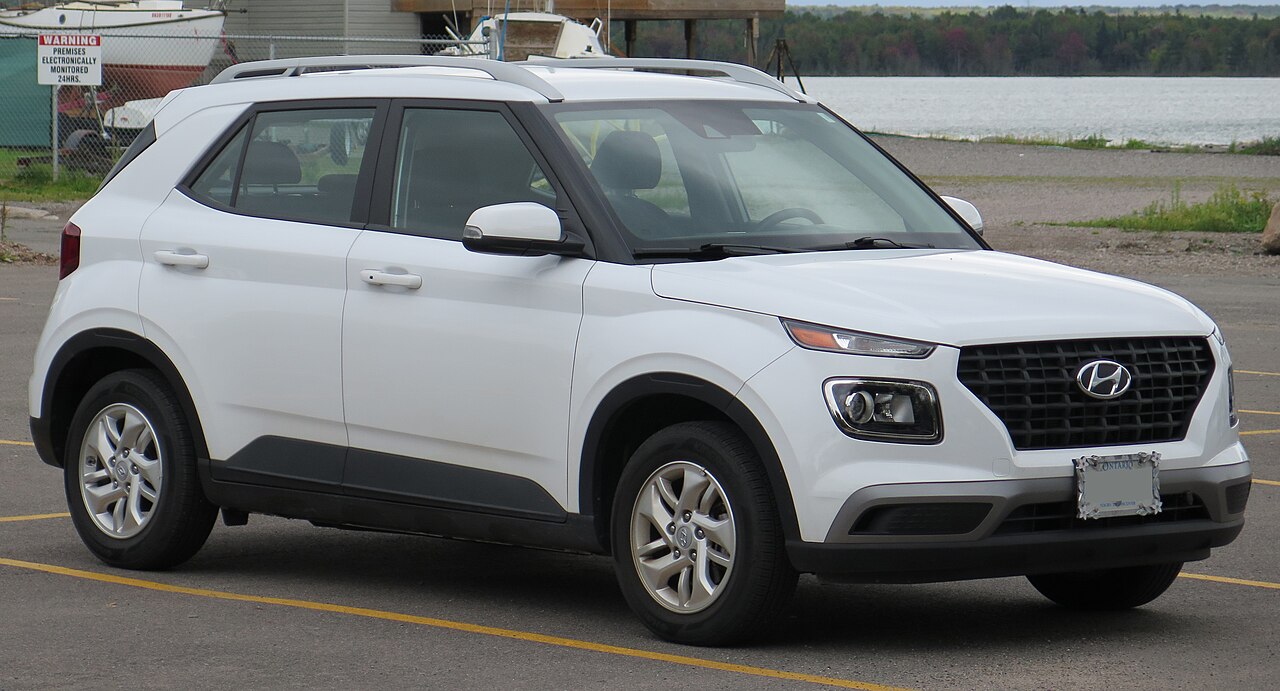 Licensed photo · Photo credit
Generations and technical specifications
Hyundai Venue – Second generation2025–present
| Specification | Value |
|---|---|
| Model code | QU2 |
| Production | November 2025 – present |
| Platform | Hyundai-Kia K1 platform |
| Engines | Petrol 1.0 L Kappa II turbo GDi I3 1.2 L Kappa II I4 Diesel 1.5 L U II CRDi I4 |
| Transmissions | 5-speed manual 6-speed manual 6-speed automatic 7-speed DCT |
| Wheelbase | 2,520 mm |
| Length | 3,995 mm |
| Width | 1,800 mm |
| Height | 1,665 mm |
| Kerb weight | 1,112–1,251 kg |
| Assembly | India: Talegaon (HMIL) |
| Designer | Park Cho-hee |
Hyundai Venue – First generation2019–present
| Specification | Value |
|---|---|
| Model code | QX |
| Production | May 2019 – present |
| Model years | 2020–present |
| Platform | Hyundai-Kia K2 |
| Engines | Petrol 1.0 L Kappa II T-GDi I3 1.2 L Kappa II I4 1.6 L Gamma II I4 1.6 L Smartstream I4 1.6 L Smartstream DPi I4 Diesel 1.4 L U II CRDi I4 1.5 L U II CRDi I4 |
| Transmissions | 5/6-speed manual 6-speed semi-automatic 6-speed automatic 7-speed DCT CVT |
| Wheelbase | 2,520 mm (QX) 2,500 mm (QXi) |
| Length | 4,040 mm (QX) 3,995 mm (QXi) |
| Width | 1,770 mm |
| Height | 1,565–1,585 mm (QX) 1,605 mm (QXi) |
| Kerb weight | 1,112–1,251 kg (QX) 1,050 kg (QXi) |
| Assembly | South Korea: Ulsan (Ulsan Plant 3) India: Chennai (HMIL) Vietnam: Ninh Bình (HTMV) Taiwan: Hukou, Hsinchu (SYM) Nepal: Ramgram, Parasi (Laxmi Motor) |
| Designer | Chan-Hee Lee, Duck-Hyun Hwang and Goo Lee |
Engines and transmissions
| Model years | Engine | Transmission | Drive | Fuel |
|---|---|---|---|---|
| 2020–2027 | 1.6 L, 4 cyl | CVT (continuously variable) | Front-wheel drive | Petrol (regular) |
| 2020 | 1.6 L, 4 cyl | 6-speed manual | Front-wheel drive | Petrol (regular) |
Fuel economy (EPA)
| Model years | Configuration | Combined | City | Highway |
|---|---|---|---|---|
| 2020–2027 | 1.6 L, 4 cyl · CVT (continuously variable) · Front-wheel drive | 7.4–7.6 L/100 km | 7.8–8.1 L/100 km | 6.9–7.4 L/100 km |
| 2020 | 1.6 L, 4 cyl · 6-speed manual · Front-wheel drive | 7.8 L/100 km | 8.7 L/100 km | 6.7 L/100 km |
Values are the official EPA label figures for each model year, shown as the lowest and highest value for the configuration. Electric models show energy use per 100 km. Real-world consumption depends on driving style, weather and load. Luggage and passenger volumes follow the EPA measuring method and can differ from the VDA figures used in Europe.
Key specifications
| Specification | Value |
|---|---|
| EPA size class | Small SUV, Midsize car |
| Model years in EPA data | 2020–2027 |
| Powertrains | Petrol |
| Engine displacement | 1.6 L |
| Cylinders | 4 |
| Transmission types | CVT, Manual |
| Drive | Front-wheel drive |
| Fuel | Petrol (regular) |
| Configurations listed | 9 |
| Luggage volume (EPA) | 538 L |
| Passenger volume (EPA) | 2,605 L |
Years and markets
| Specification | Value |
|---|---|
| Model years (US) | 2020–2027 |
Owner complaints (NHTSA)
| Component | Complaints | Most reported model years |
|---|---|---|
| Electrical system | 43 | 2021, 2023, 2024 |
| Seat belts | 23 | 2020, 2021, 2022 |
| Driver assistance | 13 | 2020, 2021, 2023 |
| Steering | 12 | 2020, 2021, 2022 |
| Transmission and drivetrain | 11 | 2020, 2021, 2023 |
| Engine and cooling | 11 | 2020, 2021, 2024 |
| Brakes | 9 | 2020, 2021, 2024 |
| Lights | 9 | 2020, 2023, 2024 |
| Body and structure | 6 | 2020, 2022, 2025 |
| Speed control and cruise | 6 | 2020, 2021, 2022 |
Source: complaints filed by owners with the U.S. National Highway Traffic Safety Administration (NHTSA) for model years 2020–2025: 139 complaints, 8 with a crash and 1 with a fire. Complaints are owner reports that NHTSA has not verified, and one complaint can name more than one component. More complaints can also mean more cars sold.