Kia
Stonic
Kia Stonic: years registered new in Europe, fault code help, warning lights and maintenance guides.
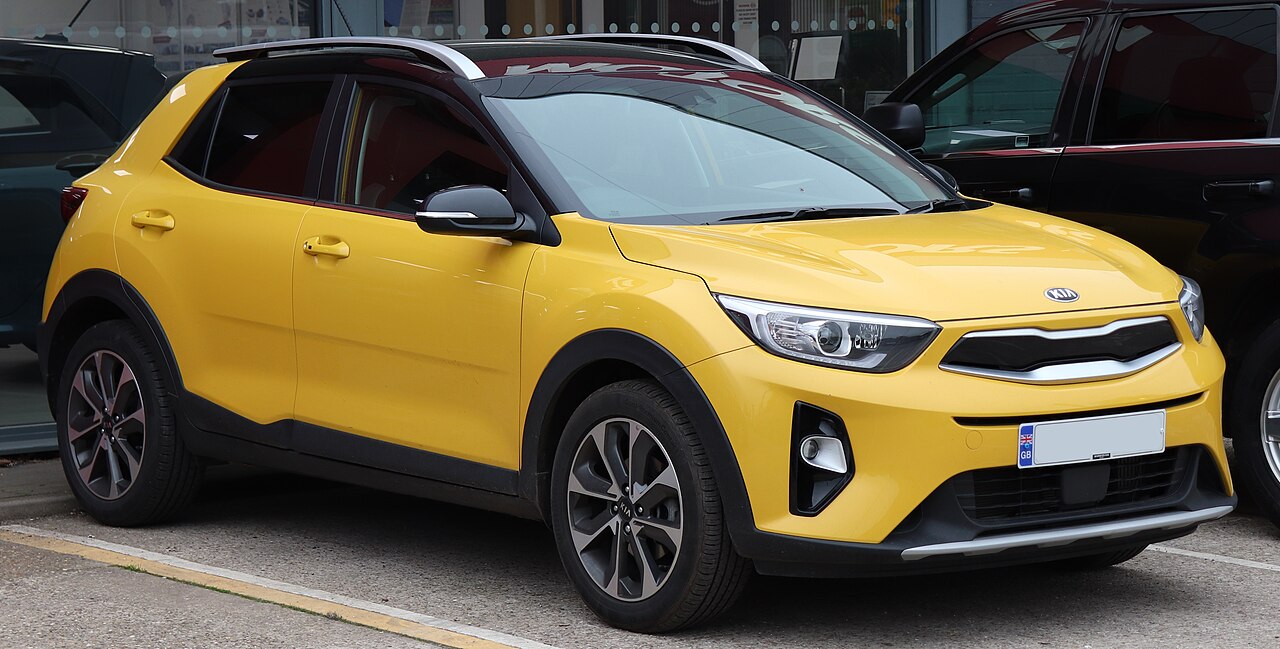 Licensed photo · Photo credit
MakeKia
New registrations (EU)2017–2026
Generations and technical specifications
Kia Stonic2017–present
| Specification | Value |
|---|---|
| Model code | YB CUV |
| Production | 2017–present |
| Body styles | 5-door hatchback |
| Layout | Front-engine, front-wheel-drive |
| Platform | Hyundai-Kia GB |
| Engines | Petrol 1.0 L Kappa II T-GDI I3 1.0 L Smartstream G1.0 T-GDI I3 1.2 L Kappa II MPI I4 1.2 L Smartstream G1.2 MPI I4 1.4 L Kappa II MPI I4 Diesel 1.6 L U II CRDi I4 1.6 L Smartstream D1.6 CRDi I4 Diesel mild hybrid 1.6 L Smartstream D1.6 CRDi I4 EcoDynamics+ |
| Transmissions | 5-speed manual 6-speed manual 6-speed automatic 7-speed DCT CVT |
| Drivetrain | Mild Hybrid (EcoDynamics+) |
| Wheelbase | 2,580 mm 2,570 mm (China) |
| Width | 1,760 mm 1,735 mm (China) |
| Height | 1,520 mm 1,533 mm (China) |
| Kerb weight | 1,060–1,104 kg (China) |
| Class | Subcompact crossover SUV (B) |
| Assembly | South Korea: Gwangmyeong (Sohari Plant, 2017–2023); Seosan (Donghee, 2023–present) China: Yancheng (Yueda Kia) Pakistan: Karachi (Lucky Motor Corporation) |
| Designer | Peter Schreyer |
EU type-approval data
| Years | Powertrain | Engine | Power | Mass | CO₂ |
|---|---|---|---|---|---|
| 2018–2022, 2025 | Petrol | 998 cm³ | 73 kW (99 PS) | 1180–1230 kg | 122–139 g/km (WLTP) |
| 2019–2025 | Petrol | 998 cm³ | 74 kW (101 PS) | 1180–1230 kg | 125–139 g/km (WLTP) |
| 2024–2025 | Petrol | 1197 cm³ | 58 kW (79 PS) | 1155 kg | 131–132 g/km (WLTP) |
| 2020–2022, 2025 | Petrol hybrid | 998 cm³ | 73 kW (99 PS) | 1225 kg | 121–128 g/km (WLTP) |
| 2020–2025 | Petrol hybrid | 998 cm³ | 74 kW (101 PS) | 1225–1260 kg | 121–128 g/km (WLTP) |
| 2020–2024 | Petrol | 1197 cm³ | 62 kW (84 PS) | 1155 kg | 127–136 g/km (WLTP) |
| 2020–2024 | Petrol hybrid | 998 cm³ | 88 kW (120 PS) | 1225–1260 kg | 119–129 g/km (WLTP) |
| 2021–2022, 2024 | LPG (bi-fuel) | 1197 cm³ | 62 kW (84 PS) | 1155–1166 kg | 114–125 g/km (WLTP) |
| 2020–2022 | Petrol | 1197 cm³ | 61 kW (83 PS) | 1155 kg | 130–135 g/km (WLTP) |
| 2017–2021 | Petrol | 998 cm³ | 88 kW (120 PS) | 1185–1225 kg | 137–139 g/km (WLTP) |
| 2017–2021 | Petrol | 1248 cm³ | 62 kW (84 PS) | 1145 kg | 150–154 g/km (WLTP) |
| 2018–2021 | Diesel | 1598 cm³ | 85 kW (116 PS) | 1270 kg | 129–131 g/km (WLTP) |
| 2018–2021 | LPG (bi-fuel) | 1368 cm³ | 73 kW (99 PS) | 1228 kg | 135 g/km (WLTP) |
| 2017–2020 | Petrol | 1248 cm³ | 61 kW (83 PS) | 1145–1192 kg | 150–154 g/km (WLTP) |
| 2017–2020 | Petrol | 1368 cm³ | 73 kW (99 PS) | 1160–1183 kg | 135–152 g/km (WLTP) |
| 2017–2019 | Diesel | 1582 cm³ | 81 kW (110 PS) | 1255–1302 kg | 109 g/km (NEDC) |
Years are registration years. Each range runs from the 10th to the 90th percentile of the values reported for new registrations; it is not an average. Mass is the mass in running order. For electric cars the power is the type-approval net power, which can be lower than the peak power in brochures.
Key specifications
| Specification | Value |
|---|---|
| Powertrains (EU) | Petrol, Petrol hybrid, Diesel, LPG (bi-fuel) |
| Engine displacement (EU) | 998–1,598 cm³ |
| Power (EU) | 61–88 kW (83–120 PS) |
| Mass in running order (EU) | 1,145–1,302 kg |
| Wheelbase (EU) | 2,580 mm |
Years and markets
| Specification | Value |
|---|---|
| New registrations (EU) | 2017–2026 |