NIO
ES8
NIO ES8: years registered new in Europe, fault code help, warning lights and maintenance guides.
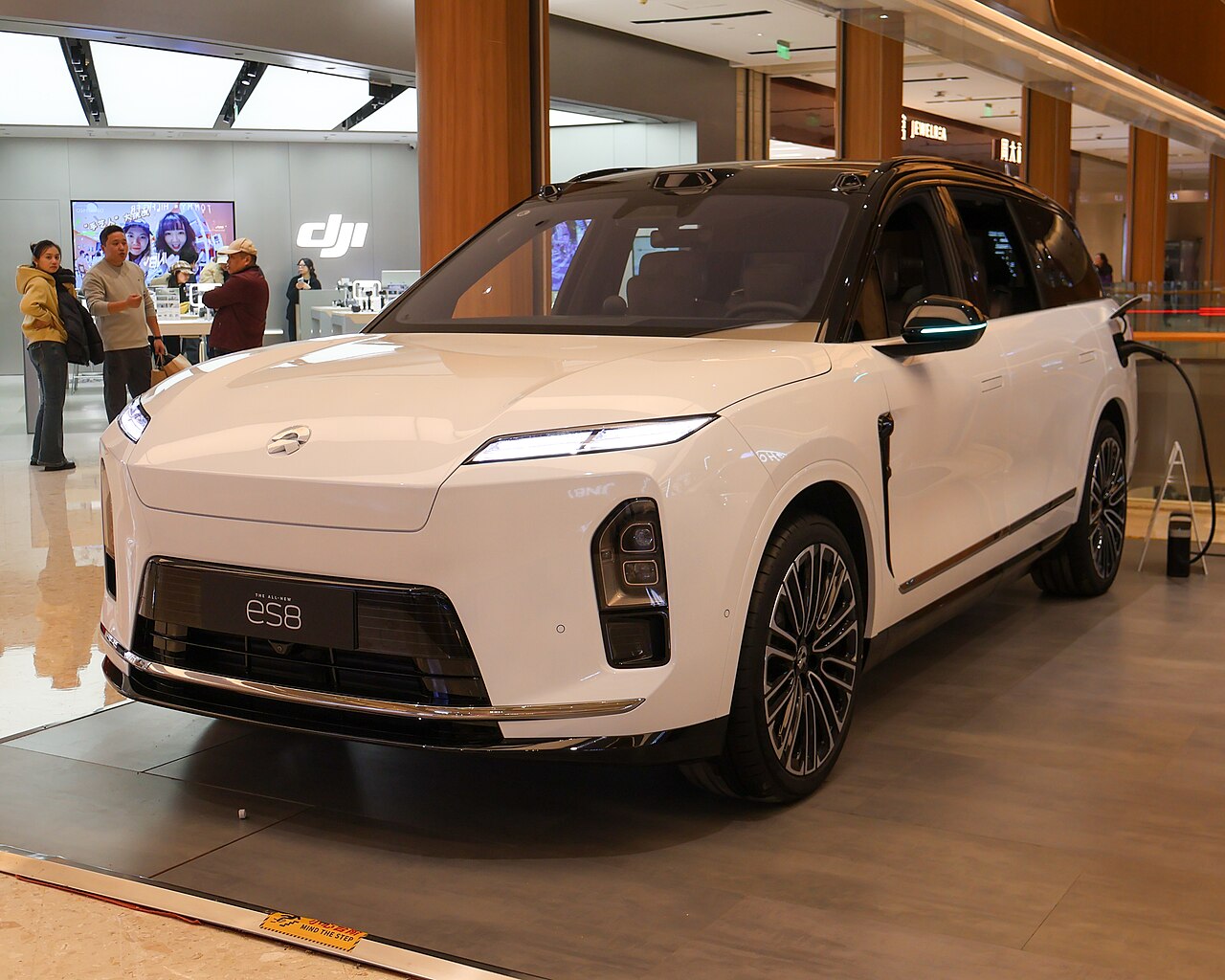 Licensed photo · Photo credit
MakeNIO
New registrations (EU)2019, 2021–2025
Generations and technical specifications
Nio ES8 – Third generation2025–present
| Specification | Value |
|---|---|
| Model code | Cetus |
| Production | 2025–present |
| Layout | Dual-motor, all-wheel drive |
| Platform | NT 3.0 |
| Battery | 102 kWh NMC CATL |
| Charging | 420 kW (DC) |
| Wheelbase | 3,130 mm |
| Length | 5,280 mm |
| Width | 2,010 mm |
| Height | 1,800 mm |
| Assembly | China: Hefei, Anhui |
Nio ES8 – Second generation2023–2025
| Specification | Value |
|---|---|
| Model code | Aries |
| Production | 2023–2025 |
| Layout | Dual-motor, all-wheel drive |
| Platform | NT 2.0 |
| Electric motor | 180 kW TZ180S001 PMSM (front), 300 kW YS300S002 AC induction (rear) |
| Transmissions | 1-speed direct-drive reduction |
| Battery | 75 kWh LFP-NMC hybrid CATL 75 kWh LFP CATL 100 kWh NMC CATL/CALB 150 kWh NMC semi-solid-state WeLion |
| Electric range | (WLTP) (CLTC) 900 km (CLTC, 150 kWh) |
| Charging | 180 kW (DC) 3.3 kW V2L |
| Wheelbase | 3,070 mm |
| Length | 5,099 mm |
| Width | 1,989 mm |
| Height | 1,750 mm |
| Assembly | China: Hefei, Anhui |
Nio ES8 – First generation2018–2023
| Specification | Value |
|---|---|
| Production | 2018–2023 |
| Layout | Dual-motor, all-wheel drive |
| Electric motor | AC induction/asynchronous, Permanent magnet motor |
| Transmissions | 1-speed direct-drive reduction |
| Battery | 75 kWh Li-ion 84 kWh Li-ion 100 kWh Li-ion |
| Electric range | 500 km WLTP with 100kWh battery |
| Wheelbase | 3,010 mm |
| Length | 5,022 mm |
| Width | 1,962 mm |
| Height | 1,756 mm |
| Kerb weight | 2,460 kg |
| Assembly | China: Hefei, Anhui |
| Designer | Park Soo-wan, Salvatore Aita, Jim Baste, Vasiliy Kurkov, Suh Ju-ho, Kris Tomasson |
EU type-approval data
| Years | Powertrain | Power | Mass | Electric range |
|---|---|---|---|---|
| 2021, 2024 | Electric | 240 kW (326 PS) | 2475–2530 kg | 364–474 km · 236–245 Wh/km |
| 2022–2024 | Electric | 400 kW (544 PS) | 2480–2525 kg | 460–480 km · 220–239 Wh/km |
| 2022–2023 | Electric | 160 kW (218 PS) | 2475–2525 kg | 364–474 km · 237–242 Wh/km |
| 2022 | Electric | 120 kW (163 PS) | 2495–2713 kg | 196–240 Wh/km |
Years are registration years. Each range runs from the 10th to the 90th percentile of the values reported for new registrations; it is not an average. Mass is the mass in running order. For electric cars the power is the type-approval net power, which can be lower than the peak power in brochures.
Key specifications
| Specification | Value |
|---|---|
| Powertrains (EU) | Electric |
| Power (EU) | 160–240 kW (218–326 PS) |
| Mass in running order (EU) | 2,475–2,530 kg |
| Wheelbase (EU) | 3,010 mm |
Years and markets
| Specification | Value |
|---|---|
| New registrations (EU) | 2019, 2021–2025 |