Peugeot
301
Peugeot 301: years registered new in Europe, fault code help, warning lights and maintenance guides.
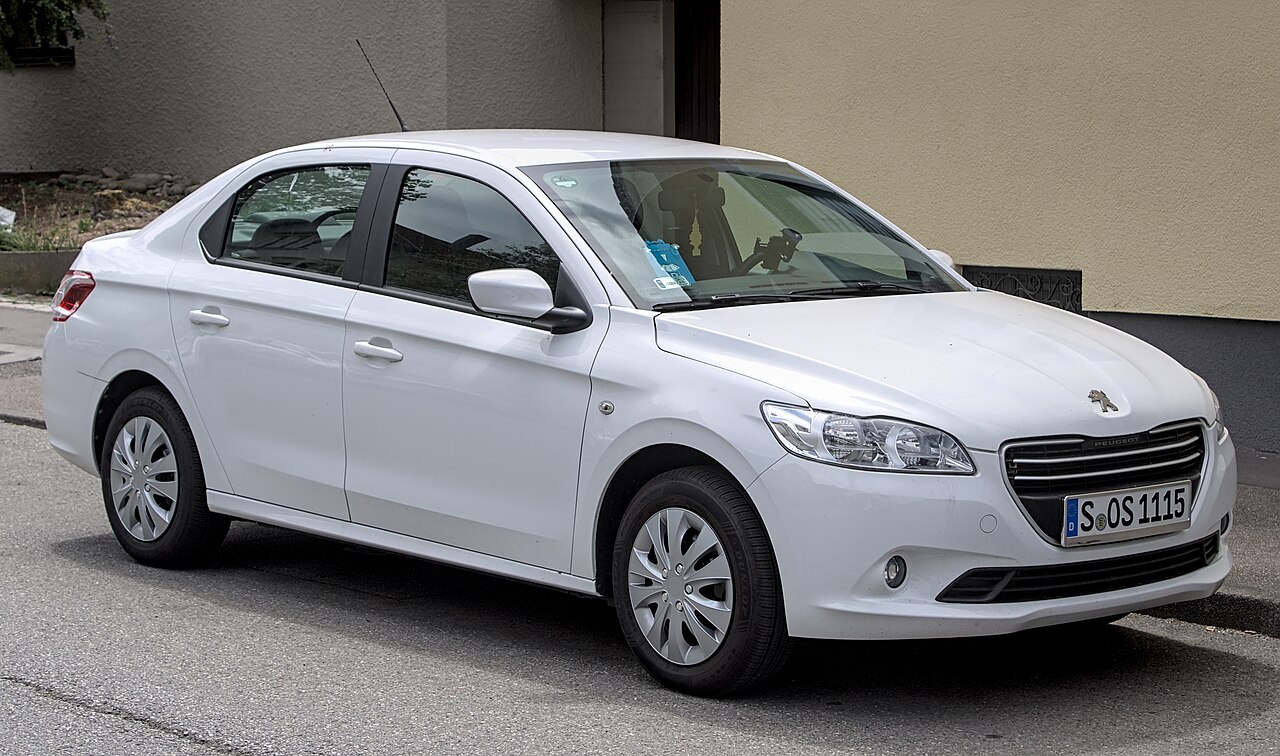 Licensed photo · Photo credit
MakePeugeot
New registrations (EU)2012–2022
Generations and technical specifications
Peugeot 301 (2012) – Peugeot 3012012–2021
| Specification | Value |
|---|---|
| Production | 2012–2021 |
| Body styles | 4-door saloon |
| Layout | Front-engine, front-wheel-drive |
| Platform | PSA PF1 platform |
| Engines | Petrol 1.2 L EB2M/EB2F VTi/PureTech I3 1.6 L EC5FNFP VTi I4 Diesel 1.5 L DV5RD BlueHDi I4 1.6 L DV6DTED/DV6FDTED HDi/BlueHDi I4 |
| Transmissions | 5 or 6-speed manual 4-speed automatic 5-speed semi-automatic |
| Wheelbase | 2,655 mm |
| Length | 4,442 mm |
| Width | 1,748 mm |
| Height | 1,446 mm |
| Kerb weight | 1,055–1,165 kg |
| Class | Subcompact car (B) |
| Assembly | China: Wuhan (DPCA) Spain: Vigo (PSA Vigo Plant) Iran: Tehran (IKAP) Nigeria: Kaduna (Peugeot Automobiles Nigeria) Kazakhstan: Kostanay (Saryarka AvtoProm) |
EU type-approval data
| Years | Powertrain | Engine | Power | Mass | CO₂ |
|---|---|---|---|---|---|
| 2018–2022 | Diesel | 1499 cm³ | 75 kW (102 PS) | 1165–1206 kg | 114–121 g/km (WLTP) |
| 2018–2019 | Petrol | 1199 cm³ | 61 kW (83 PS) | 1055–1109 kg | 137 g/km (WLTP) |
| 2012–2019 | Petrol | 1587 cm³ | 85 kW (116 PS) | 1089–1185 kg | 148–159 g/km (NEDC) |
| 2015–2019 | Diesel | 1560 cm³ | 73 kW (99 PS) | 1165–1186 kg | 98 g/km (NEDC) |
| 2015–2018 | Petrol | 1199 cm³ | 60 kW (82 PS) | 1055–1095 kg | 136 g/km (WLTP) |
| 2017 | Petrol | 1587 cm³ | 128 kW (174 PS) | 1164–1165 kg | 148 g/km (NEDC) |
| 2017 | Diesel | 1560 cm³ | 110 kW (150 PS) | 1165 kg | 98 g/km (NEDC) |
| 2013–2016 | Petrol | 1199 cm³ | 53 kW (72 PS) | 1055–1095 kg | 116–124 g/km (NEDC) |
| 2016 | LPG (bi-fuel) | 1199 cm³ | 60 kW (82 PS) | 1055 kg | 114 g/km (NEDC) |
| 2012–2015 | Diesel | 1560 cm³ | 68 kW (92 PS) | 1165–1182 kg | 108–112 g/km (NEDC) |
Years are registration years. Each range runs from the 10th to the 90th percentile of the values reported for new registrations; it is not an average. Mass is the mass in running order. For electric cars the power is the type-approval net power, which can be lower than the peak power in brochures.
Key specifications
| Specification | Value |
|---|---|
| Powertrains (EU) | Petrol, Diesel, LPG (bi-fuel) |
| Engine displacement (EU) | 1,199–1,587 cm³ |
| Power (EU) | 53–128 kW (72–174 PS) |
| Mass in running order (EU) | 1,055–1,206 kg |
| Wheelbase (EU) | 2,252–2,652 mm |
Years and markets
| Specification | Value |
|---|---|
| New registrations (EU) | 2012–2022 |