Škoda
Enyaq
Škoda Enyaq: years registered new in Europe, fault code help, warning lights and maintenance guides.
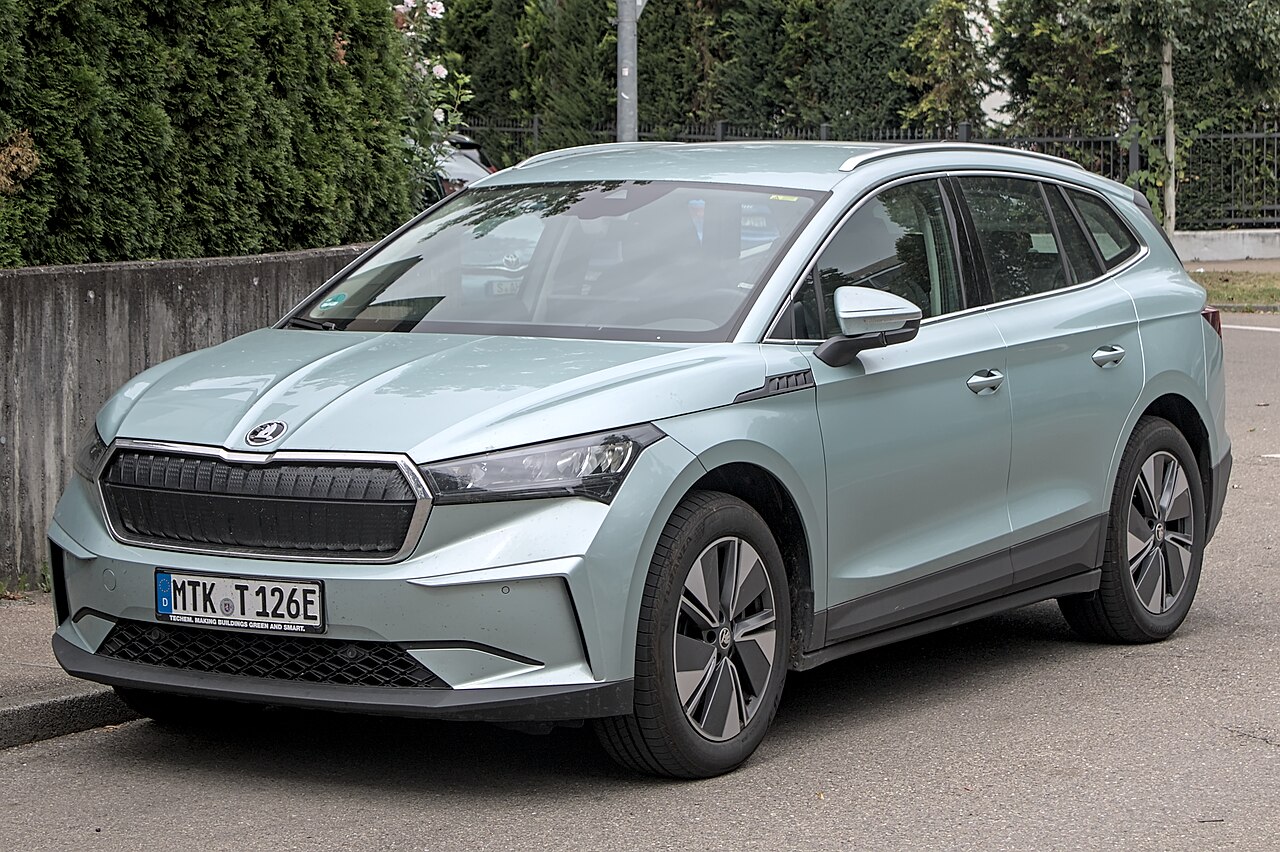 Licensed photo · Photo credit
MakeŠkoda
New registrations (EU)2020–2026
Generations and technical specifications
Škoda Enyaq2020–present
| Specification | Value |
|---|---|
| Production | November 2020–present February 2022–present (Enyaq Coupe) |
| Body styles | 5-door SUV 5-door coupé SUV (Enyaq Coupe) 5-door panel van (Enyaq Cargo) |
| Layout | 80X and RS: Dual-motor, all-wheel-drive 50, 60, 80 and 85: Rear-motor, rear-wheel drive |
| Platform | Volkswagen Group MEB |
| Electric motor | Permanent Magnet Synchronous Motor on Rear Axle 50: 109 kW 60: 132 kW 80: 150 kW 85: 210 kW Asynchronous motors (ASMs) on Front Axle and Permanent Magnet Synchronous Motor on Rear Axle 80X: 195 kW 85X: 210 kW RS (2021-2023): 225 kW RS (2024-): 250 kW |
| Battery | 80, 85, 80X and RS: 82 (77 usable) kWh lithium-ion liquid-cooled 60: 62 (58 usable) kWh lithium-ion 50: 55 (52 usable) kWh lithium-ion |
| Electric range | RS (2024-): 542 km (WLTP) 80X and RS (2021-2023): 460 km (WLTP) 85X: 539 km (WLTP) 85: 566 km (WLTP) 80: 500 km (WLTP) 60: 390 km (WLTP) 50: 340 km (WLTP) |
| Charging | 50 kW DC charging standard optional paid upgrade to 125 kW DC charging for 80, 80X and RS, 100 kW for 50 and 60; AC charging: 7.7 kW or 11 kW 3-phase (in Europe) on-board charger |
| Wheelbase | 2,765 mm |
| Length | 4,648 mm |
| Width | 1,877 mm |
| Height | 1,618 mm |
| Class | Mid-size crossover SUV (D) |
| Assembly | Czech Republic: Mladá Boleslav |
| Designer | Omer Halilhodžić, Dalibor Pantůček, Sajdin Osmančević |
EU type-approval data
| Years | Powertrain | Power | Mass | Electric range |
|---|---|---|---|---|
| 2021–2025 | Electric | 77 kW (105 PS) | 2195–2258 kg | 499–535 km · 161–174 Wh/km |
| 2022–2025 | Electric | 80 kW (109 PS) | 2193–2239 kg | 422–510 km · 171–200 Wh/km |
| 2024–2025 | Electric | 89 kW (121 PS) | 2132–2144 kg | 545–573 km · 150–157 Wh/km |
| 2020–2025 | Electric | 150 kW (204 PS) | 2090–2154 kg | 501–540 km · 157–176 Wh/km |
| 2023–2025 | Electric | 210 kW (286 PS) | 2132–2230 kg | 524–576 km · 151–164 Wh/km |
| 2023–2025 | Electric | 250 kW (340 PS) | 2235–2258 kg | 525–552 km · 160–166 Wh/km |
| 2021–2024 | Electric | 70 kW (95 PS) | 1965–2149 kg | 393–532 km · 155–170 Wh/km |
| 2021–2024 | Electric | 109 kW (148 PS) | 1940–1941 kg | 363–367 km · 158–159 Wh/km |
| 2021–2024 | Electric | 132 kW (179 PS) | 1965–1999 kg | 391–409 km · 157–163 Wh/km |
| 2021–2024 | Electric | 195 kW (265 PS) | 2193–2205 kg | 487–512 km · 161–178 Wh/km |
| 2022–2024 | Electric | 220 kW (299 PS) | 2255–2264 kg | 491–517 km · 168–177 Wh/km |
Years are registration years. Each range runs from the 10th to the 90th percentile of the values reported for new registrations; it is not an average. Mass is the mass in running order. For electric cars the power is the type-approval net power, which can be lower than the peak power in brochures.
Key specifications
| Specification | Value |
|---|---|
| Powertrains (EU) | Electric |
| Power (EU) | 70–250 kW (95–340 PS) |
| Mass in running order (EU) | 1,965–2,264 kg |
| Wheelbase (EU) | 2,770–2,772 mm |
Years and markets
| Specification | Value |
|---|---|
| New registrations (EU) | 2020–2026 |