Fortwo
smart Fortwo: official NHTSA recalls, fault code help and maintenance guides.
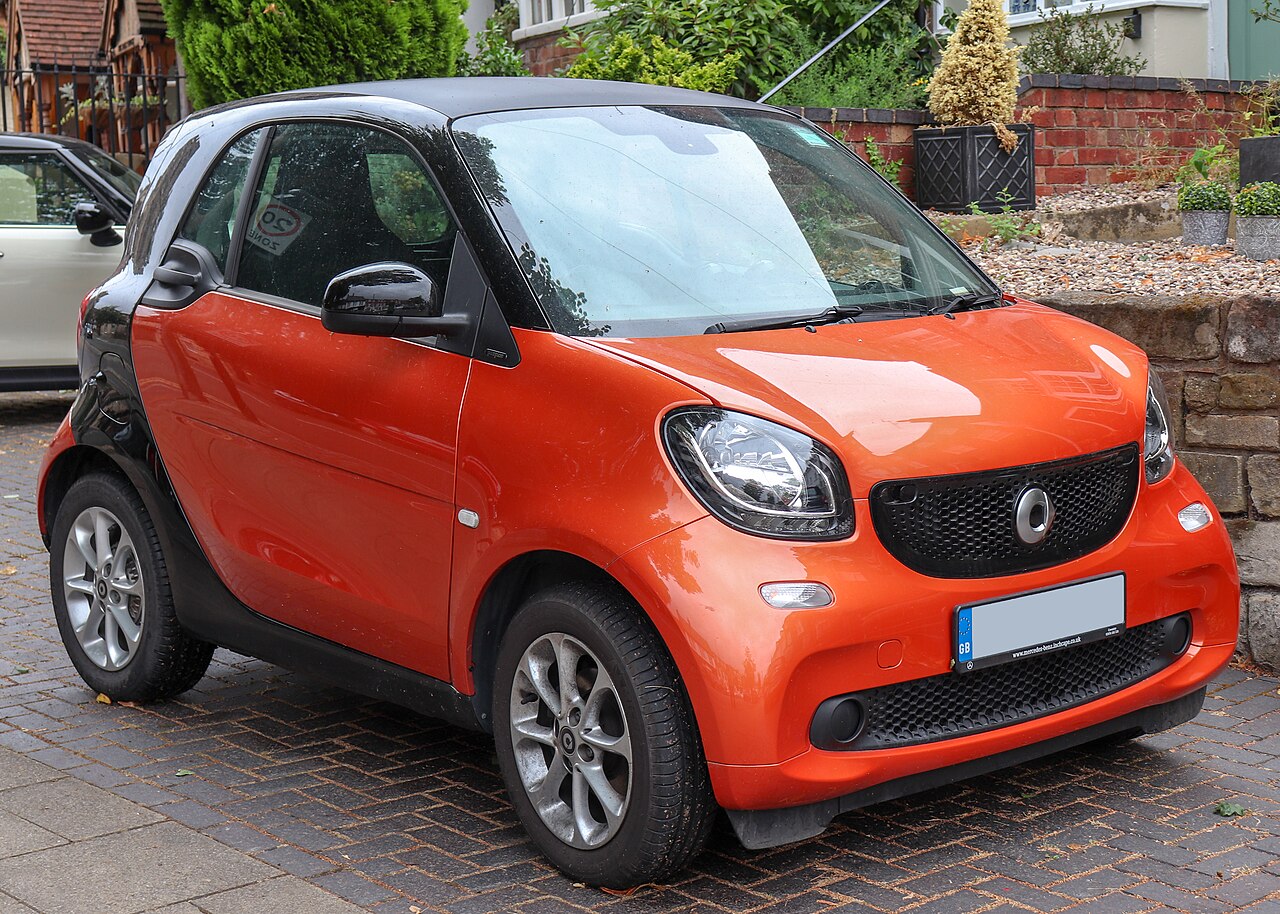 Licensed photo · Photo credit
Generations and technical specifications
Smart Fortwo2014–2024
| Specification | Value |
|---|---|
| Model code | C 453 (fortwo) / A 453 (fortwo cabrio) |
| Production | 2014–2019 2017–2024 (EQ Fortwo) |
| Body styles | 3-door hatchback 2-door cabriolet |
| Engines | 0.9 L M281 turbo I3 1.0 L M281 petrol I3 66 kW synchronous electric motor |
| Transmissions | 5-speed manual 6-speed DCT Single-speed direct drive |
| Wheelbase | 1,873 mm |
| Length | 2,695 mm |
| Width | 1,663 mm |
| Height | 1,555 mm |
| Kerb weight | 880 kg |
| Designer | Emiel Burki and Michael Gebhardt under Kai Sieber |
Smart Fortwo – Second generation2006–2014
| Specification | Value |
|---|---|
| Model code | C 451 (fortwo) / A 451 (fortwo cabrio) |
| Production | November 2006–2014 |
| Body styles | 3-door hatchback |
| Engines | 0.8 L diesel (turbo) I3 (OM660) 1.0 L petrol I3 (3B21) 1.0 L petrol (turbo) I3 (3B21T) |
| Transmissions | 5-speed automated manual |
| Wheelbase | 1,867 mm |
| Length | 2,695 mm |
| Width | 1,559 mm |
| Height | 1,542 mm |
| Kerb weight | 750–795 kg (coupe) 780–820 kg (cabrio) |
Smart Fortwo – First generation1998–2007
| Specification | Value |
|---|---|
| Model code | C 450 (Coupé) / A 450 (Cabrio) / R 450 (Crossblade) |
| Production | 1998–2007 |
| Body styles | 3-door hatchback |
| Engines | 599 cc M160 E06 turbo I3 698 cc M160 E07 turbo I3 799 cc OM660 turbodiesel I3 |
| Transmissions | 6-speed automated manual |
| Wheelbase | 1,810 mm |
| Length | 2,500 mm |
| Width | 1,510 mm K: 1,470 mm |
| Height | 1,500 mm |
| Kerb weight | 730 kg |
| Designer | Gerhard Steinle (Chief Designer) |
Engines and transmissions
| Model years | Engine | Transmission | Drive | Fuel |
|---|---|---|---|---|
| 2011, 2013–2018 | Electric motor | Single-speed | Rear-wheel drive | Electricity |
| 2016–2017 | 0.9 L, 3 cyl | 5-speed manual | Rear-wheel drive | Petrol (premium) |
| 2016–2017 | 0.9 L, 3 cyl | 6-speed automated manual | Rear-wheel drive | Petrol (premium) |
| 2009–2015 | 1.0 L, 3 cyl | 5-speed automated manual | Rear-wheel drive | Petrol (premium) |
| 2008 | 1.0 L, 3 cyl | 5-speed automatic | Rear-wheel drive | Petrol (premium) |
Fuel economy (EPA)
| Model years | Configuration | Combined | City | Highway | Electric range |
|---|---|---|---|---|---|
| 2011, 2013–2018 | Electric motor · Single-speed · Rear-wheel drive | 19.3–24.2 kWh/100 km | 16.8–22.4 kWh/100 km | 22.4–26.7 kWh/100 km | 92–109 km |
| 2016–2017 | 0.9 L, 3 cyl · 5-speed manual · Rear-wheel drive | 6.9 L/100 km | 7.6 L/100 km | 6.0–6.2 L/100 km | – |
| 2016–2017 | 0.9 L, 3 cyl · 6-speed automated manual · Rear-wheel drive | 6.7 L/100 km | 7.1 L/100 km | 6.0–6.2 L/100 km | – |
| 2009–2015 | 1.0 L, 3 cyl · 5-speed automated manual · Rear-wheel drive | 6.5 L/100 km | 6.9–7.1 L/100 km | 5.7–6.2 L/100 km | – |
| 2008 | 1.0 L, 3 cyl · 5-speed automatic · Rear-wheel drive | 6.5 L/100 km | 7.1 L/100 km | 5.7 L/100 km | – |
Values are the official EPA label figures for each model year, shown as the lowest and highest value for the configuration. Electric models show energy use per 100 km. Real-world consumption depends on driving style, weather and load. Luggage and passenger volumes follow the EPA measuring method and can differ from the VDA figures used in Europe.
EU type-approval data
| Years | Powertrain | Engine | Power | Mass | CO₂ | Electric range |
|---|---|---|---|---|---|---|
| 2017–2024 | Electric | – | 60 kW (82 PS) | 1085–1125 kg | – | 122–133 km · 161–179 Wh/km |
| 2017–2022 | Electric | – | 41 kW (56 PS) | 1085–1125 kg | – | 125–157 km · 130–191 Wh/km |
| 2015–2019 | Petrol | 898 cm³ | 66 kW (90 PS) | 940–995 kg | 134–145 g/km (WLTP) | – |
| 2016–2019 | Petrol | 898 cm³ | 80 kW (109 PS) | 995–1040 kg | 102–104 g/km (NEDC) | – |
| 2011–2019 | Petrol | 999 cm³ | 52 kW (71 PS) | 825–935 kg | 133–139 g/km (WLTP) | – |
| 2011–2017 | Petrol | 999 cm³ | 45 kW (61 PS) | 825–885 kg | 97–104 g/km (NEDC) | – |
| 2012–2016 | Electric | – | 35 kW (48 PS) | 975–995 kg | – | 144–151 Wh/km |
| 2011–2015 | Petrol | 999 cm³ | 62 kW (84 PS) | 845–875 kg | 115–120 g/km (NEDC) | – |
| 2011–2015 | Petrol | 999 cm³ | 75 kW (102 PS) | 870–895 kg | 119 g/km (NEDC) | – |
| 2011–2014 | Diesel | 799 cm³ | 40 kW (54 PS) | 845–875 kg | 86–87 g/km (NEDC) | – |
Years are registration years. Each range runs from the 10th to the 90th percentile of the values reported for new registrations; it is not an average. Mass is the mass in running order. For electric cars the power is the type-approval net power, which can be lower than the peak power in brochures.
Key specifications
| Specification | Value |
|---|---|
| EPA size class | Two-seater |
| Model years in EPA data | 2008–2018 |
| Powertrains | Electric, Petrol |
| Engine displacement | 0.9–1.0 L |
| Cylinders | 3 |
| Transmission types | Single-speed, Automated manual, Manual, Automatic |
| Drive | Rear-wheel drive |
| Fuel | Electricity, Petrol (premium) |
| Configurations listed | 36 |
| Forced induction | Turbocharged (on some versions) |
| Electric motor (EPA) | 55 kW DCPM; 30 kW DCPM |
| Electric range (EPA) | 92–109 km |
| Powertrains (EU) | Petrol, Diesel, Electric |
| Engine displacement (EU) | 799–999 cm³ |
| Power (EU) | 40–66 kW (54–90 PS) |
| Mass in running order (EU) | 825–1,125 kg |
| Wheelbase (EU) | 1,867–1,873 mm |
Years and markets
| Specification | Value |
|---|---|
| Model years (US) | 2008–2026 |
| New registrations (EU) | 2000, 2002–2025 |
Owner complaints (NHTSA)
| Component | Complaints | Most reported model years |
|---|---|---|
| Engine and cooling | 83 | 2008, 2009, 2011 |
| Transmission and drivetrain | 65 | 2008, 2009, 2011 |
| Electrical system | 46 | 2008, 2009, 2011 |
| Seat belts | 23 | 2008, 2009, 2011 |
| Fuel and propulsion | 22 | 2008, 2009, 2010 |
| Body and structure | 21 | 2008, 2009, 2010 |
| Brakes | 14 | 2008, 2009, 2011 |
| Airbags | 12 | 2008, 2009, 2012 |
| Visibility and wipers | 7 | 2008, 2009, 2010 |
| Wheels | 7 | 2008, 2009, 2017 |
Source: complaints filed by owners with the U.S. National Highway Traffic Safety Administration (NHTSA) for model years 2008–2012, 2017, 2019: 280 complaints, 14 with a crash and 40 with a fire. Complaints are owner reports that NHTSA has not verified, and one complaint can name more than one component. More complaints can also mean more cars sold.