S70
Volvo S70: official NHTSA recalls, fault code help and maintenance guides.
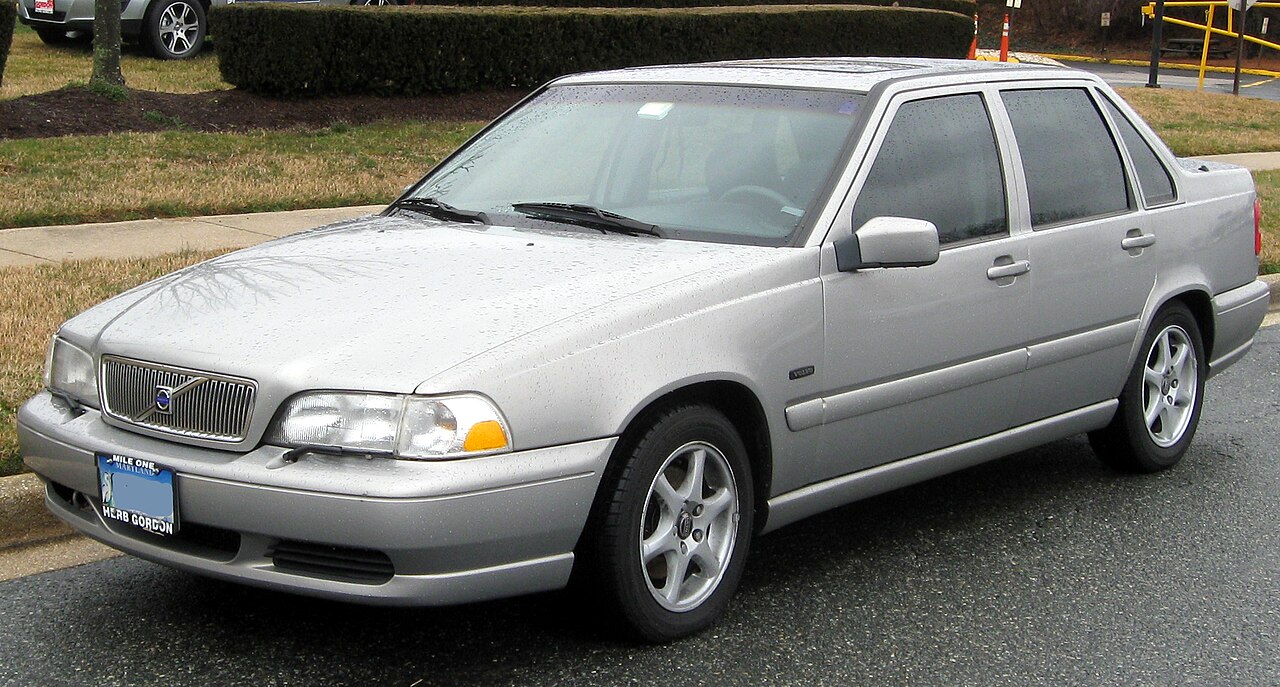 Licensed photo · Photo credit
Generations and technical specifications
Volvo S701996–2000
| Specification | Value |
|---|---|
| Production | 1996–2000 (243,078 units) |
| Model years | 1997–2000 |
| Body styles | 4-door saloon |
| Layout | Transverse Front engine front-wheel drive or four-wheel drive |
| Platform | Volvo P80 platform |
| Engines | 2.0 L I5 (petrol) 2.3 L I5 (petrol) 2.4 L I5 (petrol) 2.4 L I5 turbo (petrol) 2.4 L B5244SG I5 (Bi-Fuel) 2.5 L I5 (petrol) 2.5 L I5 turbo (petrol) 2.5 L Volvo D5252T I5 (diesel) |
| Transmissions | 5-speed Volvo M56 manual 5-speed Volvo M58 manual 5-speed Volvo M59 manual 4-speed Aisin AW50-42LE automatic 5-speed Aisin AW55-50/51SN automatic |
| Wheelbase | FWD: 2,664 mm AWD: 2,654 mm |
| Length | 4,722 mm |
| Width | 1,760 mm |
| Height | FWD: 1,402 mm AWD: 1,448 mm |
| Kerb weight | FWD: 1,428–1,510 kg AWD: 1,600–1,635 kg |
| Class | Compact executive car (D) |
| Assembly | Sweden: Torslanda (Torslandaverken) Belgium: Ghent (VCG) Canada: Halifax (VHA) |
| Designer | Peter Horbury (exterior) José Luis Diaz de la Vega (interior) |
Engines and transmissions
| Model years | Engine | Transmission | Drive | Fuel |
|---|---|---|---|---|
| 2000 | 2.3 L, 5 cyl | 4-speed automatic | Front-wheel drive | Petrol (premium) |
| 2000 | 2.3 L, 5 cyl | 5-speed manual | Front-wheel drive | Petrol (premium) |
| 2000 | 2.4 L, 5 cyl | 4-speed automatic | Four-wheel or all-wheel drive | Petrol (premium) |
| 2000 | 2.4 L, 5 cyl | 4-speed automatic | Front-wheel drive | Petrol (premium) |
| 2000 | 2.4 L, 5 cyl | 5-speed automatic | Front-wheel drive | Petrol (premium) |
| 2000 | 2.4 L, 5 cyl | 5-speed manual | Front-wheel drive | Petrol (premium) |
Fuel economy (EPA)
| Model years | Configuration | Combined | City | Highway |
|---|---|---|---|---|
| 2000 | 2.3 L, 5 cyl · 4-speed automatic · Front-wheel drive | 11.8 L/100 km | 13.8 L/100 km | 9.4 L/100 km |
| 2000 | 2.3 L, 5 cyl · 5-speed manual · Front-wheel drive | 11.2 L/100 km | 13.1 L/100 km | 9.4 L/100 km |
| 2000 | 2.4 L, 5 cyl · 4-speed automatic · Four-wheel or all-wheel drive | 12.4 L/100 km | 14.7 L/100 km | 10.2 L/100 km |
| 2000 | 2.4 L, 5 cyl · 4-speed automatic · Front-wheel drive | 11.8 L/100 km | 13.8 L/100 km | 9.8 L/100 km |
| 2000 | 2.4 L, 5 cyl · 5-speed automatic · Front-wheel drive | 11.2 L/100 km | 13.1 L/100 km | 9.0 L/100 km |
| 2000 | 2.4 L, 5 cyl · 5-speed manual · Front-wheel drive | 10.7 L/100 km | 12.4 L/100 km | 9.0 L/100 km |
Values are the official EPA label figures for each model year, shown as the lowest and highest value for the configuration. Electric models show energy use per 100 km. Real-world consumption depends on driving style, weather and load. Luggage and passenger volumes follow the EPA measuring method and can differ from the VDA figures used in Europe.
Key specifications
| Specification | Value |
|---|---|
| EPA size class | Midsize car |
| Model years in EPA data | 2000 |
| Powertrains | Petrol |
| Engine displacement | 2.3–2.4 L |
| Cylinders | 5 |
| Transmission types | Automatic, Manual |
| Drive | Front-wheel drive, Four-wheel or all-wheel drive |
| Fuel | Petrol (premium) |
| Configurations listed | 6 |
| Forced induction | Turbocharged (on some versions) |
| Luggage volume (EPA) | 425 L |
| Passenger volume (EPA) | 2,775 L |
Years and markets
| Specification | Value |
|---|---|
| Model years (US) | 2000 |
| New registrations (EU) | 2000–2002, 2005, 2007–2008, 2010–2012 |
Owner complaints (NHTSA)
| Component | Complaints | Most reported model years |
|---|---|---|
| Speed control and cruise | 74 | 2000 |
| Electrical system | 37 | 2000 |
| Engine and cooling | 27 | 2000 |
| Fuel and propulsion | 20 | 2000 |
| Transmission and drivetrain | 8 | 2000 |
| Brakes | 7 | 2000 |
| Seat belts | 6 | 2000 |
| Airbags | 6 | 2000 |
| Lights | 6 | 2000 |
| Steering | 5 | 2000 |
Source: complaints filed by owners with the U.S. National Highway Traffic Safety Administration (NHTSA) for model years 2000: 188 complaints, 10 with a crash and 1 with a fire. Complaints are owner reports that NHTSA has not verified, and one complaint can name more than one component. More complaints can also mean more cars sold.