X4
BMW X4: official NHTSA recalls, fault code help and maintenance guides.
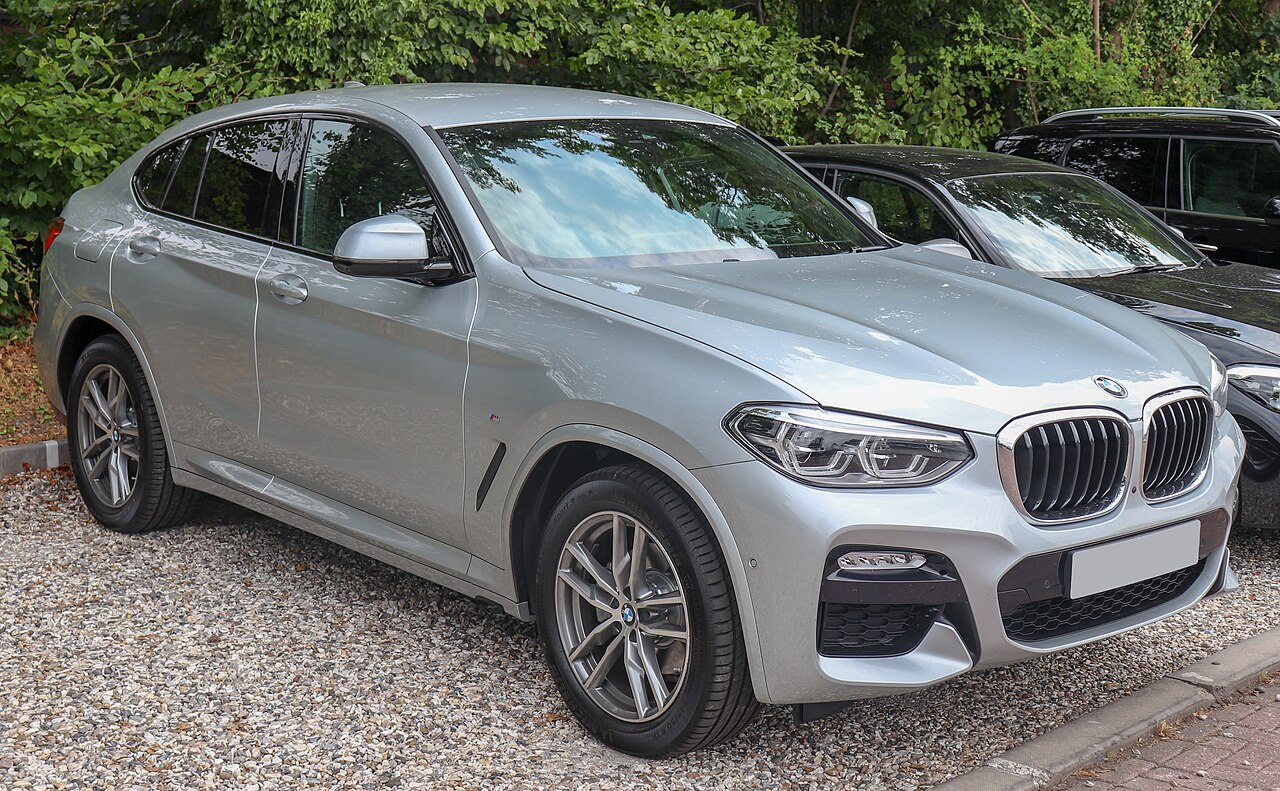 Licensed photo · Photo credit
Generations and technical specifications
BMW X4 – Second generation2018–2025
| Specification | Value |
|---|---|
| Model code | G02 / F98 (X4 M) |
| Production | March 2018 – November 2025 |
| Platform | BMW CLAR platform |
| Engines | Petrol 2.0 L B48 I4 turbo 3.0 L B58 I6 turbo/twin-turbo Diesel 2.0 L B47 I4 turbo 3.0 L B57 I6 turbo/twin turbo |
| Transmissions | 8-speed ZF 8HP automatic |
| Drivetrain | Mild hybrid |
| Wheelbase | 2,864 mm |
| Length | 4,752 mm |
| Height | 1,621 mm |
| Kerb weight | 1,715–1,895 kg |
| Assembly | United States: Greer, South Carolina (Plant Spartanburg) Brazil: Araquari, Santa Catarina (BMW do Brasil) Thailand: Rayong (BMW Thailand) India: Chennai (BMW India) Russia: Kaliningrad (Avtotor) Malaysia: Kulim (Inokom) |
| Designer | Alexander Schneider |
BMW X4 – First generation2014–2018
| Specification | Value |
|---|---|
| Model code | F26 |
| Production | July 2014 – March 2018 |
| Platform | BMW L7 |
| Engines | Petrol 2.0 L N20 I4 turbo 3.0 L N55 I6 turbo Diesel 2.0 L B47 I4 turbo 3.0 L N57 I6 turbo/twin-turbo |
| Transmissions | 6-speed manual 8-speed ZF 8HP automatic |
| Wheelbase | 2,810 mm |
| Length | 4,671 mm |
| Width | 1,881 mm |
| Height | 1,624 mm |
| Kerb weight | 1,735–1,860 kg |
| Assembly | United States: Greer, South Carolina (Plant Spartanburg) Brazil: Araquari Thailand: Rayong (BMW Thailand) Malaysia: Kulim, Kedah (Inokom) Russia: Kaliningrad (Avtotor) Egypt: 6th of October City (BAG) |
| Designer | Christoph Nordmann |
Engines and transmissions
| Model years | Engine | Transmission | Drive | Fuel |
|---|---|---|---|---|
| 2015–2025 | 2.0 L, 4 cyl | 8-speed automatic | All-wheel drive | Petrol (premium) |
| 2015–2025 | 3.0 L, 6 cyl | 8-speed automatic | All-wheel drive | Petrol (premium) |
| 2022–2025 | 3.0 L, 6 cyl mild hybrid | 8-speed automatic | All-wheel drive | Petrol (premium) |
Fuel economy (EPA)
| Model years | Configuration | Combined | City | Highway |
|---|---|---|---|---|
| 2015–2025 | 2.0 L, 4 cyl · 8-speed automatic · All-wheel drive | 9.4–10.2 L/100 km | 10.2–11.8 L/100 km | 8.1–8.7 L/100 km |
| 2015–2025 | 3.0 L, 6 cyl · 8-speed automatic · All-wheel drive | 10.2–14.7 L/100 km | 11.2–16.8 L/100 km | 8.7–12.4 L/100 km |
| 2022–2025 | 3.0 L, 6 cyl mild hybrid · 8-speed automatic · All-wheel drive | 10.2 L/100 km | 10.7–11.2 L/100 km | 9.0 L/100 km |
Values are the official EPA label figures for each model year, shown as the lowest and highest value for the configuration. Electric models show energy use per 100 km. Real-world consumption depends on driving style, weather and load. Luggage and passenger volumes follow the EPA measuring method and can differ from the VDA figures used in Europe.
EU type-approval data
| Years | Powertrain | Engine | Power | Mass | CO₂ |
|---|---|---|---|---|---|
| 2019–2025 | Petrol | 2993 cm³ | 375 kW (510 PS) | 2045–2085 kg | 245–262 g/km (WLTP) |
| 2021–2025 | Petrol hybrid | 1998 cm³ | 135 kW (184 PS) | 1875 kg | 168–175 g/km (WLTP) |
| 2021–2025 | Petrol hybrid | 1998 cm³ | 180 kW (245 PS) | 1890 kg | 170–187 g/km (WLTP) |
| 2021, 2023–2025 | Petrol hybrid | 2998 cm³ | 265 kW (360 PS) | 1995 kg | 198–208 g/km (WLTP) |
| 2020–2021, 2023–2025 | Diesel hybrid | 1995 cm³ | 140 kW (190 PS) | 1915–1945 kg | 152–161 g/km (WLTP) |
| 2020–2021, 2023–2025 | Diesel hybrid | 2993 cm³ | 210 kW (286 PS) | 2005–2010 kg | 162–178 g/km (WLTP) |
| 2020–2021, 2023–2025 | Diesel hybrid | 2993 cm³ | 250 kW (340 PS) | 2095 kg | 174–194 g/km (WLTP) |
| 2018–2021, 2023–2024 | Petrol | 1998 cm³ | 135 kW (184 PS) | 1795–1875 kg | 175–215 g/km (WLTP) |
| 2014–2020 | Diesel | 1995 cm³ | 120 kW (163 PS) | 1815–1845 kg | 165–187 g/km (WLTP) |
| 2014–2020 | Diesel | 1995 cm³ | 140 kW (190 PS) | 1815–1845 kg | 164–186 g/km (WLTP) |
| 2018–2020 | Diesel | 1995 cm³ | 170 kW (231 PS) | 1830 kg | 186–189 g/km (WLTP) |
| 2018–2020 | Diesel | 2993 cm³ | 195 kW (265 PS) | 1895–1935 kg | 184–195 g/km (WLTP) |
| 2018–2020 | Diesel | 2993 cm³ | 240 kW (326 PS) | 1970 kg | 192–203 g/km (WLTP) |
| 2014–2018 | Petrol | 1997 cm³ | 135 kW (184 PS) | 1740–1815 kg | 168–171 g/km (NEDC) |
| 2014–2018 | Petrol | 1997 cm³ | 180 kW (245 PS) | 1845 kg | 169–172 g/km (NEDC) |
| 2014–2018 | Petrol | 2979 cm³ | 225 kW (306 PS) | 1890–1895 kg | 193 g/km (NEDC) |
| 2016–2018 | Petrol | 2979 cm³ | 265 kW (360 PS) | 1915–1920 kg | 180–296 g/km (WLTP) |
| 2014–2018 | Diesel | 2993 cm³ | 190 kW (258 PS) | 1895–1900 kg | 156–159 g/km (NEDC) |
| 2014–2018 | Diesel | 2993 cm³ | 230 kW (313 PS) | 1935–1940 kg | 157 g/km (NEDC) |
| 2017 | Diesel | 1995 cm³ | 210 kW (286 PS) | 1920 kg | 136 g/km (NEDC) |
Years are registration years. Each range runs from the 10th to the 90th percentile of the values reported for new registrations; it is not an average. Mass is the mass in running order. For electric cars the power is the type-approval net power, which can be lower than the peak power in brochures.
Key specifications
| Specification | Value |
|---|---|
| EPA size class | Small SUV |
| Model years in EPA data | 2015–2025 |
| Powertrains | Petrol, Mild hybrid |
| Engine displacement | 2.0–3.0 L |
| Cylinders | 4, 6 |
| Transmission types | Automatic |
| Drive | All-wheel drive |
| Fuel | Petrol (premium) |
| Configurations listed | 35 |
| Forced induction | Turbocharged |
| Start-stop system | Yes |
| Powertrains (EU) | Petrol, Diesel, Diesel hybrid |
| Engine displacement (EU) | 1,995–2,993 cm³ |
| Power (EU) | 120–375 kW (163–510 PS) |
| Mass in running order (EU) | 1,740–2,085 kg |
| Wheelbase (EU) | 2,810–2,864 mm |
Years and markets
| Specification | Value |
|---|---|
| Model years (US) | 2015–2025 |
| New registrations (EU) | 2014–2026 |
Owner complaints (NHTSA)
| Component | Complaints | Most reported model years |
|---|---|---|
| Electrical system | 24 | 2016, 2018, 2020 |
| Engine and cooling | 23 | 2016, 2018, 2019 |
| Brakes | 10 | 2017, 2019, 2022 |
| Transmission and drivetrain | 10 | 2016, 2017, 2019 |
| Suspension | 6 | 2016, 2020, 2021 |
| Airbags | 5 | 2016, 2020, 2023 |
| Driver assistance | 5 | 2019, 2020, 2023 |
| Seat belts | 4 | 2020, 2021 |
| Fuel and propulsion | 3 | 2016, 2019, 2024 |
| Steering | 3 | 2017, 2019, 2020 |
Source: complaints filed by owners with the U.S. National Highway Traffic Safety Administration (NHTSA) for model years 2016–2025: 75 complaints, 7 with a crash and 3 with a fire. Complaints are owner reports that NHTSA has not verified, and one complaint can name more than one component. More complaints can also mean more cars sold.