Chevrolet
Captiva
Chevrolet Captiva: official NHTSA recalls, fault code help and maintenance guides.
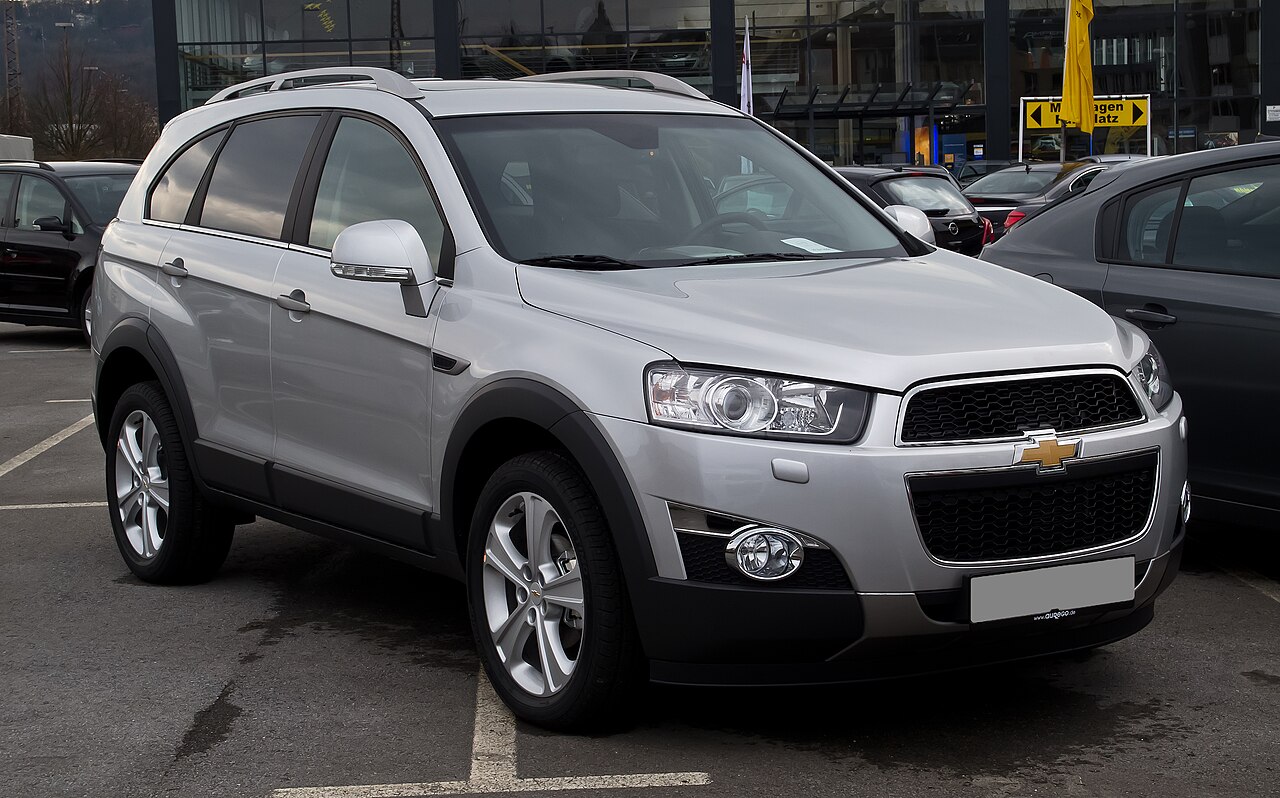 Licensed photo · Photo credit
MakeChevrolet
ClassSmall SUV
Model years (US)2012–2015
New registrations (EU)2006–2018, 2022–2023
Recall dataNHTSA (United States)
Generations and technical specifications
Chevrolet Captiva – First generation (C100/C140)2006–2018
| Specification | Value |
|---|---|
| Production | 2006–2018 |
| Layout | Front-engine, front-wheel-drive or four-wheel-drive |
| Platform | GM Theta platform |
| Engines | Petrol 2.4 L Ecotec I4 2.4 L Family II I4 3.0 L SIDI V6 3.2 L Alloytec V6 Diesel 2.0 L Fiat Family B VCDi turbo I4 2.0 L VM Motori RA 420 VCDi turbo I4 2.2 L GM Family Z VCDi turbo I4 |
| Transmissions | 5-speed automatic 5-speed manual 6-speed automatic 6-speed manual |
| Wheelbase | 2,707 mm |
| Length | 4,637 mm |
| Width | 1,849 mm |
| Height | 1,720 mm |
| Assembly | South Korea: Bupyeong-gu, Incheon (GM Korea) Thailand: Rayong (GM Thailand) China: Shenyang (SAIC-GM) Vietnam: Hanoi (GM Vietnam) India: Halol, Gujarat (GM India) Russia: Kaliningrad (Avtotor) Kazakhstan: Oskemen/Ust-Kamenogorsk Uzbekistan: Asaka (GM Uzbekistan) Egypt: 6th of October City (GM Egypt) |
Engines and transmissions
| Model years | Engine | Transmission | Drive | Fuel |
|---|---|---|---|---|
| 2013–2015 | 2.4 L, 4 cyl | 6-speed automatic | Front-wheel drive | Petrol or E85 (flex-fuel) |
| 2013–2014 | 3.0 L, 6 cyl | 6-speed automatic | All-wheel drive | Petrol or E85 (flex-fuel) |
| 2013–2014 | 3.0 L, 6 cyl | 6-speed automatic | Front-wheel drive | Petrol or E85 (flex-fuel) |
| 2012 | 2.4 L, 4 cyl | 6-speed automatic | Front-wheel drive | Petrol (regular) |
| 2012 | 3.0 L, 6 cyl | 6-speed automatic | All-wheel drive | Petrol (regular) |
| 2012 | 3.0 L, 6 cyl | 6-speed automatic | Front-wheel drive | Petrol (regular) |
Fuel economy (EPA)
| Model years | Configuration | Combined | City | Highway |
|---|---|---|---|---|
| 2012–2015 | 2.4 L, 4 cyl · 6-speed automatic · Front-wheel drive | 10.2 L/100 km | 11.8 L/100 km | 8.4 L/100 km |
| 2012–2014 | 3.0 L, 6 cyl · 6-speed automatic · All-wheel drive | 13.1 L/100 km | 14.7 L/100 km | 10.7 L/100 km |
| 2012–2014 | 3.0 L, 6 cyl · 6-speed automatic · Front-wheel drive | 12.4 L/100 km | 13.8 L/100 km | 9.8 L/100 km |
Values are the official EPA label figures for each model year, shown as the lowest and highest value for the configuration. Electric models show energy use per 100 km. Real-world consumption depends on driving style, weather and load. Luggage and passenger volumes follow the EPA measuring method and can differ from the VDA figures used in Europe.
EU type-approval data
| Years | Powertrain | Engine | Power | Mass | CO₂ |
|---|---|---|---|---|---|
| 2011–2014 | Petrol | 2384 cm³ | 123 kW (167 PS) | 1833–1933 kg | 210–219 g/km (NEDC) |
| 2011–2014 | Diesel | 2231 cm³ | 120 kW (163 PS) | 1903–1958 kg | 164–170 g/km (NEDC) |
| 2011–2014 | Diesel | 2231 cm³ | 135 kW (184 PS) | 1993–2058 kg | 170–208 g/km (NEDC) |
| 2010–2011 | Petrol | 2405 cm³ | – | 1730–1845 kg | 217–221 g/km (NEDC) |
| 2011 | Diesel | 1991 cm³ | 93 kW (126 PS) | 1855–1890 kg | 190 g/km (NEDC) |
| 2011 | Diesel | 1991 cm³ | 110 kW (150 PS) | 1890–1980 kg | 191–233 g/km (NEDC) |
| 2010 | LPG (bi-fuel) | 2405 cm³ | – | 1805–1880 kg | 204 g/km (NEDC) |
Years are registration years. Each range runs from the 10th to the 90th percentile of the values reported for new registrations; it is not an average. Mass is the mass in running order. For electric cars the power is the type-approval net power, which can be lower than the peak power in brochures.
Key specifications
| Specification | Value |
|---|---|
| EPA size class | Small SUV, SUV |
| Model years in EPA data | 2012–2015 |
| Powertrains | Flex-fuel, Petrol |
| Engine displacement | 2.4–3.0 L |
| Cylinders | 4, 6 |
| Transmission types | Automatic |
| Drive | Front-wheel drive, All-wheel drive |
| Fuel | Petrol or E85 (flex-fuel), Petrol (regular) |
| Configurations listed | 10 |
| Luggage volume (EPA) | 283 L |
| Passenger volume (EPA) | 2,662 L |
| Powertrains (EU) | Petrol, Diesel |
| Engine displacement (EU) | 2,231–2,405 cm³ |
| Power (EU) | 120–135 kW (163–184 PS) |
| Mass in running order (EU) | 1,730–2,058 kg |
| Wheelbase (EU) | 2,705–2,707 mm |
Years and markets
| Specification | Value |
|---|---|
| Model years (US) | 2012–2015 |
| New registrations (EU) | 2006–2018, 2022–2023 |