XJ
Jaguar XJ: official NHTSA recalls, fault code help and maintenance guides.
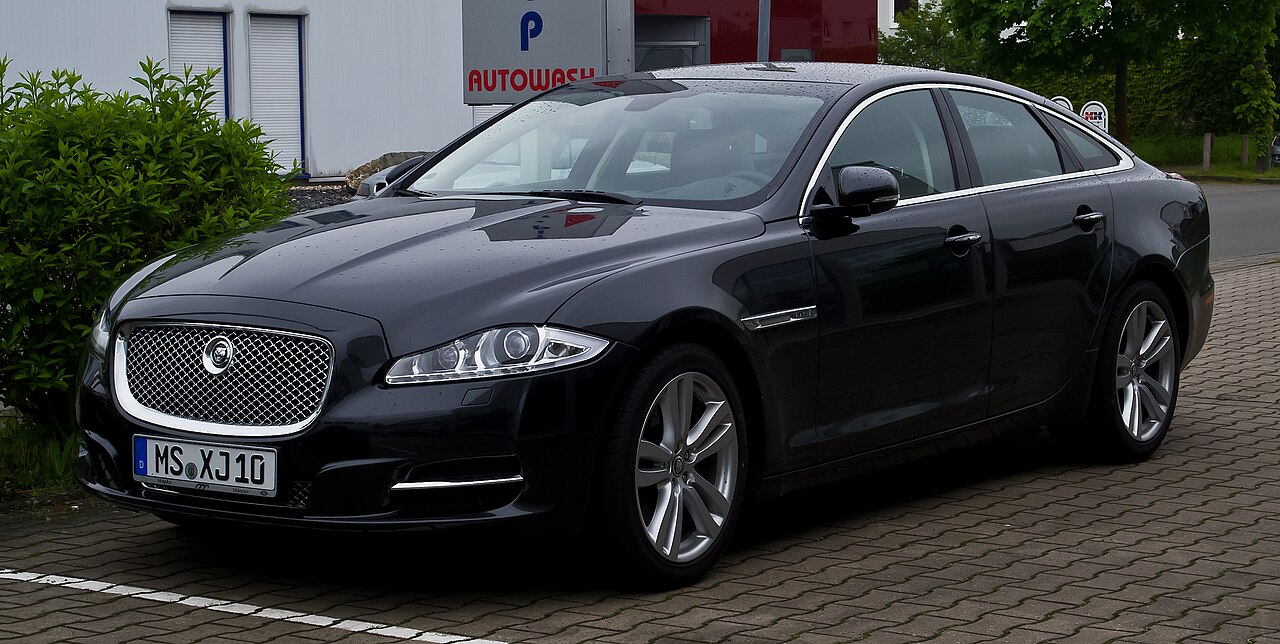 Licensed photo · Photo credit
Generations and technical specifications
Jaguar XJ (X351)2009–2019
| Specification | Value |
|---|---|
| Model code | X351 |
| Production | September 2009 – July 2019 |
| Model years | 2010–2019 |
| Body styles | 4-door saloon |
| Layout | Front-engine, rear-wheel-drive / all-wheel-drive |
| Platform | JLR D2a |
| Engines | Petrol 3.0 L supercharged AJ V6 5.0 L AJ Gen III V8 5.0 L AJ Gen III supercharged V8 Diesel 3.0 L Ford AJD twin-turbocharged V6 |
| Transmissions | 6-speed automatic 8-speed automatic (2013 onwards) |
| Wheelbase | XJ: 3,032 mm XJ-L: 3,157 mm |
| Length | XJ: 5,130 mm XJ-L: 5,255 mm |
| Width | 1,899 mm With mirrors: 2,110 mm |
| Height | 1,461 mm |
| Kerb weight | XJ Diesel: 1,796 kg Petrol: 1,755 kg Supercharged: 1,892 kg XJ-L Diesel: 1,813 kg Petrol: 1,773 kg Supercharged: 1,915 kg |
| Class | Full-size luxury car (F) |
| Assembly | United Kingdom: Birmingham (Castle Bromwich Assembly) India: Pune (JLR India) |
| Designer | Ian Callum (design director: 2005–2008) Giles Taylor (2006, 2008) |
Jaguar XJ (X350)2002–2009
| Specification | Value |
|---|---|
| Model code | X350 (2002–2005) / X356 (2005–2008) / X358 (2008–2009) |
| Production | September 2002 – March 2009 83,556 produced |
| Model years | 2003–2009 |
| Body styles | 4-door saloon |
| Layout | Front-engine, rear-wheel-drive |
| Engines | Petrol 3.0 L AJ30 V6 3.5 L AJ-V8 V8 4.2 L AJ34 V8 4.2 L AJ34S supercharged V8 Diesel 2.7 L Ford AJD V6 |
| Transmissions | 6-speed 6HP26 automatic |
| Wheelbase | SWB: 3,033 mm LWB: 3,160 mm |
| Length | SWB: 5,090 mm LWB: 5,215 mm |
| Width | 2004–2005: 1,859 mm |
| Height | SWB: 1,448 mm LWB: 1,455 mm |
| Kerb weight | 1,790 kg |
| Class | Full-size luxury car (F) |
| Assembly | United Kingdom: Coventry (Browns Lane Assembly); Birmingham (Castle Bromwich Assembly) |
| Designer | Exterior Tom Owen with Sandy Boyes (1998, 1999) Interior Giles Taylor Geoff Lawson (design director, 1997–1999) |
Jaguar XJ (X308)1997–2003
| Specification | Value |
|---|---|
| Model code | X308 |
| Production | July 1997 – December 2002 |
| Model years | 1998–2003 |
| Body styles | 4-door saloon |
| Layout | Front-engine, rear-wheel-drive |
| Engines | 3.2 L Jaguar AJ-V8 4.0 L Jaguar AJ-V8 4.0 L supercharged Jaguar AJ-V8 |
| Transmissions | 5-speed ZF 5HP24 automatic 5-speed Mercedes-Benz W5A580 automatic (supercharged models only) |
| Wheelbase | SWB: 2,870 mm LWB: 2,995 mm |
| Length | SWB: 5,024 mm LWB: 5,149 mm |
| Width | 1,799 mm |
| Height | SWB: 1,314 mm LWB: 1,333 mm |
| Kerb weight | SWB: 1,800 kg LWB: 1,875 kg |
| Class | Full-size luxury car (F) |
| Assembly | United Kingdom: Coventry, England |
| Designer | Geoff Lawson (1995) |
Engines and transmissions
| Model years | Engine | Transmission | Drive | Fuel |
|---|---|---|---|---|
| 2013–2019 | 3.0 L, 6 cyl | 8-speed automatic | All-wheel drive | Petrol (premium) |
| 2013, 2016–2019 | 3.0 L, 6 cyl | 8-speed automatic | Rear-wheel drive | Petrol (premium) |
| 2013–2019 | 5.0 L, 8 cyl | 8-speed automatic | Rear-wheel drive | Petrol (premium) |
| 2014–2015 | 3.0 L, 6 cyl | 8-speed automatic | Rear-wheel drive | Petrol (premium) or E85 |
| 2013–2015 | 5.0 L, 8 cyl | 8-speed automatic | Rear-wheel drive | Petrol (premium) or E85 |
| 2010–2012 | 5.0 L, 8 cyl | 6-speed automatic | Rear-wheel drive | Petrol (premium) |
| 2009 | 4.2 L, 8 cyl | 6-speed automatic | Rear-wheel drive | Petrol (premium) |
| 2002–2003 | 4.0 L, 8 cyl | 5-speed automatic | Rear-wheel drive | Petrol (premium) |
Fuel economy (EPA)
| Model years | Configuration | Combined | City | Highway |
|---|---|---|---|---|
| 2013–2019 | 3.0 L, 6 cyl · 8-speed automatic · All-wheel drive | 11.8–12.4 L/100 km | 13.8–14.7 L/100 km | 9.0–9.8 L/100 km |
| 2013–2019 | 3.0 L, 6 cyl · 8-speed automatic · Rear-wheel drive | 11.2–11.8 L/100 km | 13.1–13.8 L/100 km | 8.7 L/100 km |
| 2013–2019 | 5.0 L, 8 cyl · 8-speed automatic · Rear-wheel drive | 12.4–13.1 L/100 km | 14.7–15.7 L/100 km | 9.8–10.2 L/100 km |
| 2010–2012 | 5.0 L, 8 cyl · 6-speed automatic · Rear-wheel drive | 12.4–13.8 L/100 km | 14.7–15.7 L/100 km | 10.2–11.2 L/100 km |
| 2009 | 4.2 L, 8 cyl · 6-speed automatic · Rear-wheel drive | 12.4 L/100 km | 14.7 L/100 km | 9.4 L/100 km |
| 2002–2003 | 4.0 L, 8 cyl · 5-speed automatic · Rear-wheel drive | 13.1 L/100 km | 15.7 L/100 km | 10.7 L/100 km |
Values are the official EPA label figures for each model year, shown as the lowest and highest value for the configuration. Electric models show energy use per 100 km. Real-world consumption depends on driving style, weather and load. Luggage and passenger volumes follow the EPA measuring method and can differ from the VDA figures used in Europe.
EU type-approval data
| Years | Powertrain | Engine | Power | Mass | CO₂ |
|---|---|---|---|---|---|
| 2015–2020 | Diesel | 2993 cm³ | 221 kW (300 PS) | 1901–1976 kg | 197–209 g/km (WLTP) |
| 2013–2018 | Petrol | 2995 cm³ | 250 kW (340 PS) | 1908–2025 kg | 224–234 g/km (NEDC) |
| 2012–2017 | Petrol | 1999 cm³ | 177 kW (241 PS) | 1729–1865 kg | 199–216 g/km (NEDC) |
| 2011–2016 | Diesel | 2993 cm³ | 202 kW (275 PS) | 1878–2015 kg | 159–184 g/km (NEDC) |
| 2011–2014 | Petrol | 5000 cm³ | 283 kW (385 PS) | 1813–1969 kg | 264 g/km (NEDC) |
| 2010–2012 | Diesel | 2997 cm³ | – | 1929 kg | 184 g/km (NEDC) |
Years are registration years. Each range runs from the 10th to the 90th percentile of the values reported for new registrations; it is not an average. Mass is the mass in running order. For electric cars the power is the type-approval net power, which can be lower than the peak power in brochures.
Key specifications
| Specification | Value |
|---|---|
| EPA size class | Large car, Compact car |
| Model years in EPA data | 2002–2003, 2009–2019 |
| Powertrains | Petrol, Flex-fuel |
| Engine displacement | 3.0–5.0 L |
| Cylinders | 6, 8 |
| Transmission types | Automatic |
| Drive | Rear-wheel drive, All-wheel drive |
| Fuel | Petrol (premium), Petrol (premium) or E85 |
| Configurations listed | 42 |
| Forced induction | Supercharged (on some versions) |
| Start-stop system | On some versions |
| Luggage volume (EPA) | 368–510 L |
| Passenger volume (EPA) | 2,633–3,087 L |
| Powertrains (EU) | Petrol, Diesel |
| Engine displacement (EU) | 1,999–5,000 cm³ |
| Power (EU) | 177–283 kW (241–385 PS) |
| Mass in running order (EU) | 1,729–2,025 kg |
| Wheelbase (EU) | 3,030–3,157 mm |
Years and markets
| Specification | Value |
|---|---|
| Model years (US) | 2000–2019 |
| New registrations (EU) | 2000–2021, 2023 |
Owner complaints (NHTSA)
| Component | Complaints | Most reported model years |
|---|---|---|
| Engine and cooling | 27 | 2005, 2006, 2011 |
| Transmission and drivetrain | 22 | 2005, 2006, 2007 |
| Brakes | 22 | 2005, 2006, 2007 |
| Speed control and cruise | 21 | 2000, 2005, 2006 |
| Fuel and propulsion | 17 | 2006, 2007, 2011 |
| Electrical system | 14 | 2005, 2007, 2011 |
| Airbags | 13 | 2005, 2006, 2011 |
| Tyres | 11 | 2005, 2006, 2007 |
| Visibility and wipers | 8 | 2000, 2005, 2006 |
| Suspension | 8 | 2005, 2006, 2007 |
Source: complaints filed by owners with the U.S. National Highway Traffic Safety Administration (NHTSA) for model years 2000, 2005–2008, 2011, 2019: 147 complaints, 16 with a crash and 2 with a fire. Complaints are owner reports that NHTSA has not verified, and one complaint can name more than one component. More complaints can also mean more cars sold.