CX-30
Mazda CX-30: official NHTSA recalls, fault code help and maintenance guides.
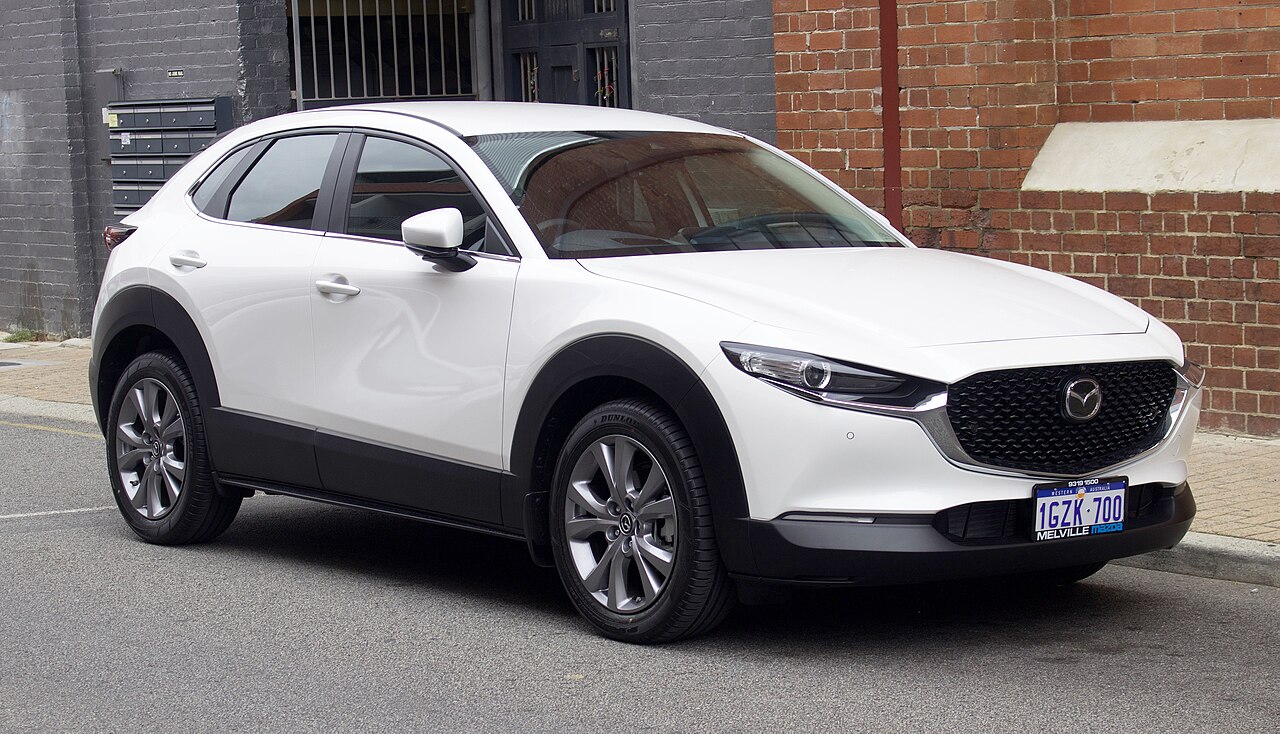 Licensed photo · Photo credit
Generations and technical specifications
Mazda CX-302019–present
| Specification | Value |
|---|---|
| Model code | DM |
| Production | 2019–present |
| Model years | 2020–present |
| Body styles | 5-door SUV |
| Layout | Front-engine, front-wheel-drive Front-engine, four-wheel-drive |
| Platform | Small Product Group |
| Engines | Gasoline 2.0 L Skyactiv-G PE-VPS I4 2.5 L Skyactiv-G PY-VPS I4 2.5 L Skyactiv-G PY-VPTS I4-turbo 2.0 L Skyactiv-X I4 Gasoline Hybrid/MHEV 2.0 L e-Skyactiv-X I4 Diesel 1.8 L Skyactiv-D I4 |
| Electric motor | 5.3 kW (6.5 hp) 24-volt e-motor (e-Skyactiv-X) 160 kW (217 hp) e-motor (CX-30 EV e-Skyactiv - China) |
| Transmissions | 6-speed Skyactiv-MT manual (1.8 L & 2.0 L) 6-speed Skyactiv-Drive automatic |
| Drivetrain | MHEV (e-Skyactiv-X) |
| Battery | 61.1 kWh lithium ion (CX-30 EV e-Skyactiv - China) |
| Wheelbase | 2,655 mm |
| Length | 4,395 mm |
| Width | 1,795 mm |
| Height | 1,540 mm 1,655 mm (CX-30 EV e-Skyactiv - China) |
| Kerb weight | 1,380–1,530 kg |
| Class | Subcompact crossover SUV |
| Assembly | Japan: Hiroshima (Ujina Plant No. 1) China: Nanjing (Changan Mazda) Malaysia: Kulim, Kedah (Inokom) Mexico: Salamanca, Guanajuato (Mazda de México Vehicle Operation) Thailand: Rayong (AutoAlliance Thailand) Indonesia: Bogor, West Java (Eurokars Produksi Pratama) Russia: Vladivostok (Sollers JSC, until 2022) |
| Designer | Ryo Yanagisawa |
Engines and transmissions
| Model years | Engine | Transmission | Drive | Fuel |
|---|---|---|---|---|
| 2020–2026 | 2.5 L, 4 cyl | 6-speed automatic | Four-wheel drive | Petrol (regular) |
| 2020–2021 | 2.5 L, 4 cyl | 6-speed automatic | Front-wheel drive | Petrol (regular) |
Fuel economy (EPA)
| Model years | Configuration | Combined | City | Highway |
|---|---|---|---|---|
| 2020–2026 | 2.5 L, 4 cyl · 6-speed automatic · Four-wheel drive | 8.1–9.4 L/100 km | 9.0–10.7 L/100 km | 7.1–7.8 L/100 km |
| 2020–2021 | 2.5 L, 4 cyl · 6-speed automatic · Front-wheel drive | 8.4 L/100 km | 9.4 L/100 km | 7.1 L/100 km |
Values are the official EPA label figures for each model year, shown as the lowest and highest value for the configuration. Electric models show energy use per 100 km. Real-world consumption depends on driving style, weather and load. Luggage and passenger volumes follow the EPA measuring method and can differ from the VDA figures used in Europe.
EU type-approval data
| Years | Powertrain | Engine | Power | Mass | CO₂ |
|---|---|---|---|---|---|
| 2020–2025 | Petrol hybrid | 1998 cm³ | 110 kW (150 PS) | 1422–1483 kg | 134–151 g/km (WLTP) |
| 2021–2025 | Petrol hybrid | 1998 cm³ | 137 kW (186 PS) | 1485–1584 kg | 128–148 g/km (WLTP) |
| 2024–2025 | Petrol hybrid | 2488 cm³ | 103 kW (140 PS) | 1455–1510 kg | 135–148 g/km (WLTP) |
| 2019–2024 | Petrol hybrid | 1998 cm³ | 90 kW (122 PS) | 1395–1481 kg | 134–151 g/km (WLTP) |
| 2019–2021 | Petrol | 1998 cm³ | 90 kW (122 PS) | 1395–1481 kg | 134–151 g/km (WLTP) |
| 2020–2021 | Petrol | 1998 cm³ | 110 kW (150 PS) | 1395–1505 kg | 134–153 g/km (WLTP) |
| 2019–2021 | Petrol | 1998 cm³ | 132 kW (179 PS) | 1443–1546 kg | 133–160 g/km (WLTP) |
| 2021 | Petrol | 1998 cm³ | 137 kW (186 PS) | 1443–1530 kg | 127–138 g/km (WLTP) |
| 2019–2021 | Petrol hybrid | 1998 cm³ | 132 kW (179 PS) | 1443–1546 kg | 133–160 g/km (WLTP) |
| 2019–2021 | Diesel | 1759 cm³ | 85 kW (116 PS) | 1419–1446 kg | 135–158 g/km (WLTP) |
Years are registration years. Each range runs from the 10th to the 90th percentile of the values reported for new registrations; it is not an average. Mass is the mass in running order. For electric cars the power is the type-approval net power, which can be lower than the peak power in brochures.
Key specifications
| Specification | Value |
|---|---|
| EPA size class | Small SUV |
| Model years in EPA data | 2020–2026 |
| Powertrains | Petrol |
| Engine displacement | 2.5 L |
| Cylinders | 4 |
| Transmission types | Automatic |
| Drive | Four-wheel drive, Front-wheel drive |
| Fuel | Petrol (regular) |
| Configurations listed | 19 |
| Forced induction | Turbocharged (on some versions) |
| Powertrains (EU) | Petrol, Petrol hybrid, Diesel |
| Engine displacement (EU) | 1,759–2,488 cm³ |
| Power (EU) | 85–137 kW (116–186 PS) |
| Mass in running order (EU) | 1,395–1,584 kg |
| Wheelbase (EU) | 2,655–2,660 mm |
Years and markets
| Specification | Value |
|---|---|
| Model years (US) | 2020–2027 |
| New registrations (EU) | 2019–2026 |
Owner complaints (NHTSA)
| Component | Complaints | Most reported model years |
|---|---|---|
| Engine and cooling | 68 | 2020, 2021, 2022 |
| Electrical system | 46 | 2021, 2022, 2025 |
| Driver assistance | 42 | 2021, 2023, 2024 |
| Brakes | 34 | 2020, 2021, 2023 |
| Visibility and wipers | 20 | 2021, 2022, 2025 |
| Transmission and drivetrain | 19 | 2020, 2021, 2023 |
| Airbags | 15 | 2021, 2022, 2024 |
| Speed control and cruise | 14 | 2021, 2023, 2025 |
| Fuel and propulsion | 13 | 2020, 2021, 2025 |
| Steering | 12 | 2022, 2023, 2025 |
Source: complaints filed by owners with the U.S. National Highway Traffic Safety Administration (NHTSA) for model years 2020–2025: 250 complaints, 24 with a crash and 1 with a fire. Complaints are owner reports that NHTSA has not verified, and one complaint can name more than one component. More complaints can also mean more cars sold.