Opel
Insignia
Opel Insignia: years registered new in Europe, fault code help, warning lights and maintenance guides.
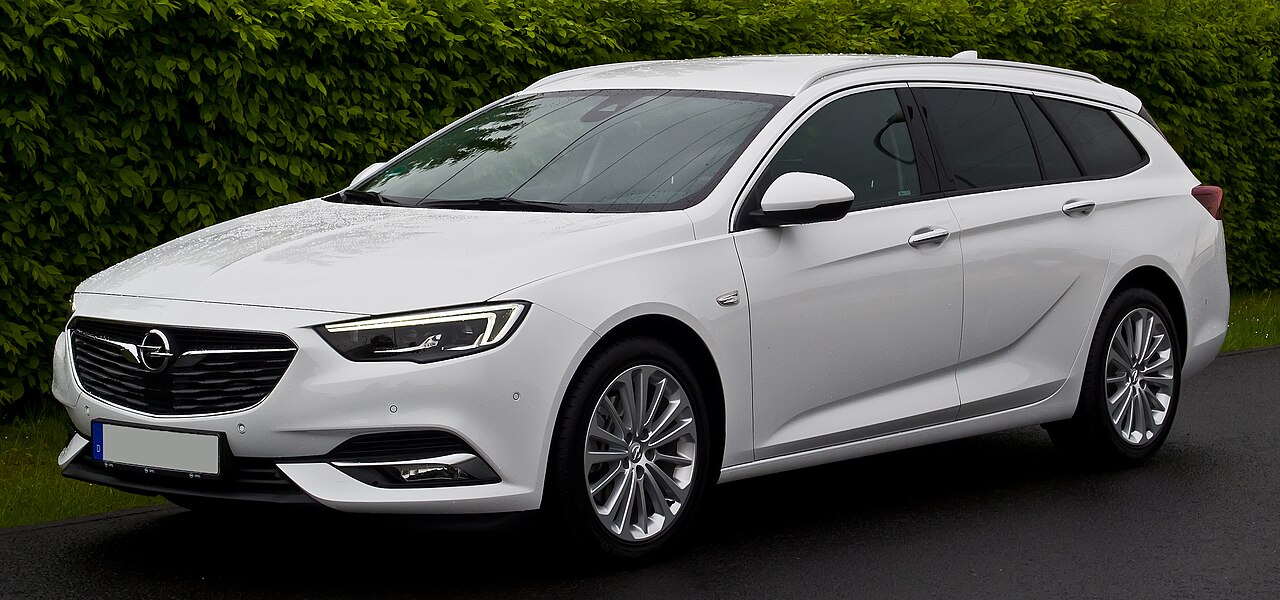 Licensed photo · Photo credit
MakeOpel
New registrations (EU)2008–2024
Generations and technical specifications
Opel Insignia B2017–present
| Specification | Value |
|---|---|
| Model code | Z18 |
| Production | 2017–present (China) 2017–2022 (other markets) |
| Model years | 2018–2020 (North America & Oceania) |
| Body styles | 5-door liftback/fastback 5-door estate |
| Platform | E2XX platform |
| Engines | Petrol 1.5 L EcoTec turbo I4 1.5 L EcoTec turbo I4 2.0 L EcoTec turbo I4 3.6 L LGX V6 Diesel 1.5 L F15DVH turbo I3 1.6 L CDTI turbo I4 2.0 L D20DTH/DTR turbo I4 2.0 L F20DVH turbo I4 |
| Transmissions | 6-speed manual 6-speed automatic 8-speed automatic 9-speed GM 9T50 automatic (Insignia Grandsport) |
| Wheelbase | 2,829 mm |
| Length | 4,897 mm 4,986 mm (wagon) |
| Width | 1,864 mm |
| Height | 1,455 mm |
| Kerb weight | 1,440–1,649 kg |
| Assembly | Germany: Rüsselsheim China: Shanghai (SAIC-GM) |
| Designer | Niels Loeb |
2003 Insignia Concept2003
| Specification | Value |
|---|---|
| Production | 2003 (Concept car) |
| Body styles | 5-door liftback/fastback |
| Layout | FR layout |
| Platform | GM V platform |
| Engines | 5.7 L LS1 V8 |
| Transmissions | 7-speed automatic |
| Wheelbase | 2,915 mm |
| Length | 4,803 mm |
| Width | 1,914 mm |
| Height | 1,414 mm |
| Class | Luxury car |
| Designer | Mark Adams Malcolm Ward |
EU type-approval data
| Years | Powertrain | Engine | Power | Mass | CO₂ |
|---|---|---|---|---|---|
| 2020–2023 | Diesel | 1496 cm³ | 90 kW (122 PS) | 1505–1619 kg | 123–138 g/km (WLTP) |
| 2020–2023 | Diesel | 1995 cm³ | 128 kW (174 PS) | 1610–1615 kg | 124–138 g/km (WLTP) |
| 2017–2021 | Diesel | 1598 cm³ | 81 kW (110 PS) | 1503–1552 kg | 128–136 g/km (WLTP) |
| 2017–2020 | Petrol | 1490 cm³ | 103 kW (140 PS) | 1441–1487 kg | 141–153 g/km (WLTP) |
| 2017–2020 | Petrol | 1490 cm³ | 121 kW (165 PS) | 1441–1522 kg | 147–167 g/km (WLTP) |
| 2015–2020 | Diesel | 1598 cm³ | 100 kW (136 PS) | 1503–1701 kg | 135–160 g/km (WLTP) |
| 2015–2020 | Diesel | 1956 cm³ | 125 kW (170 PS) | 1613–1733 kg | 149–168 g/km (WLTP) |
| 2017–2020 | Diesel | 1956 cm³ | 154 kW (209 PS) | 1733–1808 kg | 190–209 g/km (WLTP) |
| 2017–2019 | Petrol | 1998 cm³ | 191 kW (260 PS) | 1649–1699 kg | 197–199 g/km (NEDC) |
| 2011–2017 | Petrol | 1364 cm³ | 103 kW (140 PS) | 1503–1613 kg | 124 g/km (WLTP) |
| 2013–2017 | Petrol | 1598 cm³ | 125 kW (170 PS) | 1613–1701 kg | 139–170 g/km (NEDC) |
| 2010–2016 | Petrol | 1796 cm³ | – | 1503–1613 kg | 164–183 g/km (NEDC) |
| 2011–2015 | Diesel | 1956 cm³ | 81 kW (110 PS) | 1613–1788 kg | 114–133 g/km (NEDC) |
| 2013–2015 | Diesel | 1956 cm³ | 88 kW (120 PS) | 1613–1733 kg | 98–104 g/km (NEDC) |
| 2011–2015 | Diesel | 1956 cm³ | 96 kW (131 PS) | 1613–1816 kg | 116–149 g/km (NEDC) |
| 2013–2015 | Diesel | 1956 cm³ | 103 kW (140 PS) | 1613–1788 kg | 98 g/km (WLTP) |
| 2013–2015 | Diesel | 1956 cm³ | 120 kW (163 PS) | 1613–1843 kg | 119–158 g/km (NEDC) |
| 2012–2015 | Diesel | 1956 cm³ | 143 kW (194 PS) | 1701–1953 kg | 129–174 g/km (NEDC) |
| 2011–2013 | Diesel | 1956 cm³ | 118 kW (160 PS) | 1613–1843 kg | 119–164 g/km (NEDC) |
Years are registration years. Each range runs from the 10th to the 90th percentile of the values reported for new registrations; it is not an average. Mass is the mass in running order. For electric cars the power is the type-approval net power, which can be lower than the peak power in brochures.
Key specifications
| Specification | Value |
|---|---|
| Powertrains (EU) | Petrol, Diesel |
| Engine displacement (EU) | 1,364–1,995 cm³ |
| Power (EU) | 96–143 kW (131–194 PS) |
| Mass in running order (EU) | 1,441–1,953 kg |
| Wheelbase (EU) | 2,737–2,829 mm |
Years and markets
| Specification | Value |
|---|---|
| New registrations (EU) | 2008–2024 |