Opel
Grandland
Opel Grandland: years registered new in Europe, fault code help, warning lights and maintenance guides.
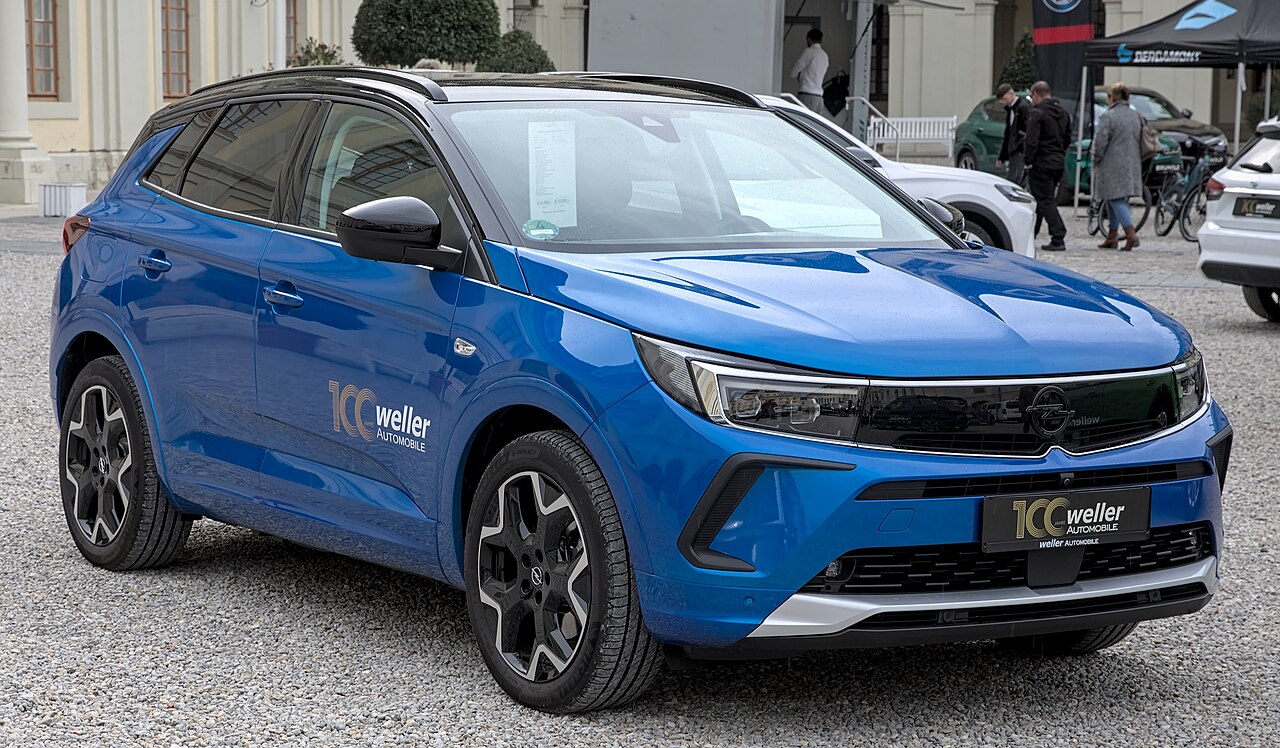 Licensed photo · Photo credit
MakeOpel
New registrations (EU)2017–2026
Generations and technical specifications
Opel Grandland – Second generation2024–present
| Specification | Value |
|---|---|
| Production | 2024–present |
| Layout | Front-engine, front-wheel-drive Front-motor, front-wheel drive (Electric) Dual-motor, all-wheel-drive (Electric) |
| Platform | STLA Medium |
| Engines | Petrol hybrid 1.2 L EB2LTEDH2 turbo I3 1.6 L EP6FADTXD turbo I4 |
| Electric motor | Permanent magnet AC synchronous motor |
| Transmissions | 6-speed e-DCT 7-speed e-DCT 1-speed direct-drive fixed gear ratio (Electric) |
| Drivetrain | Mild hybrid (MHEV) Plug-in hybrid (PHEV) |
| Battery | Lithium-ion NMC 0.43 kWh (Hybrid) 17.9 kWh (Plug-in Hybrid) 73.7 kWh, 82.2 kWh or 97 kWh (Electric) |
| Wheelbase | 2,784 mm |
| Length | 4,650 mm |
| Width | 1,905 mm |
| Height | 1,660 mm |
| Kerb weight | 1,600–2,132 kg |
| Assembly | Germany: Eisenach (Stellantis Eisenach Plant) |
Opel Grandland – First generation2017–2024
| Specification | Value |
|---|---|
| Production | 2017–2024 |
| Platform | PSA EMP2 |
| Engines | Petrol 1.2 L EB2DTS turbo I3 1.6 L EP6FDT turbo I4 Petrol PHEV 1.6 L EP6FDT/CDTX turbo I4 Diesel 1.5 L DV5 BlueHDi I4 1.6 L DV6F BlueHDi I4 2.0 L DW10 BlueHDi I4 |
| Electric motor | 1 or 2 Permanent magnet AC synchronous motor (PHEV, integrated with the eEAT8 gearbox) |
| Transmissions | 6-speed manual 8-speed automatic |
| Battery | 13.2 kWh Li-ion (PHEV) |
| Wheelbase | 2,675 mm |
| Length | 4,477 mm |
| Width | 1,856 mm |
| Height | 1,609 mm |
| Kerb weight | 1,350–1,575 kg |
| Assembly | France: Sochaux (PSA Sochaux Plant) Germany: Eisenach (Opel Eisenach) Namibia: Walvis Bay (Peugeot/Opel Assembly Namibia) |
| Designer | Uwe Müller |
EU type-approval data
| Years | Powertrain | Engine | Power | Mass | CO₂ | Electric range |
|---|---|---|---|---|---|---|
| 2024–2025 | Petrol hybrid | 1199 cm³ | 100 kW (136 PS) | 1675 kg | 122–126 g/km (WLTP) | – |
| 2024–2025 | Electric | – | 157 kW (213 PS) | 2207–2268 kg | – | 502–521 km · 171–176 Wh/km |
| 2017–2024 | Petrol | 1199 cm³ | 96 kW (131 PS) | 1353–1461 kg | 140–158 g/km (WLTP) | – |
| 2020–2024 | Petrol plug-in hybrid | 1598 cm³ | 133 kW (181 PS) | 1807–1810 kg | 28–32 g/km (WLTP) | 61–67 km · 155–164 Wh/km |
| 2020–2024 | Petrol plug-in hybrid | 1598 cm³ | 147 kW (200 PS) | 1875–1876 kg | 27–31 g/km (WLTP) | 63–66 km · 153–163 Wh/km |
| 2018–2024 | Diesel | 1499 cm³ | 96 kW (131 PS) | 1435–1523 kg | 135–146 g/km (WLTP) | – |
| 2019–2021 | Petrol | 1598 cm³ | 133 kW (181 PS) | 1480–1485 kg | 156–175 g/km (WLTP) | – |
| 2018–2021 | Diesel | 1997 cm³ | 130 kW (177 PS) | 1575 kg | 163–172 g/km (WLTP) | – |
| 2017–2019 | Diesel | 1560 cm³ | 88 kW (120 PS) | 1392–1433 kg | 104–118 g/km (NEDC) | – |
Years are registration years. Each range runs from the 10th to the 90th percentile of the values reported for new registrations; it is not an average. Mass is the mass in running order. For electric cars the power is the type-approval net power, which can be lower than the peak power in brochures.
Key specifications
| Specification | Value |
|---|---|
| Powertrains (EU) | Petrol, Petrol hybrid, Petrol plug-in hybrid, Diesel |
| Engine displacement (EU) | 1,199–1,997 cm³ |
| Power (EU) | 88–147 kW (120–200 PS) |
| Mass in running order (EU) | 1,353–1,876 kg |
| Wheelbase (EU) | 2,675 mm |
Years and markets
| Specification | Value |
|---|---|
| New registrations (EU) | 2017–2026 |