Sunfire
Pontiac Sunfire: official NHTSA recalls, fault code help and maintenance guides.
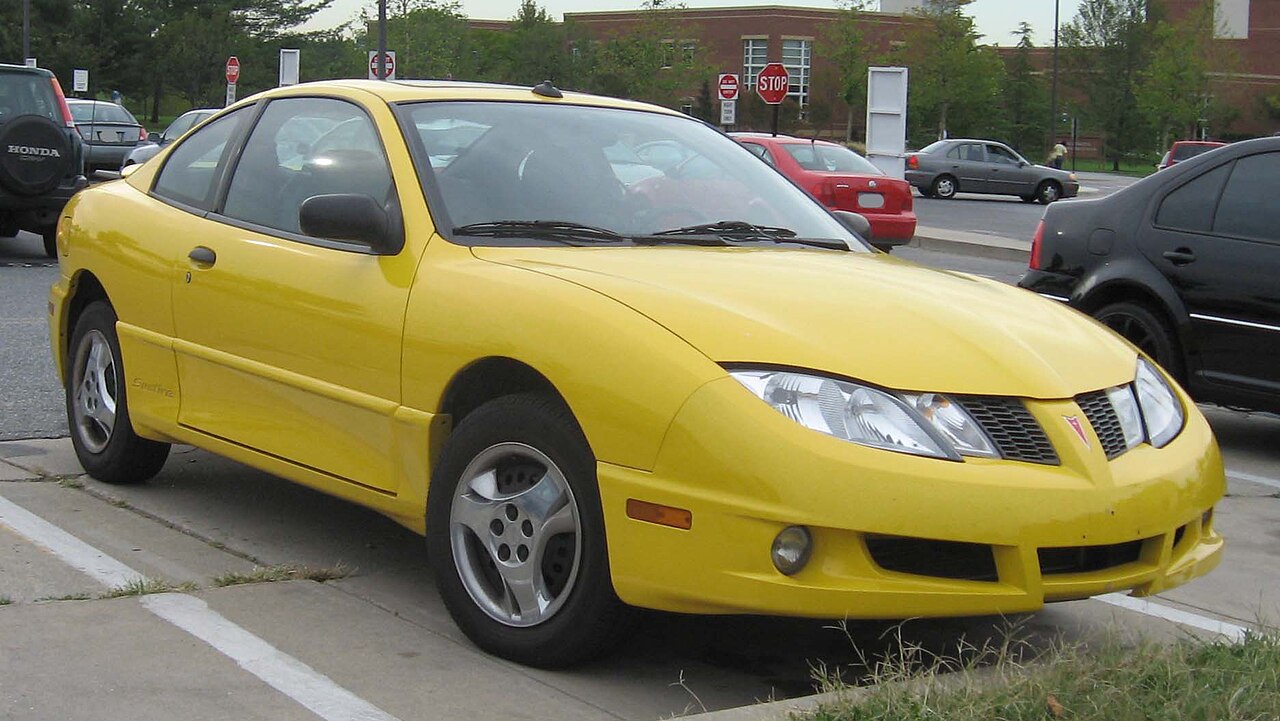 Licensed photo · Photo credit
Generations and technical specifications
Pontiac Sunfire1994–2005
| Specification | Value |
|---|---|
| Production | 1994–2005 |
| Model years | 1995–2005 |
| Body styles | 2-door convertible 2-door coupe 4-door sedan |
| Layout | FF layout |
| Platform | J-body |
| Engines | 2.2 L LN2 OHV I4 2.2 L L61 DOHC I4 2.3 L LD2 DOHC I4 2.4 L LD9 DOHC I4 |
| Transmissions | 5-speed manual 3/4-speed automatic |
| Wheelbase | 2,644 mm |
| Length | 1995–97 Sedan & 2000–05 Coupe: 4,623 mm 1998–99 Sedan: 4,615 mm 1995–99 Coupe & Convertible: 4,620 mm 2000–02 Sedan: 4,618 mm 2003–05 Sedan: 4,653 mm |
| Width | Convertible & 1995–97 Coupe: 1,712 mm 1995–97 Sedan: 1,709 mm 1998–2005 Coupe & Convertible: 1,737 mm Sedan: 1,725 mm |
| Height | 1998–2005 Coupe: 1,346 mm 1998–2005 Sedan: 1,389 mm 1998–2005 Convertible: 1,364 mm 1995–97 Coupe: 1,351 mm 1995–97 Sedan: 1,392 mm 1995–97 Convertible: 1,318 mm |
| Class | Compact/sport Compact |
| Assembly | Lansing, Michigan, United States (convertible only) Lordstown, Ohio, United States Ramos Arizpe, Coahuila, Mexico |
Engines and transmissions
| Model years | Engine | Transmission | Drive | Fuel |
|---|---|---|---|---|
| 2000–2005 | 2.2 L, 4 cyl | 4-speed automatic | Front-wheel drive | Petrol (regular) |
| 2000–2005 | 2.2 L, 4 cyl | 5-speed manual | Front-wheel drive | Petrol (regular) |
| 2000–2002 | 2.4 L, 4 cyl | 4-speed automatic | Front-wheel drive | Petrol (regular) |
| 2000–2002 | 2.4 L, 4 cyl | 5-speed manual | Front-wheel drive | Petrol (regular) |
| 2000–2001 | 2.2 L, 4 cyl | 3-speed automatic | Front-wheel drive | Petrol (regular) |
Fuel economy (EPA)
| Model years | Configuration | Combined | City | Highway |
|---|---|---|---|---|
| 2000–2005 | 2.2 L, 4 cyl · 4-speed automatic · Front-wheel drive | 9.4–10.2 L/100 km | 11.2–11.8 L/100 km | 7.6–8.1 L/100 km |
| 2000–2005 | 2.2 L, 4 cyl · 5-speed manual · Front-wheel drive | 8.7–10.2 L/100 km | 10.2–11.8 L/100 km | 7.1–7.8 L/100 km |
| 2000–2002 | 2.4 L, 4 cyl · 4-speed automatic · Front-wheel drive | 10.2–11.2 L/100 km | 12.4–13.1 L/100 km | 8.4–9.0 L/100 km |
| 2000–2002 | 2.4 L, 4 cyl · 5-speed manual · Front-wheel drive | 9.8–10.2 L/100 km | 11.8–12.4 L/100 km | 7.8–8.1 L/100 km |
| 2000–2001 | 2.2 L, 4 cyl · 3-speed automatic · Front-wheel drive | 10.2–10.7 L/100 km | 11.8 L/100 km | 8.7–9.0 L/100 km |
Values are the official EPA label figures for each model year, shown as the lowest and highest value for the configuration. Electric models show energy use per 100 km. Real-world consumption depends on driving style, weather and load. Luggage and passenger volumes follow the EPA measuring method and can differ from the VDA figures used in Europe.
Key specifications
| Specification | Value |
|---|---|
| EPA size class | Compact car, Subcompact car |
| Model years in EPA data | 2000–2005 |
| Powertrains | Petrol |
| Engine displacement | 2.2–2.4 L |
| Cylinders | 4 |
| Transmission types | Automatic, Manual |
| Drive | Front-wheel drive |
| Fuel | Petrol (regular) |
| Configurations listed | 22 |
| Luggage volume (EPA) | 368 L |
| Passenger volume (EPA) | 2,549–2,605 L |
Years and markets
| Specification | Value |
|---|---|
| Model years (US) | 2000–2005 |
Owner complaints (NHTSA)
| Component | Complaints | Most reported model years |
|---|---|---|
| Electrical system | 174 | 2000, 2002, 2005 |
| Engine and cooling | 88 | 2000, 2001, 2002 |
| Brakes | 61 | 2000, 2001, 2002 |
| Lights | 59 | 2000, 2002, 2003 |
| Fuel and propulsion | 41 | 2000, 2001, 2003 |
| Airbags | 29 | 2000, 2001, 2003 |
| Visibility and wipers | 29 | 2000, 2001, 2002 |
| Steering | 29 | 2000, 2002, 2003 |
| Transmission and drivetrain | 23 | 2000, 2002, 2003 |
| Body and structure | 20 | 2000, 2002, 2003 |
Source: complaints filed by owners with the U.S. National Highway Traffic Safety Administration (NHTSA) for model years 2000–2005: 472 complaints, 37 with a crash and 16 with a fire. Complaints are owner reports that NHTSA has not verified, and one complaint can name more than one component. More complaints can also mean more cars sold.