Volvo
S90
Volvo S90: official NHTSA recalls, fault code help and maintenance guides.
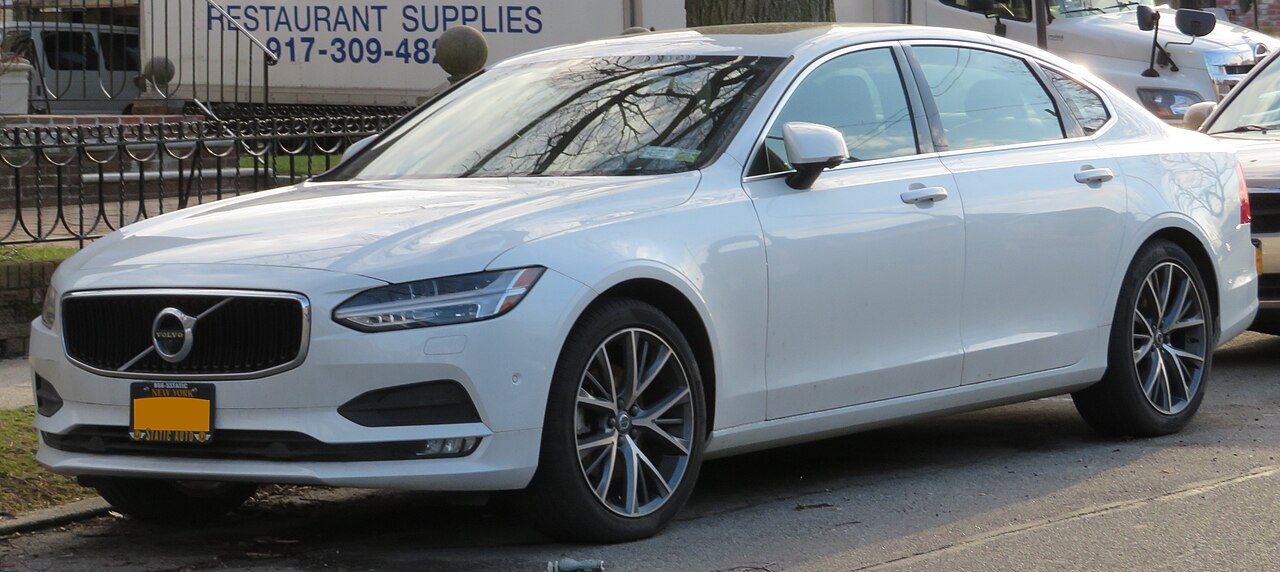 Licensed photo · Photo credit
MakeVolvo
ClassMidsize car
Model years (US)2017–2027
New registrations (EU)2012, 2016–2025
Recall dataNHTSA (United States)
Generations and technical specifications
Volvo S902016–present
| Specification | Value |
|---|---|
| Production | 2016–2017 (Sweden) 2016–present (China) |
| Model years | 2017–2025 (United States, Australia, Canada, Europe, and India) 2017–present (China, South Korea, Vietnam) |
| Body styles | 4-door saloon |
| Layout | Front-engine, front-wheel drive or all-wheel drive |
| Platform | SPA platform |
| Engines | Petrol 2.0L I4 (140kW–235kW) Diesel 2.0L I4 (140kW–173kW) Hybrid 2.0L I4 petrol (234kW–235kW + 64kW) |
| Electric motor | 2x Permanent Magnet Synchronous AC Motors 34 kW (front) 64 kW (rear) |
| Transmissions | 6-speed M66 manual 6-speed M76 manual 8-speed Aisin TG-81SC automatic |
| Drivetrain | Plug-in hybrid Mild Hybrid |
| Battery | lithium-ion battery lithium-ion battery |
| Electric range | 45 km (NEDC) |
| Length | S90: 4,963 mm S90L: 5,083 mm |
| Width | 1,890 mm 2,019 mm with mirrors |
| Height | S90: 1,443–1,450 mm |
| Kerb weight | S90: 1,800–2,150 kg |
| Class | Executive car (E) |
| Assembly | Sweden: Torslanda (Torslandaverken, until mid-2017) China: Daqing (Daqing Volvo Car Manufacturing Co., Ltd) Malaysia: Shah Alam (VCMM) India: Bengaluru (Volvo Trucks) |
| Designer | Thomas Ingenlath Örjan Sterner (Exterior) Tisha Johnson (Interior) |
Engines and transmissions
| Model years | Engine | Transmission | Drive | Fuel |
|---|---|---|---|---|
| 2026 | 2.0 L, 4 cyl mild hybrid | 8-speed automatic | Front-wheel drive | Petrol (premium) |
| 2023–2025 | 2.0 L, 4 cyl mild hybrid | 8-speed automatic | All-wheel drive | Petrol (premium) |
| 2018–2023, 2025 | 2.0 L, 4 cyl plug-in hybrid | 8-speed automatic | All-wheel drive | Petrol (premium) and electricity |
| 2017–2022 | 2.0 L, 4 cyl | 8-speed automatic | All-wheel drive | Petrol (premium) |
| 2017–2019 | 2.0 L, 4 cyl | 8-speed automatic | Front-wheel drive | Petrol (premium) |
Fuel economy (EPA)
| Model years | Configuration | Combined | City | Highway | Electric range |
|---|---|---|---|---|---|
| 2026 | 2.0 L, 4 cyl mild hybrid · 8-speed automatic · Front-wheel drive | 8.4 L/100 km | 9.8 L/100 km | 6.9 L/100 km | – |
| 2023–2025 | 2.0 L, 4 cyl mild hybrid · 8-speed automatic · All-wheel drive | 9.0–9.4 L/100 km | 10.2–10.7 L/100 km | 7.4–7.6 L/100 km | – |
| 2018–2023, 2025 | 2.0 L, 4 cyl plug-in hybrid · 8-speed automatic · All-wheel drive | 7.8–8.1 L/100 km | 8.4–9.0 L/100 km | 7.1–7.6 L/100 km | 34–61 km |
| 2017–2022 | 2.0 L, 4 cyl · 8-speed automatic · All-wheel drive | 9.0–9.4 L/100 km | 10.2–11.2 L/100 km | 7.4–7.6 L/100 km | – |
| 2017–2019 | 2.0 L, 4 cyl · 8-speed automatic · Front-wheel drive | 8.7 L/100 km | 9.8–10.2 L/100 km | 6.7–6.9 L/100 km | – |
Values are the official EPA label figures for each model year, shown as the lowest and highest value for the configuration. Electric models show energy use per 100 km. Real-world consumption depends on driving style, weather and load. Luggage and passenger volumes follow the EPA measuring method and can differ from the VDA figures used in Europe.
EU type-approval data
| Years | Powertrain | Engine | Power | Mass | CO₂ | Electric range |
|---|---|---|---|---|---|---|
| 2020–2025 | Petrol hybrid | 1969 cm³ | 145 kW (197 PS) | 1823–1846 kg | 148–159 g/km (WLTP) | – |
| 2022–2025 | Petrol plug-in hybrid | 1969 cm³ | 228 kW (310 PS) | 2119 kg | 17–19 g/km (WLTP) | 86–89 km · 173–177 Wh/km |
| 2020–2025 | Diesel hybrid | 1969 cm³ | 173 kW (235 PS) | 1912–1993 kg | 145–156 g/km (WLTP) | – |
| 2020–2024 | Petrol hybrid | 1969 cm³ | 184 kW (250 PS) | 1823–1887 kg | 148–161 g/km (WLTP) | – |
| 2019–2022 | Petrol plug-in hybrid | 1969 cm³ | 223 kW (303 PS) | 2094 kg | 43–54 g/km (WLTP) | 51–59 km · 147–154 Wh/km |
| 2018–2021 | Petrol | 1969 cm³ | 184 kW (250 PS) | 1703–1800 kg | 171–180 g/km (WLTP) | – |
| 2018–2021 | Petrol | 1969 cm³ | 228 kW (310 PS) | 1816–1899 kg | 198–208 g/km (WLTP) | – |
| 2016–2021 | Diesel | 1969 cm³ | 110 kW (150 PS) | 1679–1715 kg | 148–152 g/km (WLTP) | – |
| 2016–2021 | Diesel | 1969 cm³ | 140 kW (190 PS) | 1717–1834 kg | 149–207 g/km (WLTP) | – |
| 2016–2021 | Diesel | 1969 cm³ | 173 kW (235 PS) | 1798–1904 kg | 169–178 g/km (WLTP) | – |
| 2018–2020 | Petrol | 1969 cm³ | 140 kW (190 PS) | 1703–1800 kg | 169–178 g/km (WLTP) | – |
| 2016–2018 | Petrol | 1969 cm³ | 187 kW (254 PS) | 1712–1807 kg | 149 g/km (NEDC) | – |
| 2016–2018 | Petrol | 1969 cm³ | 235 kW (320 PS) | 1799–1898 kg | 165 g/km (NEDC) | – |
Years are registration years. Each range runs from the 10th to the 90th percentile of the values reported for new registrations; it is not an average. Mass is the mass in running order. For electric cars the power is the type-approval net power, which can be lower than the peak power in brochures.
Key specifications
| Specification | Value |
|---|---|
| EPA size class | Midsize car |
| Model years in EPA data | 2017–2026 |
| Powertrains | Mild hybrid, Plug-in hybrid, Petrol |
| Engine displacement | 2.0 L |
| Cylinders | 4 |
| Transmission types | Automatic |
| Drive | Front-wheel drive, All-wheel drive |
| Fuel | Petrol (premium), Petrol (premium) and electricity |
| Configurations listed | 23 |
| Forced induction | Turbo- and supercharged |
| Start-stop system | Yes |
| Electric motor (EPA) | 34 and 107 kW 3-phase Sync; 34 and 107 kW 3-phase Sync.; 34 and 65 kW 3-phase Sync. |
| Luggage volume (EPA) | 396 L |
| Passenger volume (EPA) | 2,775–2,888 L |
| Powertrains (EU) | Petrol, Petrol hybrid, Petrol plug-in hybrid, Diesel, Diesel hybrid |
| Engine displacement (EU) | 1,969 cm³ |
| Power (EU) | 110–228 kW (150–310 PS) |
| Mass in running order (EU) | 1,679–2,119 kg |
| Wheelbase (EU) | 2,940–2,941 mm |
Years and markets
| Specification | Value |
|---|---|
| Model years (US) | 2017–2027 |
| New registrations (EU) | 2012, 2016–2025 |