F-150
Ford F-150: official NHTSA recalls, fault code help and maintenance guides.
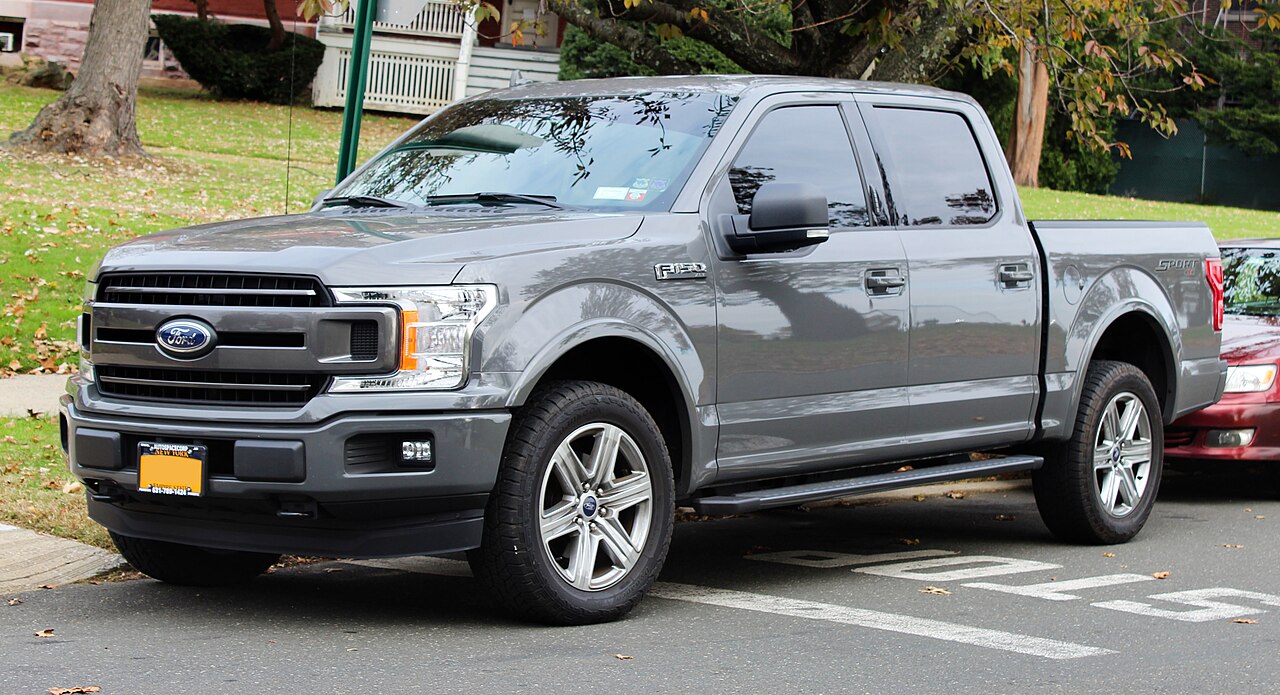 Licensed photo · Photo credit
Generations and technical specifications
Ford F-Series (fourteenth generation)2020–present
| Specification | Value |
|---|---|
| Production | October 12, 2020 – present |
| Model years | 2021–present |
| Body styles | 2-door regular cab 2+2-door extended cab (SuperCab) 4-door crew cab (SuperCrew) |
| Layout | Front-engine, rear-wheel drive Front-engine, four-wheel drive |
| Platform | Ford T3 |
| Engines | Gasoline 2.7 L EcoBoost Nano twin-turbo V6 (2021–2026) 3.0 L EcoBoost Nano twin-turbo V6 (2027–) 3.5 L EcoBoost D35 twin-turbo V6 5.2 L Carnivore V8 (Raptor R) Flex-fuel 3.3 L Cyclone V6 (2021–2023) 5.0 L Coyote V8 Gasoline Hybrid 3.5 L PowerBoost twin-turbo V6 Diesel 3.0 L Power Stroke turbo V6 (2021) |
| Electric motor | 35 kW BorgWarner HVH250 (hybrid) |
| Transmissions | 10-speed 10R80 SelectShift automatic |
| Drivetrain | Power-split |
| Battery | lithium-ion (hybrid) |
| Charging | V2L: 7.2 kW (hybrid), 2 kW (petrol) |
| Wheelbase | Regular Cab: 3,119–3,594 mm SuperCab: 3,693–4,168 mm SuperCrew: 3,693–3,993 mm |
| Length | Regular Cab: 5,311–5,784 mm SuperCab: 5,885–6,358 mm SuperCrew: 5,885–6,185 mm Raptor: 5,908 mm |
| Width | Standard: 2,029 mm Raptor: 2,200 mm |
| Height | Regular Cab: 1,910–1,956 mm SuperCab: 1,918–1,961 mm SuperCrew: 1,920–1,971 mm Tremor: 2,014 mm Raptor: 2,027–2,050 mm |
| Kerb weight | ≥ 1,824 kg |
| Class | Full-size pickup truck |
| Assembly | United States: Claycomo, Missouri (Kansas City Assembly); Dearborn, Michigan (Dearborn Truck Plant) Australia: Mickleham, Victoria (Ford Australia, RHD Conversion) |
| Designer | Raleigh Haire (2016) |
Ford F-Series (thirteenth generation)2014–2020
| Specification | Value |
|---|---|
| Production | November 11, 2014 – October 2020 |
| Model years | 2015–2020 |
| Body styles | 2-door regular cab 2+2-door extended cab, SuperCab 4-door crew cab, SuperCrew |
| Layout | Front-engine, rear-wheel drive Front-engine, four-wheel drive |
| Platform | Ford T3 |
| Engines | Gasoline 3.3 L Cyclone V6 3.5 L Cyclone V6 2.7 L EcoBoost Nano twin-turbo V6 3.5 L EcoBoost twin-turbo V6 5.0 L Coyote V8 Diesel 3.0 L Power Stroke turbo V6 |
| Transmissions | 6-speed 6R80 automatic 10-speed 10R80 automatic |
| Wheelbase | 3,109–4,158 mm |
| Length | 5,316–6,363 mm |
| Width | 2,029 mm |
| Height | 1,910–1,953 mm |
| Kerb weight | 1,846–2,584 kg |
| Class | Full-size pickup truck |
| Assembly | United States: Claycomo, Missouri (Kansas City Assembly); Dearborn, Michigan (Dearborn Truck Plant) Gurun, Kedah, Malaysia (CKD) |
| Designer | Gordon Platto (chief designer) Brad Richards (exterior) |
Ford F-Series (twelfth generation)2008–2014
| Specification | Value |
|---|---|
| Production | October 2008 – December 2014 |
| Model years | 2009–2014 |
| Body styles | 2-door single cab 2+2 door extended cab 4-door crew cab |
| Layout | Front engine, rear-wheel drive / four-wheel drive |
| Platform | Ford T platform (T1) |
| Engines | 4.6 L (281 CID) 2V Modular V8 4.6 L (281 CID) 3V Modular V8 5.4 L (330 CID) 3V Modular V8 3.5 L EcoBoost V6 3.7 L Ti-VCT V6 5.0 L (302 CID) Coyote V8 6.2 L (379 CID) 2V Boss V8 |
| Transmissions | 4-speed 4R75E automatic (with 4.6L 2V) 6-speed 6R80 automatic (with other engines) |
| Wheelbase | Regular cab 6.5' box 2009–2011: 3,195 mm 2012–2014: 3,198 mm SuperCab 5.5' box 2009 only: 3,373 mm Regular cab 8' box, SuperCab 6.5' box and SuperCrew 5.5' box 2009–2011: 3,668 mm 2012–2014: 3,670 mm SuperCrew 6.5' box 2009–2011: 3,978 mm 2012–2014: 3,975 mm SuperCab 8' box 2009–2011: 4,145 mm 2012–2014: 4,143 mm |
| Length | Regular cab 6.5' box 2009–2011: 5,413 mm 2012–2014: 5,415 mm SuperCab 5.5' box 2009 only: 5,585 mm Regular cab 8' box, SuperCab 6.5' box, and SuperCrew 5.5' box 2009–2011: 5,885 mm 2012–2014: 5,890 mm SuperCrew 6.5' box 2009–2011: 6,190 mm 2012–2014: 6,195 mm SuperCab 8' box 2009–2011: 6,358 mm 2012–2014: 6,360 mm |
| Width | 2009–2011: 2,004 mm 2012–2014: 2,012 mm SVT Raptor: 2,192 mm |
| Height | Regular cab 2009–2011 Regular Cab 6.5' box: 1,938 mm 2012–2014 Regular Cab 6.5' box: 1,930 mm 2009–2011 Regular Cab 8' box: 1,938 mm 2012–2014 Regular Cab 8' box: 1,930 mm SuperCab 2009 SuperCab 5.5' box: 1,938 mm 2009–2011 SuperCab 6.5' box: 1,941 mm 2012–2014 SuperCab 6.5' box: 1,933 mm 2009–2011 SuperCab 8' box: 1,935 mm 2012–2014 SuperCab 8' box: 1,923 mm SuperCrew 2009–2011 SuperCrew 5.5' box: 1,887 mm 2012–2014 SuperCrew 5.5' box: 1,948 mm 2009–2011 SuperCrew 6.5' box: 1,930 mm 2012–2014 SuperCrew 6.5' box: 1,920 mm SVT Raptor SuperCab: 1,994 mm +1 more |
| Assembly | Dearborn, Michigan, United States (Dearborn Truck) Claycomo, Missouri, United States (Kansas City Assembly) Valencia, Venezuela (Valencia Assembly) Cuautitlán, Mexico (Cuautitlán Assembly) |
| Designer | Pat Schiavone (2005, 2006) |
Ford F-Series (eleventh generation)2003–2008
| Specification | Value |
|---|---|
| Production | June 2003 – July 2008 |
| Model years | 2004–2008 |
| Body styles | 2-door pickup 4-door pickup |
| Engines | 4.2 L (256 CID) Essex V6 4.6 L (281 CID) Triton V8 5.4 L (330 CID) Triton V8 |
| Transmissions | 4-speed automatic (4R75E, 4R70E) 5-speed manual ("M5OD-R2") |
| Wheelbase | 3,200 mm (Regular cab 6.5' box) 3,378 mm (SuperCab 5.5' box) 3,531 mm (SuperCrew 5.5' box) 3,683 mm (SuperCab 6.5' box and regular cab 8' box) 3,835 mm (SuperCrew 6.5' box) 4,140 mm (SuperCab 8' box) |
| Length | 5,380 mm (Regular cab 6.5' box) 5,532 mm (SuperCab 5.5' box) 5,685 mm (SuperCrew 5.5' box) 5,837 mm (SuperCab 6.5' box and regular cab 8' box) 5,989 mm (SuperCrew 6.5' box) 6,294 mm (SuperCab 8' box) |
| Width | 2,004 mm |
| Assembly | Cuautitlán, Mexico Dearborn, Michigan, U.S. Kansas City, Missouri, U.S. Norfolk, Virginia, U.S. Valencia, Venezuela (Valencia Assembly) |
| Designer | Tyler Blake, Patrick Schiavone (1999, 2000) |
Ford F-Series (tenth generation)1995–2009
| Specification | Value |
|---|---|
| Production | November 29, 1995 – June 28, 2004 July 1996–1999 (F-250) 1996–2009 (Mexico) |
| Model years | 1997–2004 1997–1999 (F-250) |
| Body styles | 2-door regular cab 2+1-door extended cab 2+2-door extended cab 4-door Crew cab pickup |
| Layout | FR layout 4WD layout |
| Platform | Ford P platform |
| Engines | 4.2 L Essex V6 4.6 L Triton V8 5.4 L Triton V8 5.4 L Triton S/C V8 |
| Transmissions | 4-speed 4R70W automatic 4-speed E4OD automatic (1997–1998 5.4 L only) 4-speed 4R100 automatic (5.4 L only) 5-speed M5OD-R2 manual |
| Wheelbase | Regular cab/6.5' bed: 3,045 mm Regular cab/8' bed, SuperCab/6.5' bed, and SuperCrew: 3,526 mm SuperCab/8' bed: 3,990 mm |
| Length | Regular cab/6.5' bed: 5,136 mm Regular cab/8' bed, SuperCab/6.5' bed, and SuperCrew: 5,646 mm SuperCab/8' bed: 6,081 mm |
| Width | 2,019 mm |
| Height | 1,847 mm (4×2) 1,908 mm (4×4) |
| Class | Full-size pickup truck |
| Assembly | Kansas City Assembly (Claycomo, Missouri) Norfolk Assembly (Norfolk, Virginia) Kentucky Truck Assembly (Louisville, Kentucky) Ontario Truck Plant (Oakville, Ontario, Canada) Cuautitlán Assembly (Cuautitlán, Mexico) Valencia Assembly (Valencia, Venezuela) |
| Designer | Andrew Jacobson; Bob Aikins (concept: 1992, production design: 1993) |
Engines and transmissions
| Model years | Engine | Transmission | Drive | Fuel |
|---|---|---|---|---|
| 2018–2026 | 2.7 L, 6 cyl | 10-speed automatic | Part-time four-wheel drive | Petrol (regular) |
| 2018–2026 | 2.7 L, 6 cyl | 10-speed automatic | Rear-wheel drive | Petrol (regular) |
| 2017–2026 | 3.5 L, 6 cyl | 10-speed automatic | Part-time four-wheel drive | Petrol (regular) |
| 2017–2026 | 3.5 L, 6 cyl | 10-speed automatic | Rear-wheel drive | Petrol (regular) |
| 2021–2026 | 3.5 L, 6 cyl hybrid | 10-speed automatic | Part-time four-wheel drive | Petrol (regular) |
| 2021–2023, 2026 | 3.5 L, 6 cyl hybrid | 10-speed automatic | Rear-wheel drive | Petrol (regular) |
| 2018, 2024–2026 | 5.0 L, 8 cyl | 10-speed automatic | Part-time four-wheel drive | Petrol (regular) |
| 2018, 2024–2026 | 5.0 L, 8 cyl | 10-speed automatic | Rear-wheel drive | Petrol (regular) |
| 2025–2026 | 5.2 L, 8 cyl | 10-speed automatic | Part-time four-wheel drive | Petrol (premium) |
| 2022–2025 | Electric motor | Single-speed | All-wheel drive | Electricity |
| 2025 | Electric motor | Single-speed | Four-wheel drive | Electricity |
| 2023–2024 | 5.2 L, 8 cyl | 10-speed automatic | Part-time four-wheel drive | Petrol (regular) |
| +51 more configurations |
Fuel economy (EPA)
| Model years | Configuration | Combined | City | Highway | Electric range |
|---|---|---|---|---|---|
| 2018–2026 | 2.7 L, 6 cyl · 10-speed automatic · Part-time four-wheel drive | 11.2–11.8 L/100 km | 12.4–13.8 L/100 km | 9.8–10.2 L/100 km | – |
| 2018–2026 | 2.7 L, 6 cyl · 10-speed automatic · Rear-wheel drive | 10.7–11.2 L/100 km | 11.8–13.1 L/100 km | 9.0–9.4 L/100 km | – |
| 2017–2026 | 3.5 L, 6 cyl · 10-speed automatic · Part-time four-wheel drive | 11.8–15.7 L/100 km | 13.1–16.8 L/100 km | 9.8–14.7 L/100 km | – |
| 2017–2026 | 3.5 L, 6 cyl · 10-speed automatic · Rear-wheel drive | 11.2–12.4 L/100 km | 13.1–13.8 L/100 km | 9.4–11.2 L/100 km | – |
| 2021–2026 | 3.5 L, 6 cyl hybrid · 10-speed automatic · Part-time four-wheel drive | 9.8–10.2 L/100 km | 9.8–10.7 L/100 km | 9.8–10.2 L/100 km | – |
| 2021–2023, 2026 | 3.5 L, 6 cyl hybrid · 10-speed automatic · Rear-wheel drive | 9.4–9.8 L/100 km | 9.4–10.2 L/100 km | 9.0–9.4 L/100 km | – |
| 2018–2026 | 5.0 L, 8 cyl · 10-speed automatic · Part-time four-wheel drive | 12.4–14.7 L/100 km | 13.8–16.8 L/100 km | 9.8–12.4 L/100 km | – |
| 2018–2026 | 5.0 L, 8 cyl · 10-speed automatic · Rear-wheel drive | 11.8–13.8 L/100 km | 13.8–15.7 L/100 km | 9.4–11.8 L/100 km | – |
| 2023–2026 | 5.2 L, 8 cyl · 10-speed automatic · Part-time four-wheel drive | 19.6 L/100 km | 23.5 L/100 km | 15.7 L/100 km | – |
| 2022–2025 | Electric motor · Single-speed · All-wheel drive | 29.8–31.5 kWh/100 km | 26.9–28.7 kWh/100 km | 29.8–35.0 kWh/100 km | 370–515 km |
| 2025 | Electric motor · Single-speed · Four-wheel drive | 29.2 kWh/100 km | 26.6 kWh/100 km | 32.3 kWh/100 km | 483 km |
| 2021–2023 | 3.3 L, 6 cyl · 10-speed automatic · Part-time four-wheel drive | 11.8 L/100 km | 12.4 L/100 km | 10.7 L/100 km | – |
| +37 more configurations |
Values are the official EPA label figures for each model year, shown as the lowest and highest value for the configuration. Electric models show energy use per 100 km. Real-world consumption depends on driving style, weather and load. Luggage and passenger volumes follow the EPA measuring method and can differ from the VDA figures used in Europe.
EU type-approval data
| Years | Powertrain | Power | Mass | Electric range |
|---|---|---|---|---|
| 2024–2025 | Electric | 337 kW (458 PS) | 2965 kg | 429 km · 266 Wh/km |
| 2024 | Electric | 92 kW (125 PS) | 2979 kg | – |
Years are registration years. Each range runs from the 10th to the 90th percentile of the values reported for new registrations; it is not an average. Mass is the mass in running order. For electric cars the power is the type-approval net power, which can be lower than the peak power in brochures.
Key specifications
| Specification | Value |
|---|---|
| EPA size class | Standard pickup |
| Model years in EPA data | 2000–2026 |
| Powertrains | Petrol, Hybrid, Electric, Flex-fuel, Diesel, Natural gas (CNG), Bi-fuel |
| Engine displacement | 2.7–6.2 L |
| Cylinders | 6, 8 |
| Transmission types | Automatic, Single-speed, Manual |
| Drive | Rear-wheel drive, Part-time four-wheel drive, All-wheel drive, Four-wheel drive, Four-wheel or all-wheel drive |
| Fuel | Petrol (regular), Petrol (premium), Electricity, Petrol or E85 (flex-fuel), Diesel, Natural gas (CNG), Petrol or natural gas, Petrol or LPG |
| Configurations listed | 425 |
| Forced induction | Turbo- and supercharged (on some versions) |
| Start-stop system | On some versions |
| Electric motor (EPA) | 210 and 210 kW AC PMSM; 358 and 358 kW AC PMSM; 210 and 210 kW ACPM |
| Electric range (EPA) | 370–515 km |
| Powertrains (EU) | Electric |
| Power (EU) | 337 kW (458 PS) |
| Mass in running order (EU) | 2,965 kg |
Years and markets
| Specification | Value |
|---|---|
| Model years (US) | 2000–2027 |
| New registrations (EU) | 2024–2025 |
Owner complaints (NHTSA)
| Component | Complaints | Most reported model years |
|---|---|---|
| Engine and cooling | 1857 | 2001, 2002, 2004 |
| Visibility and wipers | 1300 | 2000, 2004, 2005 |
| Transmission and drivetrain | 1089 | 2002, 2004, 2005 |
| Electrical system | 917 | 2000, 2001, 2002 |
| Speed control and cruise | 850 | 2000, 2001, 2002 |
| Fuel and propulsion | 770 | 2000, 2001, 2002 |
| Brakes | 736 | 2004, 2005, 2006 |
| Body and structure | 552 | 2000, 2004, 2005 |
| Airbags | 526 | 2000, 2004, 2005 |
| Steering | 446 | 2000, 2004, 2006 |
Source: complaints filed by owners with the U.S. National Highway Traffic Safety Administration (NHTSA) for model years 2000–2009, 2016–2020: 9274 complaints, 588 with a crash and 884 with a fire. Complaints are owner reports that NHTSA has not verified, and one complaint can name more than one component. More complaints can also mean more cars sold.