HR-V
Honda HR-V: official NHTSA recalls, fault code help and maintenance guides.
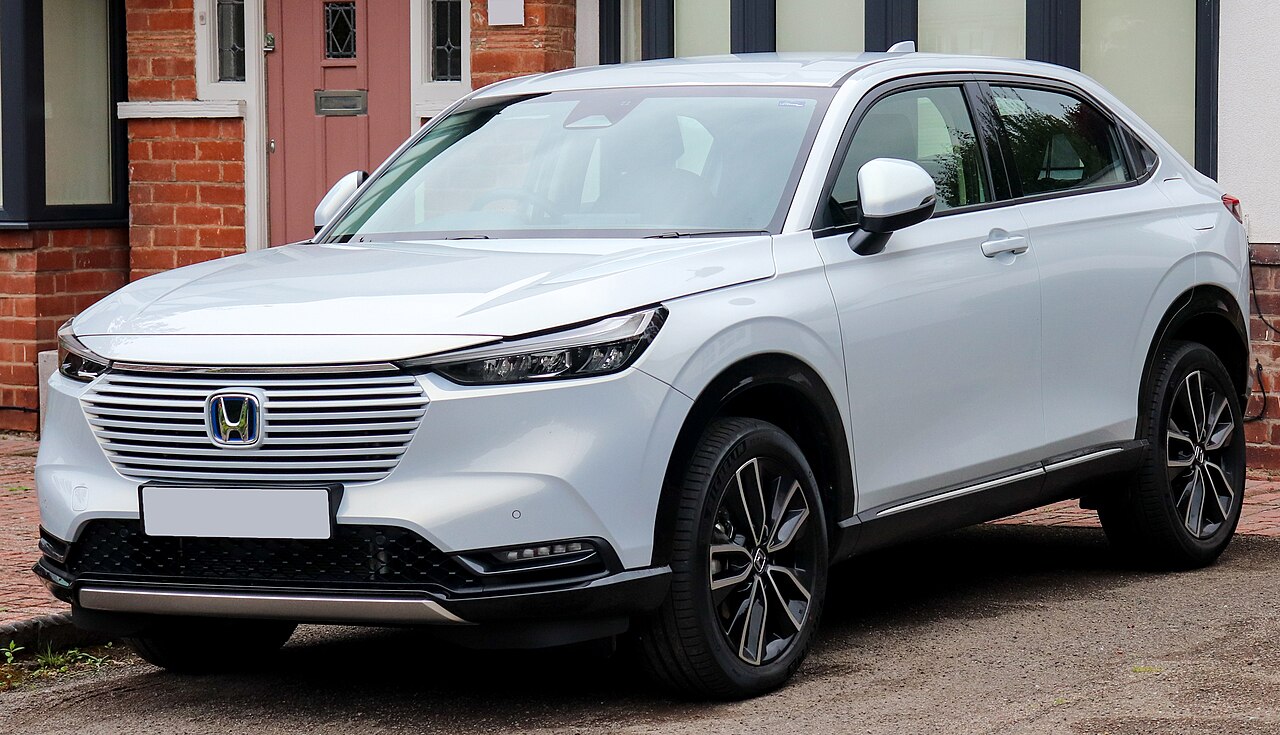 Licensed photo · Photo credit
Generations and technical specifications
Honda HR-V (third generation)2021–present
| Specification | Value |
|---|---|
| Model code | RV3 / RV4 / RV5 / RV6 / RS1 (electric) |
| Production | April 2021 – present |
| Body styles | 5-door SUV |
| Layout | Front-engine, front-wheel-drive Front-engine, all-wheel-drive |
| Platform | Honda Global Small Car Honda e:N Architecture F (e:NS1/e:NP1/e:Ny1/e:N1) |
| Engines | Petrol 1.5 L L15B i-VTEC I4 (RV3/4) 1.5 L L15ZF i-VTEC I4 1.5 L L15C1 VTEC turbo I4 2.0 L Honda K engine I4 (US) Petrol HEV 1.5 L LEB-MMD/LEC-H5/LEC6 Atkinson cycle DOHC i-MMD I4 (RV5/6) |
| Electric motor | 2x AC PMSM (e:HEV) TZ190HSBMCF61 and TZ190HSAMCF61 permanent magnet synchronous motor (electric versions) |
| Transmissions | CVT e-CVT i-MMD (e:HEV) |
| Drivetrain | Sport Hybrid i-MMD (e:HEV) |
| Battery | 53.6–68.8 kWh NMC lithium-ion (electric versions) |
| Electric range | 420–510 km (China Light-Duty Vehicle Test Cycle, electric versions) |
| Wheelbase | 2,610 mm |
| Length | 4,330–4,385 mm |
| Width | 1,790 mm |
| Height | 1,580–1,590 mm |
| Kerb weight | 1,250–1,450 kg |
| Class | Subcompact crossover SUV (B) |
| Assembly | Japan: Yorii, Saitama China: Guangzhou (GAC Honda); Wuhan (Dongfeng Honda) Taiwan: Pingtung Thailand: Ayutthaya; Prachinburi Indonesia: Karawang (HPM) Malaysia: Alor Gajah, Malacca Brazil: Itirapina Pakistan: Lahore (Honda Atlas) Ghana: Tema (Honda Ghana) |
| Designer | Daisuke Akojima |
Honda HR-V – Second generation2013–2022
| Specification | Value |
|---|---|
| Model code | RU1 / RU2 / RU3 / RU4 / RU5 |
| Production | December 2013 – 2022 |
| Model years | 2016–2022 |
| Body styles | 5-door SUV |
| Platform | Honda Global Small Car |
| Engines | Petrol 1.5 L L15Z DOHC i-VTEC I4 1.5 L L15B DOHC i-VTEC I4 1.5 L L15BP/L15BS DOHC VTC I4 turbo 1.5 L L15BY DOHC VTC I4 turbo 1.8 L R18Z9 SOHC i-VTEC I4 Diesel 1.6 L N16A DOHC i-DTEC I4 Common rail turbo-diesel Petrol hybrid 1.5 L LEB Atkinson cycle i-DCD I4 |
| Electric motor | Honda H1 AC PMSM (hybrid) |
| Transmissions | 6-speed manual CVT 7-speed DCT (hybrid) |
| Drivetrain | Sport Hybrid i-DCD (Vezel/HR-V Hybrid) |
| Wheelbase | 2,610 mm |
| Width | 1,770 mm |
| Kerb weight | 1,180–1,270 kg |
| Class | Subcompact crossover SUV (B) |
| Assembly | Japan: Yorii, Saitama Mexico: Celaya; Guanajuato; El Salto, Jalisco Brazil: Sumaré Argentina: Campana, Buenos Aires China: Guangzhou (Guangqi Honda, Vezel); Wuhan (Dongfeng Honda, XR-V) Indonesia: Karawang (HPM) Malaysia: Alor Gajah, Malacca Thailand: Ayutthaya Taiwan: Pingtung Nigeria: Lagos |
| Designer | Masaki Kobayashi Daisuke Toriyama (XR-V) |
Engines and transmissions
| Model years | Engine | Transmission | Drive | Fuel |
|---|---|---|---|---|
| 2023–2027 | 2.0 L, 4 cyl | CVT (continuously variable) | All-wheel drive | Petrol (regular) |
| 2023–2027 | 2.0 L, 4 cyl | CVT (continuously variable) | Front-wheel drive | Petrol (regular) |
| 2016–2018, 2021–2022 | 1.8 L, 4 cyl | CVT (continuously variable) | All-wheel drive | Petrol (regular) |
| 2016–2022 | 1.8 L, 4 cyl | CVT (continuously variable) | Front-wheel drive | Petrol (regular) |
| 2019–2020 | 1.8 L, 4 cyl | CVT (continuously variable) | Four-wheel drive | Petrol (regular) |
| 2016–2018 | 1.8 L, 4 cyl | 6-speed manual | Front-wheel drive | Petrol (regular) |
Fuel economy (EPA)
| Model years | Configuration | Combined | City | Highway |
|---|---|---|---|---|
| 2023–2027 | 2.0 L, 4 cyl · CVT (continuously variable) · All-wheel drive | 8.7 L/100 km | 9.4 L/100 km | 7.8 L/100 km |
| 2023–2027 | 2.0 L, 4 cyl · CVT (continuously variable) · Front-wheel drive | 8.4 L/100 km | 9.0 L/100 km | 7.4 L/100 km |
| 2016–2018, 2021–2022 | 1.8 L, 4 cyl · CVT (continuously variable) · All-wheel drive | 8.1–8.4 L/100 km | 8.7–9.0 L/100 km | 7.4–7.6 L/100 km |
| 2016–2022 | 1.8 L, 4 cyl · CVT (continuously variable) · Front-wheel drive | 7.6–7.8 L/100 km | 8.4 L/100 km | 6.9 L/100 km |
| 2019–2020 | 1.8 L, 4 cyl · CVT (continuously variable) · Four-wheel drive | 8.1–8.4 L/100 km | 8.7–9.0 L/100 km | 7.6 L/100 km |
| 2016–2018 | 1.8 L, 4 cyl · 6-speed manual · Front-wheel drive | 8.4 L/100 km | 9.4 L/100 km | 7.1 L/100 km |
Values are the official EPA label figures for each model year, shown as the lowest and highest value for the configuration. Electric models show energy use per 100 km. Real-world consumption depends on driving style, weather and load. Luggage and passenger volumes follow the EPA measuring method and can differ from the VDA figures used in Europe.
EU type-approval data
| Years | Powertrain | Engine | Power | Mass | CO₂ |
|---|---|---|---|---|---|
| 2022–2025 | Petrol hybrid | 1498 cm³ | 79 kW (107 PS) | 1452 kg | 122 g/km (WLTP) |
| 2015–2021 | Petrol | 1498 cm³ | 96 kW (131 PS) | 1312–1322 kg | 148–156 g/km (WLTP) |
| 2019–2021 | Petrol | 1498 cm³ | 134 kW (182 PS) | 1412–1452 kg | 151–162 g/km (WLTP) |
| 2015–2020 | Diesel | 1597 cm³ | 88 kW (120 PS) | 1395–1435 kg | 132–136 g/km (WLTP) |
| 2017 | Petrol | 1498 cm³ | 144 kW (196 PS) | 1312–1387 kg | 120–134 g/km (NEDC) |
Years are registration years. Each range runs from the 10th to the 90th percentile of the values reported for new registrations; it is not an average. Mass is the mass in running order. For electric cars the power is the type-approval net power, which can be lower than the peak power in brochures.
Key specifications
| Specification | Value |
|---|---|
| EPA size class | Small estate, Small SUV |
| Model years in EPA data | 2016–2027 |
| Powertrains | Petrol |
| Engine displacement | 1.8–2.0 L |
| Cylinders | 4 |
| Transmission types | CVT, Manual |
| Drive | All-wheel drive, Front-wheel drive, Four-wheel drive |
| Fuel | Petrol (regular) |
| Configurations listed | 41 |
| Luggage volume (EPA) | 651–680 L |
| Passenger volume (EPA) | 2,803–2,832 L |
| Powertrains (EU) | Petrol, Petrol hybrid, Diesel |
| Engine displacement (EU) | 1,498–1,597 cm³ |
| Power (EU) | 79–134 kW (107–182 PS) |
| Mass in running order (EU) | 1,312–1,452 kg |
| Wheelbase (EU) | 2,610 mm |
Years and markets
| Specification | Value |
|---|---|
| Model years (US) | 2016–2027 |
| New registrations (EU) | 2000–2007, 2010–2026 |
Owner complaints (NHTSA)
| Component | Complaints | Most reported model years |
|---|---|---|
| Visibility and wipers | 438 | 2018, 2023, 2024 |
| Electrical system | 309 | 2016, 2018, 2019 |
| Transmission and drivetrain | 178 | 2016, 2017, 2022 |
| Steering | 176 | 2023, 2024, 2025 |
| Fuel and propulsion | 161 | 2018, 2019, 2020 |
| Brakes | 121 | 2016, 2018, 2019 |
| Driver assistance | 112 | 2019, 2023, 2024 |
| Engine and cooling | 111 | 2016, 2019, 2022 |
| Body and structure | 102 | 2016, 2017, 2023 |
| Airbags | 81 | 2016, 2019, 2021 |
Source: complaints filed by owners with the U.S. National Highway Traffic Safety Administration (NHTSA) for model years 2016–2025: 1836 complaints, 97 with a crash and 6 with a fire. Complaints are owner reports that NHTSA has not verified, and one complaint can name more than one component. More complaints can also mean more cars sold.