EV6
Kia EV6: official NHTSA recalls, fault code help and maintenance guides.
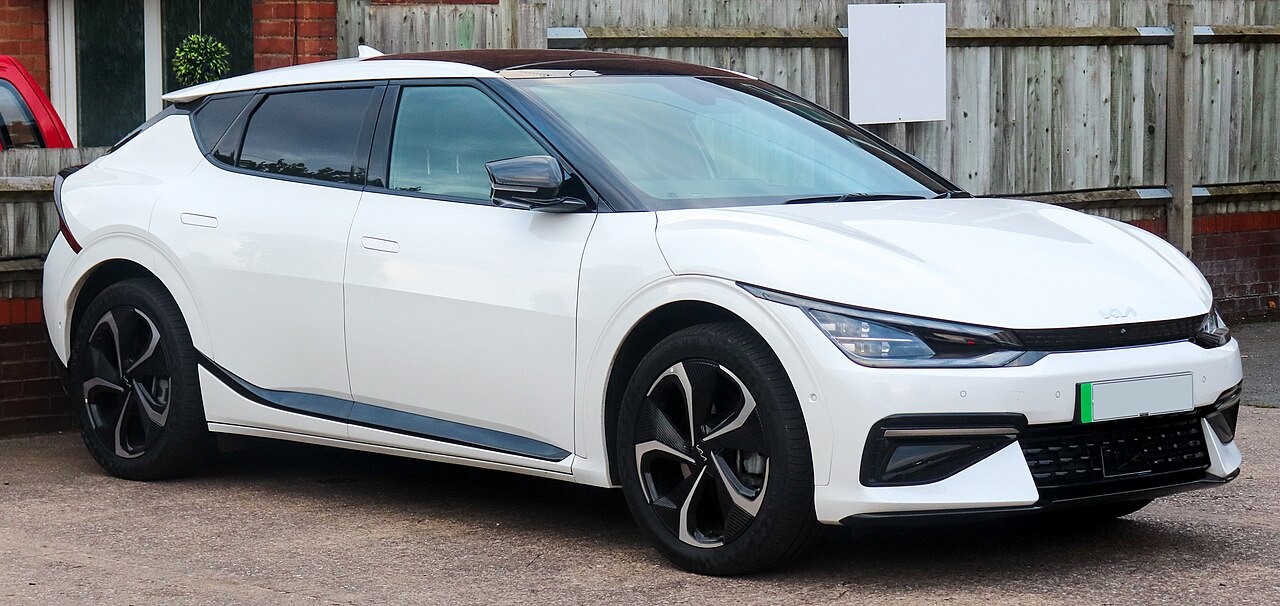 Licensed photo · Photo credit
Generations and technical specifications
Kia EV62021–present
| Specification | Value |
|---|---|
| Model code | CV |
| Production | 2021–present |
| Model years | 2022–present (Global, US) 2022–2025 (Canada) |
| Body styles | 5-door SUV |
| Layout | Rear-motor, rear-wheel-drive Dual-motor, all-wheel-drive |
| Platform | Hyundai E-GMP |
| Electric motor | Permanent magnet synchronous motor |
| Transmissions | Single-speed reduction gear |
| Battery | 58 kWh or 77.4 kWh or 84.0 kWh battery nickel-cobalt-manganese lithium |
| Electric range | Up to 510 km |
| Charging | AC 11 kW DC 180 kW (58 kWh battery) 240 kW (77.4 kWh battery) Vehicle-to-load ({{abbr|V2L|Vehicle-To-Load}}) 1.9 kW (international) 3.6 kW (Europe) |
| Wheelbase | 2,900 mm |
| Height | 1,550 mm 1,545 mm (GT) |
| Class | Compact crossover SUV |
| Assembly | South Korea: Hwaseong (Autoland Hwasung) United States: West Point, Georgia (KMMG) |
| Designer | Lee Hyo-Sung and Choi Hong-Seok |
Engines and transmissions
| Model years | Engine | Transmission | Drive | Fuel |
|---|---|---|---|---|
| 2022–2026 | Electric motor | Single-speed | All-wheel drive | Electricity |
| 2022–2026 | Electric motor | Single-speed | Rear-wheel drive | Electricity |
Fuel economy (EPA)
| Model years | Configuration | Combined | City | Highway | Electric range |
|---|---|---|---|---|---|
| 2022–2026 | Electric motor · Single-speed · All-wheel drive | 19.3–26.4 kWh/100 km | 17.5–24.7 kWh/100 km | 21.5–28.4 kWh/100 km | 332–475 km |
| 2022–2026 | Electric motor · Single-speed · Rear-wheel drive | 17.4–18.4 kWh/100 km | 15.2–16.4 kWh/100 km | 20.2–21.1 kWh/100 km | 373–513 km |
Values are the official EPA label figures for each model year, shown as the lowest and highest value for the configuration. Electric models show energy use per 100 km. Real-world consumption depends on driving style, weather and load. Luggage and passenger volumes follow the EPA measuring method and can differ from the VDA figures used in Europe.
EU type-approval data
| Years | Powertrain | Power | Mass | Electric range |
|---|---|---|---|---|
| 2021–2022, 2025 | Electric | 56 kW (76 PS) | 1985 kg | 504–528 km · 165–172 Wh/km |
| 2021–2022, 2025 | Electric | 81 kW (110 PS) | 2090 kg | 484–506 km · 172–180 Wh/km |
| 2021–2025 | Electric | 125 kW (170 PS) | 1875 kg | 394 km · 166 Wh/km |
| 2021–2025 | Electric | 168 kW (228 PS) | 1985–2050 kg | 504–560 km · 165–172 Wh/km |
| 2021–2025 | Electric | 239 kW (325 PS) | 2090–2150 kg | 484–546 km · 170–180 Wh/km |
| 2022–2025 | Electric | 430 kW (585 PS) | 2200 kg | 424 km · 206 Wh/km |
| 2025 | Electric | 478 kW (650 PS) | 2220 kg | 450 km · 209 Wh/km |
| 2022 | Electric | 73 kW (99 PS) | 2090 kg | 484–506 km · 172–180 Wh/km |
Years are registration years. Each range runs from the 10th to the 90th percentile of the values reported for new registrations; it is not an average. Mass is the mass in running order. For electric cars the power is the type-approval net power, which can be lower than the peak power in brochures.
Key specifications
| Specification | Value |
|---|---|
| EPA size class | Small SUV, Small estate |
| Model years in EPA data | 2022–2026 |
| Powertrains | Electric |
| Transmission types | Single-speed |
| Drive | All-wheel drive, Rear-wheel drive |
| Fuel | Electricity |
| Configurations listed | 23 |
| Electric motor (EPA) | 175 and 303 kW PMSM; 74 and 165 kW PMSM; 168 kW PMSM; 125 kW PMSM |
| Luggage volume (EPA) | 680 L |
| Passenger volume (EPA) | 2,917–2,945 L |
| Electric range (EPA) | 332–513 km |
| Powertrains (EU) | Electric |
| Power (EU) | 56–430 kW (76–585 PS) |
| Mass in running order (EU) | 1,875–2,200 kg |
| Wheelbase (EU) | 2,900 mm |
Years and markets
| Specification | Value |
|---|---|
| Model years (US) | 2022–2027 |
| New registrations (EU) | 2021–2026 |
Owner complaints (NHTSA)
| Component | Complaints | Most reported model years |
|---|---|---|
| Electrical system | 409 | 2022, 2023, 2024 |
| Fuel and propulsion | 98 | 2022, 2023, 2024 |
| Transmission and drivetrain | 97 | 2022, 2023, 2024 |
| Engine and cooling | 40 | 2022, 2023, 2024 |
| Driver assistance | 30 | 2022, 2024, 2025 |
| Brakes | 27 | 2022, 2023, 2024 |
| Speed control and cruise | 24 | 2022, 2023, 2024 |
| Body and structure | 15 | 2022, 2024, 2025 |
| Lights | 13 | 2022, 2023, 2024 |
| Visibility and wipers | 7 | 2022, 2023, 2025 |
Source: complaints filed by owners with the U.S. National Highway Traffic Safety Administration (NHTSA) for model years 2022–2025: 547 complaints, 20 with a crash and 2 with a fire. Complaints are owner reports that NHTSA has not verified, and one complaint can name more than one component. More complaints can also mean more cars sold.