Air
Lucid Air: official NHTSA recalls, fault code help and maintenance guides.
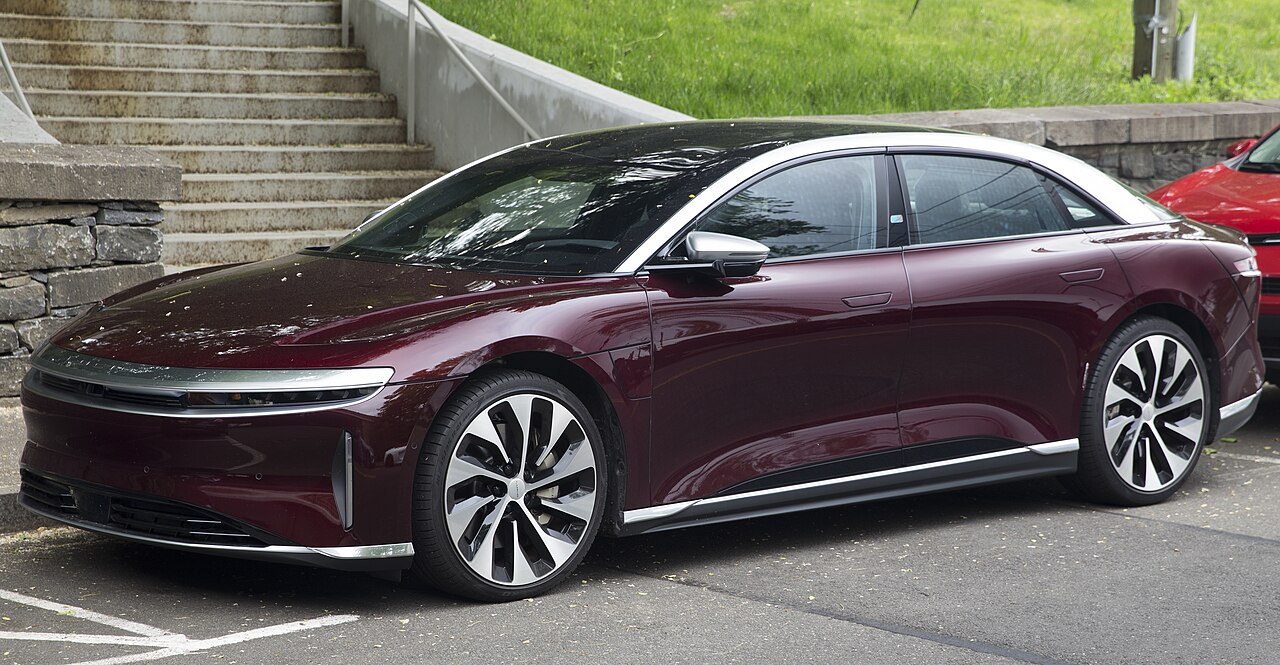 Licensed photo · Photo credit
Generations and technical specifications
Lucid Air2021–present
| Specification | Value |
|---|---|
| Production | September 2021 – present |
| Model years | 2022–present |
| Body styles | Four-door sedan |
| Layout | Rear-motor, rear-wheel-drive Dual-motor, all-wheel-drive Tri-motor, all-wheel-drive |
| Transmissions | One-speed fixed gear |
| Battery | 88, 93, 112 or 118 kWh lithium-ion |
| Charging | AC: 19.2 kW AC (240V at 80A) DC: 250 or 300 kW, CCS connector |
| Wheelbase | 2,960 mm |
| Length | 4,975 mm |
| Width | 1,939 mm |
| Height | 1,410 mm |
| Class | Executive car (E) |
| Assembly | United States: Casa Grande, Arizona |
| Designer | Derek Jenkins |
Engines and transmissions
| Model years | Engine | Transmission | Drive | Fuel |
|---|---|---|---|---|
| 2022–2027 | Electric motor | Single-speed | All-wheel drive | Electricity |
| 2024–2027 | Electric motor | Single-speed | Rear-wheel drive | Electricity |
Fuel economy (EPA)
| Model years | Configuration | Combined | City | Highway | Electric range |
|---|---|---|---|---|---|
| 2022–2027 | Electric motor · Single-speed · All-wheel drive | 15.0–20.0 kWh/100 km | 14.9–19.4 kWh/100 km | 14.9–20.7 kWh/100 km | 581–837 km |
| 2024–2027 | Electric motor · Single-speed · Rear-wheel drive | 14.4–16.2 kWh/100 km | 14.1–15.8 kWh/100 km | 14.8–16.7 kWh/100 km | 599–676 km |
Values are the official EPA label figures for each model year, shown as the lowest and highest value for the configuration. Electric models show energy use per 100 km. Real-world consumption depends on driving style, weather and load. Luggage and passenger volumes follow the EPA measuring method and can differ from the VDA figures used in Europe.
EU type-approval data
| Years | Powertrain | Power | Mass | Electric range |
|---|---|---|---|---|
| 2024–2025 | Electric | 164 kW (223 PS) | 2337 kg | 648–730 km · 141–160 Wh/km |
| 2024–2025 | Electric | 165 kW (224 PS) | 2135–2145 kg | – |
| 2022–2023, 2025 | Electric | 208 kW (283 PS) | 2435 kg | 783–882 km · 148–176 Wh/km |
| 2025 | Electric | 325 kW (442 PS) | 2145 kg | 708–747 km · 130–137 Wh/km |
| 2023–2025 | Electric | 375 kW (510 PS) | 2337 kg | 648–725 km · 141–160 Wh/km |
| 2025 | Electric | 411 kW (559 PS) | 2337 kg | 660–725 km · 141–157 Wh/km |
| 2023–2025 | Electric | 464 kW (631 PS) | 2435 kg | 799 km · 166–182 Wh/km |
| 2023–2025 | Electric | 466 kW (634 PS) | 2435 kg | 783–785 km · 160–161 Wh/km |
| 2025 | Electric | 539 kW (733 PS) | 2337 kg | 677–794 km · 134–158 Wh/km |
| 2025 | Electric | 674 kW (916 PS) | 2435 kg | 817–882 km · 135–160 Wh/km |
| 2025 | Electric | 964 kW (1311 PS) | 2435 kg | 799 km · 166 Wh/km |
| 2023–2024 | Electric | 156 kW (212 PS) | 2337 kg | 660–725 km · 141–157 Wh/km |
| 2023–2024 | Electric | 255 kW (347 PS) | 2337 kg | 660–725 km · 141–157 Wh/km |
| 2023–2024 | Electric | 500 kW (680 PS) | 2435 kg | 799–883 km · 150–166 Wh/km |
| 2023 | Electric | 202 kW (275 PS) | 2337–2412 kg | – |
| 2022 | Electric | 597 kW (812 PS) | 2465–2475 kg | – |
Years are registration years. Each range runs from the 10th to the 90th percentile of the values reported for new registrations; it is not an average. Mass is the mass in running order. For electric cars the power is the type-approval net power, which can be lower than the peak power in brochures.
Key specifications
| Specification | Value |
|---|---|
| EPA size class | Large car |
| Model years in EPA data | 2022–2027 |
| Powertrains | Electric |
| Transmission types | Single-speed |
| Drive | All-wheel drive, Rear-wheel drive |
| Fuel | Electricity |
| Configurations listed | 49 |
| Electric motor (EPA) | 178 and 433 kW ACPM; 330 kW ACPM; 310 kW ACPM; 310, 310 and 310 kW ACPM |
| Luggage volume (EPA) | 906 L |
| Passenger volume (EPA) | 2,803–2,860 L |
| Electric range (EPA) | 581–837 km |
| Powertrains (EU) | Electric |
| Power (EU) | 156–674 kW (212–916 PS) |
| Mass in running order (EU) | 2,145–2,435 kg |
| Wheelbase (EU) | 2,960 mm |
Years and markets
| Specification | Value |
|---|---|
| Model years (US) | 2022–2027 |
| New registrations (EU) | 2022–2025 |
Owner complaints (NHTSA)
| Component | Complaints | Most reported model years |
|---|---|---|
| Electrical system | 21 | 2022, 2023, 2024 |
| Transmission and drivetrain | 18 | 2022, 2024, 2025 |
| Driver assistance | 17 | 2022, 2023, 2025 |
| Brakes | 9 | 2023, 2024, 2025 |
| Fuel and propulsion | 7 | 2022, 2023, 2024 |
| Visibility and wipers | 6 | 2022, 2023, 2025 |
| Speed control and cruise | 6 | 2022, 2023, 2024 |
| Airbags | 5 | 2022, 2023, 2025 |
| Engine and cooling | 5 | 2022, 2023, 2024 |
| Seats | 4 | 2022, 2023, 2024 |
Source: complaints filed by owners with the U.S. National Highway Traffic Safety Administration (NHTSA) for model years 2022–2025: 78 complaints, 17 with a crash and 0 with a fire. Complaints are owner reports that NHTSA has not verified, and one complaint can name more than one component. More complaints can also mean more cars sold.