4Runner
Toyota 4Runner: official NHTSA recalls, fault code help and maintenance guides.
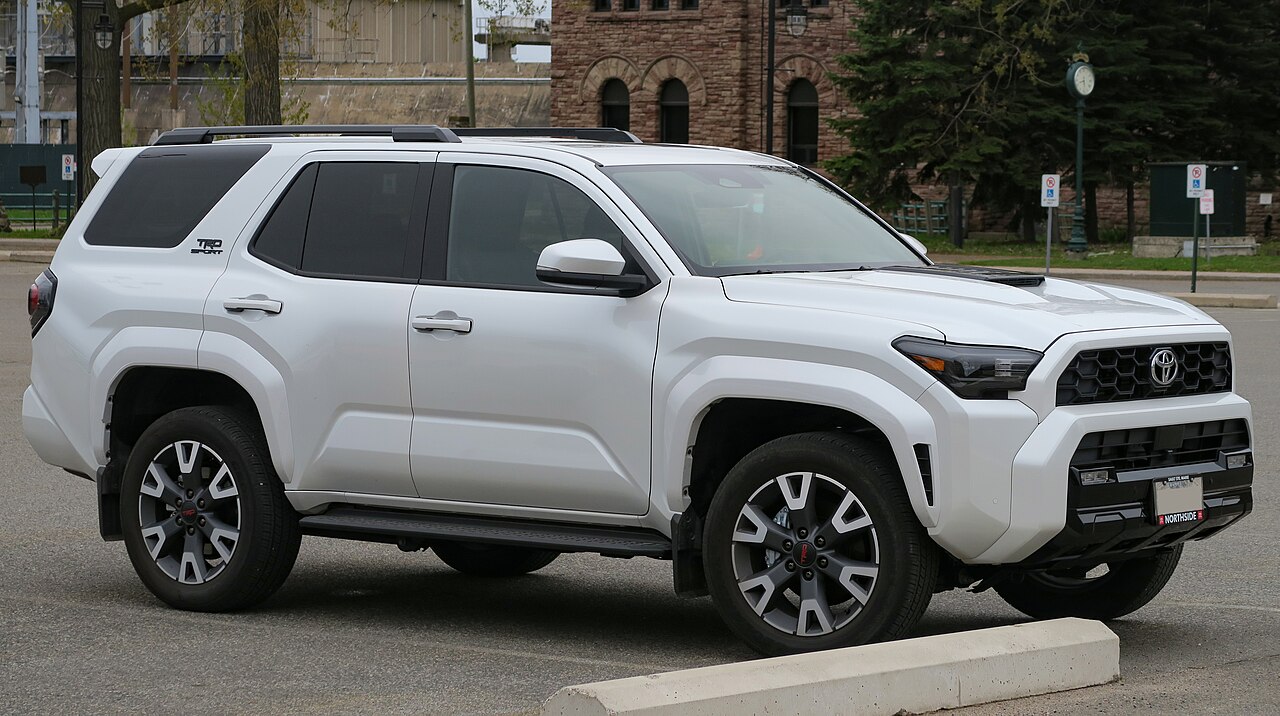 Licensed photo · Photo credit
Generations and technical specifications
Toyota 4Runner – Sixth generation2024–present
| Specification | Value |
|---|---|
| Model code | N500 |
| Production | December 2024 – present |
| Model years | 2025–present |
| Body styles | 5-door SUV |
| Platform | TNGA: GA-F |
| Engines | Gasoline 2.4 L T24A-FTS turbo I4 (TZNA50/55) Gasoline hybrid 2.4 L T24A-FTS turbo I4 (TZNH55) |
| Transmissions | 8-speed "Direct Shift" ECTi automatic |
| Drivetrain | Parallel (i-Force Max) |
| Battery | 1.87 kWh, 6.5 Ah, 288 V NiMH (i-Force Max) |
| Wheelbase | 2,850 mm |
| Length | 4,950 mm |
| Width | 1,976 mm |
| Height | 1,798 mm |
| Class | Mid-size SUV |
| Assembly | Japan: Tahara, Aichi (Tahara plant) |
| Designer | Adam Rabinowitz, Kevin Hunter |
Toyota 4Runner – Fifth generation2009–2024
| Specification | Value |
|---|---|
| Model code | N280 |
| Production | August 2009 – August 2024 |
| Model years | 2010–2024 (US) |
| Body styles | 5-door SUV |
| Platform | Toyota F2 |
| Engines | Gasoline 2.7 L 2TR-FE I4 (TRN280; 2009–2010) 4.0 L 1GR-FE V6 (GRN280/285; 2009–2024) |
| Transmissions | 4-speed automatic (2.7 L) 5-speed automatic (4.0 L) |
| Wheelbase | 2,789 mm |
| Length | 4,823–4,859 mm |
| Width | 1,925 mm |
| Height | 1,796 mm |
| Kerb weight | 1,996–2,180 kg |
| Class | Mid-size SUV |
| Assembly | Japan: Tahara, Aichi (Tahara plant) |
| Designer | Ken Iwasaki and Tom Matsumoto Eishi Suzuki (2014 facelift) |
Toyota 4Runner – Fourth generation2002–2009
| Specification | Value |
|---|---|
| Model code | N210 |
| Production | August 2002 – August 2009 November 2002 - September 2009 (Hilux Surf) |
| Model years | 2003–2009 (US) |
| Body styles | 5-door SUV |
| Platform | Toyota F2 |
| Engines | Gasoline 2.7 L 3RZ-FE I4 (RZN210/215; Japan, 2002–2004) 2.7 L 2TR-FE I4 (TRN210/215; Japan, 2004–2009) 3.4 L 5VZ-FE V6 (VZN210/215; Japan, 2002–2005) 4.0 L 1GR-FE V6 (GRN210/215; North America from 2002 to 2009, Japan from 2005 to 2009) 4.7 L 2UZ-FE V8 (UZN210/215; North America, 2002–2009) Diesel 3.0 L 1KD-FTV D-4D turbo I4 (KDN215; Japan, 2002–2005) |
| Transmissions | 4-speed A3xx automatic 5-speed A7xx automatic |
| Wheelbase | 2,789 mm |
| Length | 4,801–4,806 mm |
| Width | 1,875–1,910 mm |
| Height | 1,750–1,819 mm |
| Kerb weight | 1,941 kg |
| Class | Mid-size SUV |
| Assembly | Japan: Tahara, Aichi; Hamura, Tokyo (Hino) |
Toyota 4Runner – Third generation1995–2002
| Specification | Value |
|---|---|
| Model code | N180 |
| Production | August 1995 – August 2002 |
| Model years | 1996–2002 (US) |
| Body styles | 5-door SUV |
| Engines | Gasoline 2.7 L 3RZ-FE I4 (RZN180/185; Japan from 1995 to 2002, North America from 1995 to 2000) 3.4 L 5VZ-FE V6 (VZN180/185; 1995–2002) Diesel 3.0 L 1KZ-TE turbo I4 (KZN185; Japan, 1995–2000) 3.0 L 1KD-FTV D-4D turbo I4 (KDN185; Japan, 2000–2002) |
| Transmissions | 5-speed manual 4-speed A340F automatic |
| Wheelbase | 2,675 mm |
| Length | 4,540–4,850 mm |
| Width | 1,690–1,800 mm |
| Height | 1,750–1,805 mm |
| Kerb weight | 1,640–1,770 kg |
| Class | Mid-size SUV |
| Assembly | Japan: Tahara, Aichi; Hamura, Tokyo (Hino) |
Engines and transmissions
| Model years | Engine | Transmission | Drive | Fuel |
|---|---|---|---|---|
| 2025–2026 | 2.4 L, 4 cyl | 8-speed automatic | Four-wheel drive | Petrol (regular) |
| 2025–2026 | 2.4 L, 4 cyl | 8-speed automatic | Part-time four-wheel drive | Petrol (regular) |
| 2025–2026 | 2.4 L, 4 cyl | 8-speed automatic | Rear-wheel drive | Petrol (regular) |
| 2025–2026 | 2.4 L, 4 cyl hybrid | 8-speed automatic | Four-wheel drive | Petrol (regular) |
| 2025–2026 | 2.4 L, 4 cyl hybrid | 8-speed automatic | Part-time four-wheel drive | Petrol (regular) |
| 2013–2024 | 4.0 L, 6 cyl | 5-speed automatic | All-wheel drive | Petrol (regular) |
| 2010–2024 | 4.0 L, 6 cyl | 5-speed automatic | Part-time four-wheel drive | Petrol (regular) |
| 2005–2024 | 4.0 L, 6 cyl | 5-speed automatic | Rear-wheel drive | Petrol (regular) |
| 2010–2012 | 4.0 L, 6 cyl | 5-speed automatic | Four-wheel drive | Petrol (regular) |
| 2000, 2010–2011 | 2.7 L, 4 cyl | 4-speed automatic | Rear-wheel drive | Petrol (regular) |
| 2005–2009 | 4.0 L, 6 cyl | 5-speed automatic | Four-wheel or all-wheel drive | Petrol (regular) |
| 2003–2009 | 4.7 L, 8 cyl | 5-speed automatic | Four-wheel or all-wheel drive | Petrol (regular) |
| +9 more configurations |
Fuel economy (EPA)
| Model years | Configuration | Combined | City | Highway |
|---|---|---|---|---|
| 2025–2026 | 2.4 L, 4 cyl · 8-speed automatic · Four-wheel drive | 11.2 L/100 km | 11.8 L/100 km | 9.8 L/100 km |
| 2025–2026 | 2.4 L, 4 cyl · 8-speed automatic · Part-time four-wheel drive | 11.2 L/100 km | 12.4 L/100 km | 9.4 L/100 km |
| 2025–2026 | 2.4 L, 4 cyl · 8-speed automatic · Rear-wheel drive | 10.7 L/100 km | 11.8 L/100 km | 9.0–9.8 L/100 km |
| 2025–2026 | 2.4 L, 4 cyl hybrid · 8-speed automatic · Four-wheel drive | 10.2 L/100 km | 10.2–10.7 L/100 km | 9.8 L/100 km |
| 2025–2026 | 2.4 L, 4 cyl hybrid · 8-speed automatic · Part-time four-wheel drive | 10.2 L/100 km | 10.2 L/100 km | 9.8 L/100 km |
| 2013–2024 | 4.0 L, 6 cyl · 5-speed automatic · All-wheel drive | 13.1–13.8 L/100 km | 13.8–14.7 L/100 km | 11.2–12.4 L/100 km |
| 2010–2024 | 4.0 L, 6 cyl · 5-speed automatic · Part-time four-wheel drive | 12.4–13.8 L/100 km | 13.8–14.7 L/100 km | 10.7–12.4 L/100 km |
| 2005–2024 | 4.0 L, 6 cyl · 5-speed automatic · Rear-wheel drive | 12.4–13.8 L/100 km | 13.8–14.7 L/100 km | 10.2–12.4 L/100 km |
| 2010–2012 | 4.0 L, 6 cyl · 5-speed automatic · Four-wheel drive | 12.4 L/100 km | 13.8 L/100 km | 10.7 L/100 km |
| 2000, 2010–2011 | 2.7 L, 4 cyl · 4-speed automatic · Rear-wheel drive | 11.8–12.4 L/100 km | 13.1–13.8 L/100 km | 10.2–11.2 L/100 km |
| 2005–2009 | 4.0 L, 6 cyl · 5-speed automatic · Four-wheel or all-wheel drive | 13.8 L/100 km | 14.7–15.7 L/100 km | 11.8–12.4 L/100 km |
| 2003–2009 | 4.7 L, 8 cyl · 5-speed automatic · Four-wheel or all-wheel drive | 14.7–15.7 L/100 km | 16.8 L/100 km | 13.1–13.8 L/100 km |
| +9 more configurations |
Values are the official EPA label figures for each model year, shown as the lowest and highest value for the configuration. Electric models show energy use per 100 km. Real-world consumption depends on driving style, weather and load. Luggage and passenger volumes follow the EPA measuring method and can differ from the VDA figures used in Europe.
EU type-approval data
| Years | Powertrain | Engine | Mass | CO₂ |
|---|---|---|---|---|
| 2017 | Petrol | 1496 cm³ | 1120–1123 kg | 109 g/km (NEDC) |
Years are registration years. Each range runs from the 10th to the 90th percentile of the values reported for new registrations; it is not an average. Mass is the mass in running order. For electric cars the power is the type-approval net power, which can be lower than the peak power in brochures.
Key specifications
| Specification | Value |
|---|---|
| EPA size class | Standard SUV, SUV |
| Model years in EPA data | 2000–2026 |
| Powertrains | Petrol, Hybrid |
| Engine displacement | 2.4–4.7 L |
| Cylinders | 4, 6, 8 |
| Transmission types | Automatic, Manual |
| Drive | Rear-wheel drive, Part-time four-wheel drive, Four-wheel drive, All-wheel drive, Four-wheel or all-wheel drive |
| Fuel | Petrol (regular) |
| Configurations listed | 98 |
| Forced induction | Turbocharged (on some versions) |
| Start-stop system | On some versions |
| Powertrains (EU) | Petrol |
| Engine displacement (EU) | 1,496 cm³ |
| Mass in running order (EU) | 1,120–1,123 kg |
| Wheelbase (EU) | 2,510 mm |
Years and markets
| Specification | Value |
|---|---|
| Model years (US) | 2000–2027 |
| New registrations (EU) | 2000–2025 |
Owner complaints (NHTSA)
| Component | Complaints | Most reported model years |
|---|---|---|
| Body and structure | 1479 | 2000, 2003, 2004 |
| Suspension | 648 | 2000, 2003, 2004 |
| Airbags | 486 | 2010, 2011, 2012 |
| Brakes | 450 | 2000, 2003, 2004 |
| Engine and cooling | 333 | 2003, 2004, 2005 |
| Transmission and drivetrain | 332 | 2000, 2002, 2003 |
| Steering | 262 | 2003, 2004, 2005 |
| Speed control and cruise | 211 | 2003, 2004, 2005 |
| Electrical system | 205 | 2004, 2006, 2014 |
| Visibility and wipers | 137 | 2003, 2005, 2006 |
Source: complaints filed by owners with the U.S. National Highway Traffic Safety Administration (NHTSA) for model years 2000–2025: 4453 complaints, 254 with a crash and 34 with a fire. Complaints are owner reports that NHTSA has not verified, and one complaint can name more than one component. More complaints can also mean more cars sold.