Camry
Toyota Camry: official NHTSA recalls, fault code help and maintenance guides.
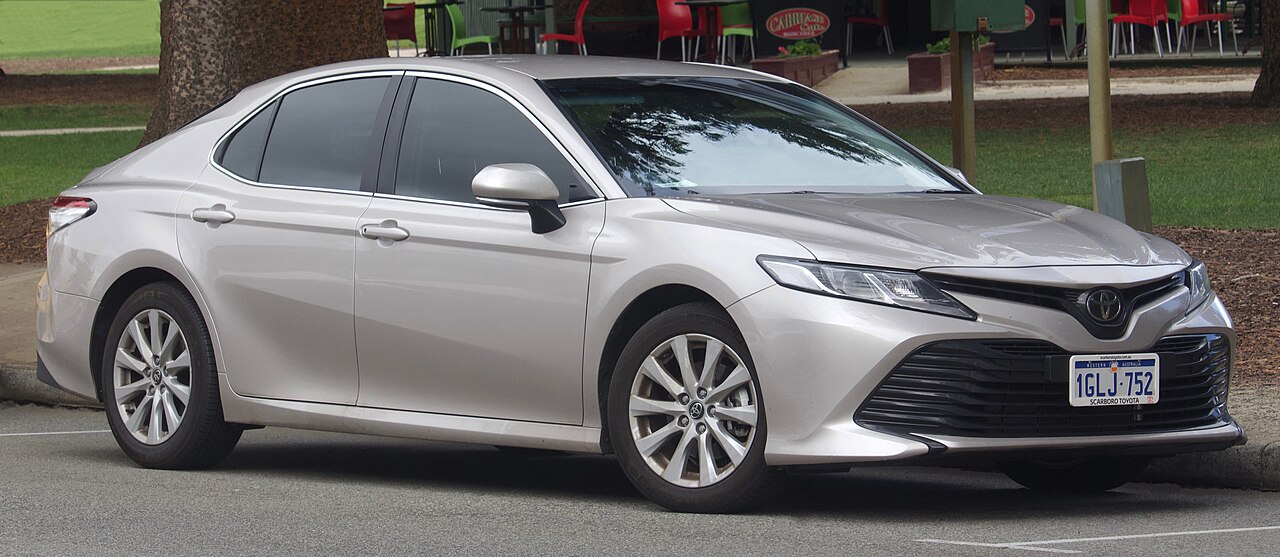 Licensed photo · Photo credit
Generations and technical specifications
Toyota Camry (XV80)2023–present
| Specification | Value |
|---|---|
| Model code | XV80 |
| Production | October 2023 – present (China) April 2024 – present (US) October 2024 – present (Thailand) December 2024 – present (India) |
| Model years | 2025 – present |
| Body styles | 4-door sedan |
| Layout | Front-engine, front-wheel-drive Front-engine, four-wheel-drive |
| Platform | TNGA: GA-K |
| Engines | Gasoline 2.0 L M20A-FKS I4 (MXVA80) 2.0 L M20C-FKS I4 (China, MXVA80) 2.5 L A25A-FKS I4 (AXVA80) Gasoline hybrid 2.0 L M20F-FXS I4 (China, MXVH80) 2.5 L A25A-FXS I4 (AXVH80) 2.5 L A25D-FXS I4 (China, AXVH80) |
| Transmissions | 8-speed UB80E automatic (A25A-FKS) K120 CVT with physical first gear (M20A-FKS/M20C-FKS) Aisin Seiki T110 eCVT (hybrid models) |
| Drivetrain | Power-split |
| Wheelbase | 2,825 mm |
| Length | 4,885–4,920 mm |
| Width | 1,840 mm |
| Height | 1,445 mm |
| Class | Mid-size car |
| Assembly | Japan: Toyota, Aichi (Tsutsumi plant, export only) China: Nansha, Guangzhou (GAC Toyota) India: Bidadi (TKML) Thailand: Chachoengsao (TMT) United States: Georgetown, Kentucky (TMMK) |
| Designer | Adam Rabinowitz |
Toyota Camry (XV70)2017–2024
| Specification | Value |
|---|---|
| Production | June 2017 – December 2023 (Japan) June 2017 – April 2024 (US) December 2017 – October 2023 (China) April 2018 – March 2022 (Russia) October 2018 – October 2024 (Thailand) January 2019 – December 2024 (India) |
| Model years | 2018–2024 |
| Body styles | 4-door sedan |
| Layout | Front-engine, front-wheel-drive Front-engine, four-wheel-drive |
| Platform | TNGA: GA-K |
| Engines | Petrol 2.0 L 6AR-FSE I4 2.0 L M20A-FKS I4 2.0 L M20C-FKS I4 (China) 2.0 L 6AR-FBS I4 2.5 L 2AR-FE I4 2.5 L A25A-FKS I4 2.5 L A25A-FKB I4 2.5 L A25C-FKS I4 (China) 3.5 L 2GR-FKS V6 Petrol hybrid 2.5 L A25A-FXS I4 2.5 L A25D-FXS I4 (China) |
| Electric motor | 88 kW 3NM permanent magnet synchronous (hybrid) |
| Transmissions | 6-speed U761E automatic (6AR-FSE, 6AR-FBS, 2AR-FE) 8-speed UA80E automatic (2GR-FKS) 8-speed UB80E automatic (A25A-FKS, A25A-FKB) K120 CVT with physical first gear Aisin Seiki T110 eCVT (hybrid) |
| Drivetrain | Power-split (hybrid) |
| Battery | 6.5 Ah (1.6 kW·h) 244.8V NiMH 1.0 kW·h 259V Li-ion (Hybrid LE; North America) |
| Wheelbase | 2,824 mm |
| Length | 4,879–4,910 mm |
| Width | 1,839 mm |
| Height | 1,445 mm |
| Class | Mid-size car |
| Assembly | Japan: Toyota, Aichi (Tsutsumi plant) United States: Georgetown, Kentucky (TMMK) China: Nansha, Guangzhou (GAC Toyota) Thailand: Chachoengsao (TMT) India: Bidadi (TKML) Russia: Saint Petersburg (TMMR) |
| Designer | Ian Cartabiano (Concept leader, Exterior SE/XSE, US-Specification: 2014, 2015) Shin Okahara (regular exterior: 2014) Ken Kubota (Project chief designer) Toshimitsu Araki (interior design: 2014) Chinatsu Kato (colours & trim: 2015–16) |
Toyota Camry (XV50)2011–2020
| Specification | Value |
|---|---|
| Production | February 2012 – August 2017 (Aurion) August 2011 – May 2017 (Japan, US) October 2011 – October 2017 (Australia) November 2011 – December 2017 (China) November 2011 – March 2018 (Russia) December 2011 – August 2020 (Taiwan) March 2012 – September 2018 (Thailand) May 2012 – October 2018 (Malaysia) July 2012 – March 2019 (Vietnam) August 2012 – November 2018 (India) |
| Model years | 2012–2017 |
| Body styles | 4-door sedan |
| Layout | Front-engine, front-wheel-drive |
| Platform | Toyota K platform |
| Engines | 2.0 L 1AZ-FE VVT-i I4 145 hp 2.0 L 6AR-FSE VVT-iW D-4S I4 165 hp (Malaysia, Thailand, Taiwan, Russia and China) 2.5 L 2AR-FE Dual VVT-i I4 178–181 hp 2.5 L 5AR-FE Dual VVT-i I4 173 hp (China) 3.5 L 2GR-FE Dual VVT-i V6 268 hp 2.5 L 2AR-FXE Dual VVT-i I4 154 hp Hybrid electric |
| Electric motor | 105 kW 2JM permanent magnet synchronous (hybrid) |
| Transmissions | 4/6-speed automatic 6-speed manual eCVT (hybrid) |
| Drivetrain | Series-parallel (HSD) |
| Battery | 1.6 kWh Panasonic High voltage NiMH |
| Wheelbase | 2,775 mm |
| Length | 4,865 mm (US & Asia) 4,820 mm |
| Width | 1,820 mm |
| Height | 1,470 mm |
| Kerb weight | 1,447 kg (LE) 1,470 kg (SE) 1,540 kg (XLE V6) 1,551 kg (SE V6) |
| Class | Mid-size car |
| Assembly | Japan: Toyota, Aichi (Tsutsumi plant) Australia: Altona China: Nansha, Guangzhou India: Bidadi (TKML) Malaysia: Shah Alam (UMW Toyota Motor) Russia: Saint Petersburg Taiwan: Zhongli (Kuozui Motors) Thailand: Chachoengsao United States: Georgetown, Kentucky (TMMK); Lafayette, Indiana (SIA) Vietnam: Phúc Yên, Vĩnh Phúc |
| Designer | Hirotada Kobayashi and Tomonori Matsumoto (regular: 2009) Kentarou Asakura (sports version, regular: 2009) Hirofumi Fukui and Kazumi Kowaki (prestige: 2009) Keisuke Matsuno (hybrid version, prestige: 2009) Matt Sperling and Kengo Iwanaga (facelift, regular: 2012) |
Toyota Camry (XV40)2006–2011
| Specification | Value |
|---|---|
| Production | January 2006 – August 2011 (Japan) February 2006 – August 2011 (US) June 2006 – October 2011 (Australia) December 2007 – October 2011 (Russia) |
| Model years | 2007–2011 |
| Body styles | 4-door sedan |
| Layout | Front-engine, front-wheel drive Front-engine, four-wheel drive |
| Platform | Toyota K platform |
| Engines | Gasoline 2.0 L 1AZ-FE VVT-i I4 2.4 L 2AZ-FE VVT-i I4 2.5 L 2AR-FE Dual VVT-i I4 3.5 L 2GR-FE Dual VVT-i V6 Gasoline hybrid 2.4 L 2AZ-FXE VVT-i I4 |
| Electric motor | 2x Permanent magnet Motor (Camry Hybrid) |
| Transmissions | 5/6-speed manual 4/5/6-speed automatic eCVT (hybrid) |
| Drivetrain | Series-parallel (Hybrid Synergy Drive) |
| Battery | 1.6 kWh Panasonic High voltage NiMH |
| Wheelbase | 2,776 mm |
| Length | 4,805 mm |
| Width | 1,820 mm |
| Height | 1,470 mm |
| Class | Mid-size car |
| Assembly | Japan: Toyota, Aichi (Tsutsumi plant) Australia: Altona, Victoria (TMCA) Russia: Saint Petersburg United States: Georgetown, Kentucky (TMMK); Lafayette, Indiana (SIA) |
| Designer | Hiroyuki Metsugi (2003) Takafumi Ito and Kazumi Kouwaki (2009 regular model facelift: 2007) Anthony Cheung and Nicolas Hogios (2009 Prestige model facelift) |
Toyota Camry (XV30)2001–2006
| Specification | Value |
|---|---|
| Production | June 2001 – December 2005 (Japan) July 2001 – February 2006 (US) August 2002 – June 2006 (Australia) |
| Model years | 2002–2006 |
| Body styles | 4-door sedan |
| Layout | Front-engine, front-wheel drive Front-engine, four-wheel drive |
| Platform | Toyota K platform |
| Engines | 2.0 L 1AZ-FE VVT-i I4, 144 hp 2.4 L 2AZ-FE VVT-i I4, 157 hp 3.0 L 1MZ-FE VVT-i V6 192 hp w/o VVT-i (2002) 210 hp w/ VVT-i (2003–2006) 3.3 L 3MZ-FE VVT-i V6 225 hp SE (2004–2006) |
| Transmissions | 5-speed manual 4-speed U241E automatic 5-speed U151E automatic 4-speed U140E automatic 5-speed U250E automatic |
| Wheelbase | 2,720 mm |
| Length | 4,820 mm |
| Width | 1,810 mm |
| Height | 1,490 mm (2005–06) 1,470 mm (2002–04 LE) 1,480 mm (2002–04 SE & XLE) |
| Class | Mid-size car |
| Assembly | Japan: Toyota, Aichi (Tsutsumi plant) Australia: Altona Malaysia: Shah Alam Philippines: Santa Rosa (TMP) Taiwan: Zhongli (Kuozui Motors) Thailand: Chachoengsao United States: Georgetown, Kentucky Vietnam: Phúc Yên, Vĩnh Phúc |
| Designer | Kengo Matsumoto, Hiroyuki Metsugi and Machio Nakamura (1999) |
Toyota Camry – V501998–2003
| Specification | Value |
|---|---|
| Model code | V50 |
| Production | July 1998 – October 2003 |
| Body styles | 4-door sedan 5-door station wagon |
| Layout | Transverse front-engine, front-wheel-drive Transverse front-engine, four-wheel-drive |
| Platform | Toyota MC platform |
| Engines | 1.8 L I4 2.0 L I4 |
| Wheelbase | 2,700 mm |
| Length | 4,670 mm |
| Width | 1,695 mm |
| Kerb weight | 1,310 kg |
| Assembly | Japan: Toyota, Aichi (Tsutsumi plant) |
Toyota Camry (XV20)1996–2002
| Specification | Value |
|---|---|
| Model code | XV20 |
| Production | August 1996 – July 2001 (Japan, U.S.) September 1996 – June 2002 (Philippines) July 1997 – August 2002 (Australia) March 1997 – May 2002 (Thailand) June 1999 – September 2002 (Indonesia) |
| Model years | 1997–2001 |
| Body styles | 4-door sedan 5-door station wagon |
| Layout | Front-engine, front-wheel drive Front-engine, four-wheel drive |
| Engines | 2.2 L 5S-FE I4 (gasoline) 3.0 L 1MZ-FE VVT-i V6 (gasoline) 2.5 L 2MZ-FE V6 (gasoline) |
| Transmissions | 5-speed E153 manual 5-speed S51 manual 4-speed A140E automatic 4-speed A541E automatic |
| Wheelbase | 2,670 mm |
| Length | 4,765 mm |
| Width | 1,786 mm |
| Height | 1,430 mm |
| Kerb weight | 1,361 kg |
| Class | Mid-size car |
| Assembly | Japan: Toyota, Aichi (Tsutsumi plant) Australia: Altona China: Zhanjiang, Guangdong Indonesia: Karawang (1999–2002) Philippines: Parañaque (1996–1997); Santa Rosa (1997–2002) Thailand: Chachoengsao United States: Georgetown, Kentucky Vietnam: Vĩnh Phúc |
| Designer | Kawazu Masahiko (1993) |
Toyota Camry (XV10)1991–2002
| Specification | Value |
|---|---|
| Production | September 1991 – August 1996 (US) November 1991 – July 1996 (Japan) 1991–1994 (China) September 1992 – October 2002 (South Africa) December 1992 – July 1997 (Australia) October 1993 – February 1997 (Thailand) |
| Model years | 1992–1996 |
| Body styles | 2-door coupé 4-door sedan 4-door station wagon |
| Layout | Front-engine, front-wheel drive |
| Engines | 2.2 L 5S-FE I4 3.0 L 3VZ-FE V6 3.0 L 1MZ-FE V6 |
| Transmissions | 5-speed E53 manual 5-speed S51 manual 4-speed A140E automatic 4-speed A540E automatic 4-speed A541E automatic |
| Wheelbase | 2,620 mm |
| Length | Sedan: 4,780 mm Station wagon: 4,811 mm |
| Width | 1,770 mm |
| Height | Coupé: 1,394 mm Sedan: 1,410 mm Station wagon: 1,430 mm |
| Class | Mid-size car |
| Assembly | Japan: Toyota City, Aichi (Tsutsumi plant) Australia: Port Melbourne (1993–1994); Altona (1994–1997): (Toyota Australia) China: Zhanjiang, Guangdong South Africa: Durban United States: Georgetown, Kentucky |
| Designer | Osamu Shikado (1988) Tadahiro Kobayashi (Facelift: 1993) |
Engines and transmissions
| Model years | Engine | Transmission | Drive | Fuel |
|---|---|---|---|---|
| 2025–2026 | 2.5 L, 4 cyl hybrid | CVT (continuously variable) | All-wheel drive | Petrol (regular) |
| 2012–2026 | 2.5 L, 4 cyl hybrid | CVT (continuously variable) | Front-wheel drive | Petrol (regular) |
| 2020–2024 | 2.5 L, 4 cyl | 8-speed automatic | All-wheel drive | Petrol (regular) |
| 2018–2024 | 2.5 L, 4 cyl | 8-speed automatic | Front-wheel drive | Petrol (regular) |
| 2018–2024 | 3.5 L, 6 cyl | 8-speed automatic | Front-wheel drive | Petrol (regular) |
| 2010–2017 | 2.5 L, 4 cyl | 6-speed automatic | Front-wheel drive | Petrol (regular) |
| 2007–2017 | 3.5 L, 6 cyl | 6-speed automatic | Front-wheel drive | Petrol (regular) |
| 2007–2011 | 2.4 L, 4 cyl hybrid | CVT (continuously variable) | Front-wheel drive | Petrol (regular) |
| 2010–2011 | 2.5 L, 4 cyl | 6-speed manual | Front-wheel drive | Petrol (regular) |
| 2005–2009 | 2.4 L, 4 cyl | 5-speed automatic | Front-wheel drive | Petrol (regular) |
| 2002–2009 | 2.4 L, 4 cyl | 5-speed manual | Front-wheel drive | Petrol (regular) |
| 2003–2006 | 3.0 L, 6 cyl | 5-speed automatic | Front-wheel drive | Petrol (regular) |
| +7 more configurations |
Fuel economy (EPA)
| Model years | Configuration | Combined | City | Highway |
|---|---|---|---|---|
| 2025–2026 | 2.5 L, 4 cyl hybrid · CVT (continuously variable) · All-wheel drive | 4.7–5.5 L/100 km | 4.6–5.5 L/100 km | 4.8–5.5 L/100 km |
| 2012–2026 | 2.5 L, 4 cyl hybrid · CVT (continuously variable) · Front-wheel drive | 4.5–6.2 L/100 km | 4.4–5.9 L/100 km | 4.4–6.4 L/100 km |
| 2020–2024 | 2.5 L, 4 cyl · 8-speed automatic · All-wheel drive | 8.1–8.4 L/100 km | 9.4 L/100 km | 6.9 L/100 km |
| 2018–2024 | 2.5 L, 4 cyl · 8-speed automatic · Front-wheel drive | 6.9–7.6 L/100 km | 8.1–8.7 L/100 km | 5.7–6.2 L/100 km |
| 2018–2024 | 3.5 L, 6 cyl · 8-speed automatic · Front-wheel drive | 9.0–9.4 L/100 km | 10.7 L/100 km | 7.1–7.6 L/100 km |
| 2010–2017 | 2.5 L, 4 cyl · 6-speed automatic · Front-wheel drive | 8.4–9.4 L/100 km | 9.4–10.7 L/100 km | 6.9–7.6 L/100 km |
| 2007–2017 | 3.5 L, 6 cyl · 6-speed automatic · Front-wheel drive | 9.4–10.7 L/100 km | 11.2–12.4 L/100 km | 7.8–8.4 L/100 km |
| 2007–2011 | 2.4 L, 4 cyl hybrid · CVT (continuously variable) · Front-wheel drive | 6.9–7.1 L/100 km | 7.1–7.6 L/100 km | 6.7–6.9 L/100 km |
| 2010–2011 | 2.5 L, 4 cyl · 6-speed manual · Front-wheel drive | 9.0 L/100 km | 10.7 L/100 km | 7.1–7.4 L/100 km |
| 2005–2009 | 2.4 L, 4 cyl · 5-speed automatic · Front-wheel drive | 9.4–9.8 L/100 km | 11.2 L/100 km | 7.6–7.8 L/100 km |
| 2002–2009 | 2.4 L, 4 cyl · 5-speed manual · Front-wheel drive | 9.4–9.8 L/100 km | 11.2 L/100 km | 7.6–7.8 L/100 km |
| 2003–2006 | 3.0 L, 6 cyl · 5-speed automatic · Front-wheel drive | 11.2 L/100 km | 13.1 L/100 km | 8.7–9.0 L/100 km |
| +7 more configurations |
Values are the official EPA label figures for each model year, shown as the lowest and highest value for the configuration. Electric models show energy use per 100 km. Real-world consumption depends on driving style, weather and load. Luggage and passenger volumes follow the EPA measuring method and can differ from the VDA figures used in Europe.
EU type-approval data
| Years | Powertrain | Engine | Power | Mass | CO₂ |
|---|---|---|---|---|---|
| 2019–2025 | Petrol hybrid | 2487 cm³ | 131 kW (178 PS) | 1670–1698 kg | 120–126 g/km (WLTP) |
| 2024–2025 | Petrol hybrid | 2487 cm³ | 137 kW (186 PS) | 1635–1645 kg | 109–111 g/km (WLTP) |
| 2019–2021 | Petrol | 2487 cm³ | 131 kW (178 PS) | 1450–1670 kg | 119–126 g/km (WLTP) |
| 2020–2021 | Petrol plug-in hybrid | 2487 cm³ | 131 kW (178 PS) | 1730–1743 kg | 120 g/km (WLTP) |
Years are registration years. Each range runs from the 10th to the 90th percentile of the values reported for new registrations; it is not an average. Mass is the mass in running order. For electric cars the power is the type-approval net power, which can be lower than the peak power in brochures.
Key specifications
| Specification | Value |
|---|---|
| EPA size class | Midsize car, Compact car |
| Model years in EPA data | 2000–2026 |
| Powertrains | Hybrid, Petrol, Natural gas (CNG) |
| Engine displacement | 2.2–3.5 L |
| Cylinders | 4, 6 |
| Transmission types | CVT, Automatic, Manual |
| Drive | All-wheel drive, Front-wheel drive |
| Fuel | Petrol (regular), Natural gas (CNG) |
| Configurations listed | 144 |
| Start-stop system | On some versions |
| Luggage volume (EPA) | 255–481 L |
| Passenger volume (EPA) | 2,747–2,917 L |
| Powertrains (EU) | Petrol, Petrol hybrid |
| Engine displacement (EU) | 2,487 cm³ |
| Power (EU) | 131–137 kW (178–186 PS) |
| Mass in running order (EU) | 1,450–1,698 kg |
| Wheelbase (EU) | 2,825 mm |
Years and markets
| Specification | Value |
|---|---|
| Model years (US) | 2000–2027 |
| New registrations (EU) | 2000–2025 |
Owner complaints (NHTSA)
| Component | Complaints | Most reported model years |
|---|---|---|
| Speed control and cruise | 3064 | 2002, 2007, 2009 |
| Brakes | 2237 | 2002, 2007, 2009 |
| Engine and cooling | 2212 | 2002, 2007, 2009 |
| Visibility and wipers | 1495 | 2007, 2008, 2009 |
| Transmission and drivetrain | 1478 | 2007, 2012, 2018 |
| Body and structure | 1476 | 2007, 2008, 2009 |
| Airbags | 1333 | 2002, 2004, 2007 |
| Electrical system | 1087 | 2007, 2009, 2012 |
| Steering | 939 | 2004, 2007, 2015 |
| Fuel and propulsion | 622 | 2007, 2018, 2019 |
Source: complaints filed by owners with the U.S. National Highway Traffic Safety Administration (NHTSA) for model years 2000–2024: 15454 complaints, 2459 with a crash and 251 with a fire. Complaints are owner reports that NHTSA has not verified, and one complaint can name more than one component. More complaints can also mean more cars sold.