Avalon
Toyota Avalon: official NHTSA recalls, fault code help and maintenance guides.
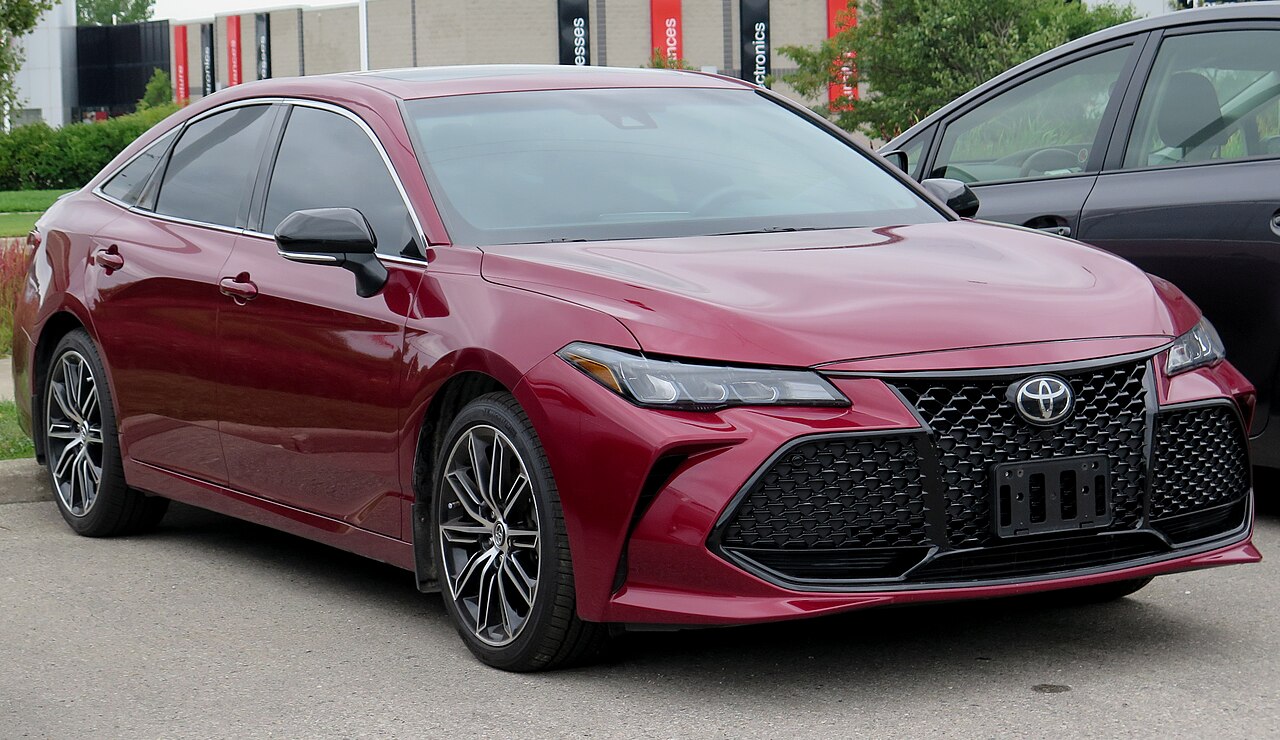 Licensed photo · Photo credit
Generations and technical specifications
Toyota Avalon – Fifth generation2018–present
| Specification | Value |
|---|---|
| Model code | XX50 |
| Production | April 2018 – August 2022 (US) 2019–present (China) |
| Model years | 2019–2022 (US) |
| Layout | Front-engine, front-wheel-drive Front-engine, four-wheel-drive (2020–2022) |
| Platform | TNGA: GA-K |
| Engines | Gasoline 2.0 L M20A-FKS I4 (gasoline) 2.0 L M20D-FKS I4 (gasoline, China) 2.5 L A25A-FKS I4 (gasoline, AWD) 2.5 L A25G-FKS I4 (gasoline, China) 3.5 L 2GR-FKS V6 (gasoline) Hybrid 2.5 L A25A-FXS I4 (hybrid) 2.5 L A25H-FXS I4 (hybrid, China) |
| Transmissions | K120 CVT with physical first gear (2.0 L I4) 8-speed Direct Shift automatic (2.5 L I4 & 3.5 L V6) eCVT (hybrid) |
| Drivetrain | Power-split |
| Battery | 1.0 kW·h 259V Li-ion |
| Wheelbase | 2,870 mm |
| Length | 4,978 mm |
| Width | 1,849 mm |
| Height | 1,435 mm |
| Kerb weight | 1,615–1,685 kg |
| Assembly | United States: Georgetown, Kentucky (TMMK) China: Tianjin (2019–2022: TFTM) China: Sichuan (2021–present: SFTM) |
| Designer | Randy Stephens (2015) |
Toyota Avalon – Fourth generation2012–2018
| Specification | Value |
|---|---|
| Model code | XX40 |
| Production | November 2012 – March 2018 |
| Model years | 2013–2018 |
| Layout | Front-engine, front-wheel-drive |
| Platform | Toyota K platform |
| Engines | 3.5 L 2GR-FE V6 2.5 L 2AR-FXE I4 (hybrid) |
| Transmissions | 6-speed automatic eCVT (hybrid) |
| Drivetrain | Power-split |
| Wheelbase | 2,820 mm |
| Length | 4,978 mm |
| Width | 1,835 mm |
| Height | 1,460 mm |
| Kerb weight | 1,575–1,630 kg |
| Assembly | United States: Georgetown, Kentucky (TMMK) |
| Designer | Kevin Hunter and Ian Cartabiano (2010) |
Toyota Avalon – Third generation2004–2012
| Specification | Value |
|---|---|
| Model code | XX30 |
| Production | December 2004 – October 2012 |
| Model years | 2005–2012 |
| Layout | Front-engine, front-wheel-drive |
| Platform | Toyota K platform |
| Engines | 3.5 L 2GR-FE V6 |
| Transmissions | 5-speed U151E automatic 6-speed U660E automatic |
| Wheelbase | 2,820 mm |
| Length | 2004–2010: 5,009 mm 2010–2012: 5,020 mm |
| Width | 1,850 mm |
| Height | 1,485 mm |
| Kerb weight | 1,615–1,660 kg |
| Assembly | United States: Georgetown, Kentucky (TMMK) |
| Designer | Masanari Sakae, Yoshikazu Harada, Kenta Shimoguchi and Ian Cartabiano (2003) |
Toyota Avalon – Second generation1999–2004
| Specification | Value |
|---|---|
| Model code | XX20 |
| Production | September 1999 – November 2004 |
| Model years | 2000–2004 |
| Layout | Front-engine, front-wheel-drive |
| Platform | Toyota K platform |
| Engines | 3.0 L 1MZ-FE V6 |
| Transmissions | 4-speed A541E automatic |
| Wheelbase | 2,720 mm |
| Length | 4,874 mm |
| Width | 1,821 mm |
| Height | 1999–2002: 1,466 mm 2002–2004: 1,450 mm |
| Assembly | United States: Georgetown, Kentucky (TMMK) |
| Designer | Kevin Hunter and Yo Hiruta (1997) |
Toyota Avalon – First generation1994–2005
| Specification | Value |
|---|---|
| Model code | XX10 |
| Production | September 1994 – August 1999 April 2000 – June 2005 (Australia) |
| Model years | 1995–1999 |
| Layout | Front-engine, front-wheel-drive |
| Platform | Toyota K platform (for Australian market) |
| Engines | 3.0 L 1MZ-FE V6 |
| Transmissions | 4-speed A541E automatic |
| Wheelbase | 2,720 mm |
| Length | 1994–97: 4,831 mm 1997–99: 4,874 mm |
| Width | 1994–97: 1,786 mm 1997–99: 1,791 mm |
| Height | 1994–97: 1,420 mm 1997–99: 1,440 mm |
| Assembly | United States: Georgetown, Kentucky (TMMK) Australia: Altona (Toyota Australia) |
| Designer | Kawazu Masahiko (Design Manager: 1991) Kusama Toshiharu (Design Chief: 1990-93) Hideaki Otsubo (facelift: 1995) |
Engines and transmissions
| Model years | Engine | Transmission | Drive | Fuel |
|---|---|---|---|---|
| 2013–2022 | 2.5 L, 4 cyl hybrid | CVT (continuously variable) | Front-wheel drive | Petrol (regular) |
| 2019–2022 | 3.5 L, 6 cyl | 8-speed automatic | Front-wheel drive | Petrol (regular) |
| 2021 | 2.5 L, 4 cyl | 8-speed automatic | All-wheel drive | Petrol (regular) |
| 2008–2018 | 3.5 L, 6 cyl | 6-speed automatic | Front-wheel drive | Petrol (regular) |
| 2005–2007 | 3.5 L, 6 cyl | 5-speed automatic | Front-wheel drive | Petrol (regular) |
| 2000–2004 | 3.0 L, 6 cyl | 4-speed automatic | Front-wheel drive | Petrol (regular) |
Fuel economy (EPA)
| Model years | Configuration | Combined | City | Highway |
|---|---|---|---|---|
| 2013–2022 | 2.5 L, 4 cyl hybrid · CVT (continuously variable) · Front-wheel drive | 5.3–5.9 L/100 km | 5.5–5.9 L/100 km | 5.3–6.0 L/100 km |
| 2019–2022 | 3.5 L, 6 cyl · 8-speed automatic · Front-wheel drive | 9.0–9.4 L/100 km | 10.7–11.2 L/100 km | 7.4–7.8 L/100 km |
| 2021 | 2.5 L, 4 cyl · 8-speed automatic · All-wheel drive | 8.4 L/100 km | 9.4 L/100 km | 6.9 L/100 km |
| 2008–2018 | 3.5 L, 6 cyl · 6-speed automatic · Front-wheel drive | 9.4–10.7 L/100 km | 11.2–12.4 L/100 km | 7.8–8.4 L/100 km |
| 2005–2007 | 3.5 L, 6 cyl · 5-speed automatic · Front-wheel drive | 10.2–10.7 L/100 km | 11.8–12.4 L/100 km | 8.4 L/100 km |
| 2000–2004 | 3.0 L, 6 cyl · 4-speed automatic · Front-wheel drive | 10.7–11.2 L/100 km | 12.4–13.1 L/100 km | 8.7 L/100 km |
Values are the official EPA label figures for each model year, shown as the lowest and highest value for the configuration. Electric models show energy use per 100 km. Real-world consumption depends on driving style, weather and load. Luggage and passenger volumes follow the EPA measuring method and can differ from the VDA figures used in Europe.
Key specifications
| Specification | Value |
|---|---|
| EPA size class | Midsize car, Large car |
| Model years in EPA data | 2000–2022 |
| Powertrains | Petrol, Hybrid |
| Engine displacement | 2.5–3.5 L |
| Cylinders | 4, 6 |
| Transmission types | Automatic, CVT |
| Drive | Front-wheel drive, All-wheel drive |
| Fuel | Petrol (regular) |
| Configurations listed | 45 |
| Start-stop system | On some versions |
| Luggage volume (EPA) | 396–453 L |
| Passenger volume (EPA) | 2,917–3,030 L |
Years and markets
| Specification | Value |
|---|---|
| Model years (US) | 2000–2022 |
Owner complaints (NHTSA)
| Component | Complaints | Most reported model years |
|---|---|---|
| Speed control and cruise | 551 | 2005, 2006, 2007 |
| Airbags | 536 | 2002, 2003, 2004 |
| Steering | 292 | 2000, 2005, 2006 |
| Lights | 280 | 2006, 2008, 2009 |
| Electrical system | 256 | 2003, 2008, 2011 |
| Engine and cooling | 255 | 2000, 2005, 2006 |
| Brakes | 241 | 2000, 2005, 2006 |
| Transmission and drivetrain | 190 | 2005, 2006, 2007 |
| Body and structure | 179 | 2006, 2007, 2013 |
| Visibility and wipers | 150 | 2000, 2011, 2013 |
Source: complaints filed by owners with the U.S. National Highway Traffic Safety Administration (NHTSA) for model years 2000–2022: 2911 complaints, 440 with a crash and 24 with a fire. Complaints are owner reports that NHTSA has not verified, and one complaint can name more than one component. More complaints can also mean more cars sold.