A5
Audi A5: official NHTSA recalls, fault code help and maintenance guides.
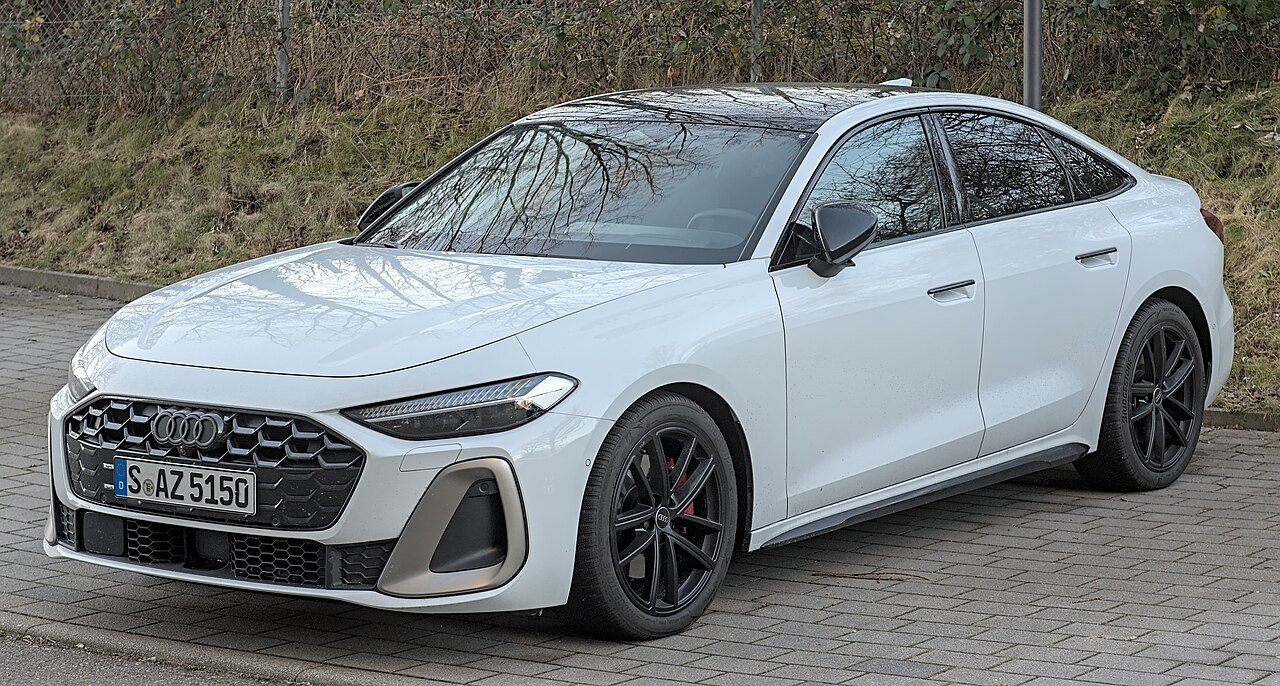 Licensed photo · Photo credit
Generations and technical specifications
Audi A5 – Third generation2024–present
| Specification | Value |
|---|---|
| Model code | B10 |
| Production | August 2024 – present |
| Model years | 2025–present |
| Body styles | 5-door liftback (A5, A5L sportback) 4-door sedan (A5L sedan) 5-door station wagon (Avant) |
| Platform | Premium Platform Combustion (PPC) |
| Engines | Petrol 2.0 L EA888 I4 turbo (MHEV) 3.0 L EA839 V6 turbo (MHEV) Petrol-PHEV 2.0 L EA888 I4 turbo (CDL) (e-hybrid) 2.9 L EA839TT twin-turbocharged V6 (RS5) Diesel 2.0 L EA288 evo I4 turbo (MHEV) |
| Electric motor | 48-volt main electrical system (MHEV) Permanent-magnet electric motor (e-hybrid) |
| Transmissions | 7-speed dual-clutch 7-speed S tronic dual-clutch automatic (e-hybrid) |
| Drivetrain | Mild hybrid 48V PHEV (e-hybrid) |
| Battery | 25.9 kWh Li-ion (e-hybrid) |
| Electric range | 72 km (e-hybrid) |
| Wheelbase | 2,900 mm 2,969 mm (A5L sedan) 2,922 mm (A5L sportback) |
| Length | 4,829 mm 4,908 mm (A5L sedan) 4,903 mm (A5L sportback) |
| Width | 1,860 mm 1,883 mm (A5L sportback) |
| Height | 1,440 mm 1,442 mm (A5L sedan) 1,427 mm (A5L sportback) |
| Kerb weight | 1,770–2,040 kg |
| Assembly | Germany: Neckarsulm China: Changchun (FAW-VW, A5L Sedan) Shanghai (SAIC-VW, A5L Sportback) |
| Designer | Jakob Hirzel Ramon Bäurle (interior designer) |
Audi A5 – Second generation2016–2025
| Specification | Value |
|---|---|
| Model code | F5 |
| Production | June 2016 – 2024 |
| Model years | 2018–2024 (coupe and cabriolet) 2018–2025 (sportback) |
| Body styles | 2-door coupé 2-door convertible 4-door liftback sedan |
| Platform | Volkswagen Group MLBevo platform |
| Engines | Petrol: 1.4 L EA211 TFSI I4 16V 152 (35 TFSI) 2.0 L EA888 TFSI I4 + Mild Hybrid 48V 190 (40 TFSI / 40 TFSI S-Line) 2.0L TFSI + CNG I4 170 (g-Tron) 2.0 L EA888 CDLA TFSI I4 + Mild Hybrid 48V 252 (45 TFSI/45 TFSI Quattro) 2.9 L BiTurbo TFSI V6 450 (RS5) 3.0 L TFSI V6 355 (S5) Diesel 2.0 L TDI I4 190 3.0 L V6 TDI 220 3.0 L V6 TDI 290 |
| Transmissions | 6-speed manual 7-speed S-Tronic dual-clutch automatic 8-speed tiptronic automatic (A5 3.0 TDI & S5 & RS5) |
| Drivetrain | MHEV |
| Wheelbase | A5 Coupé & Cabriolet: 2,764 mm S5 Coupé: 2,765 mm A5 Sportback: 2,824 mm S5 Sportback: 2,825 mm |
| Length | S5 Coupé A5 Sportback: 4,733 mm S5 Sportback: 4,752 mm |
| Width | A5 & S5 Coupé: 1,846 mm A5 & S5 Sportback: 1,843 mm |
| Height | A5 Coupé: 1,371 mm S5 Coupé: 1,368 mm A5 Sportback: 1,386 mm S5 Sportback: 1,384 mm |
| Assembly | Germany: Ingolstadt (Coupe & Sportback) Germany: Neckarsulm (Cabriolet) |
| Designer | Jakob Hirzel |
Engines and transmissions
| Model years | Engine | Transmission | Drive | Fuel |
|---|---|---|---|---|
| 2018–2020, 2025–2027 | 2.0 L, 4 cyl | 7-speed automated manual | All-wheel drive | Petrol (premium) |
| 2021–2025 | 2.0 L, 4 cyl mild hybrid | 7-speed automated manual | All-wheel drive | Petrol (premium) |
| 2010–2018 | 2.0 L, 4 cyl | 6-speed manual | All-wheel drive | Petrol (premium) |
| 2013–2017 | 2.0 L, 4 cyl | 8-speed automatic | All-wheel drive | Petrol (premium) or E85 |
| 2010–2014 | 2.0 L, 4 cyl | CVT (continuously variable) | Front-wheel drive | Petrol (premium) |
| 2011–2013 | 2.0 L, 4 cyl | 8-speed automatic | All-wheel drive | Petrol (premium) |
| 2010 | 2.0 L, 4 cyl | 6-speed automatic | All-wheel drive | Petrol (premium) |
| 2010 | 3.2 L, 6 cyl | 6-speed automatic | All-wheel drive | Petrol (premium) |
| 2008–2009 | 3.2 L, 6 cyl | 6-speed automatic | Four-wheel or all-wheel drive | Petrol (premium) |
| 2008–2009 | 3.2 L, 6 cyl | 6-speed manual | Four-wheel or all-wheel drive | Petrol (premium) |
Fuel economy (EPA)
| Model years | Configuration | Combined | City | Highway |
|---|---|---|---|---|
| 2018–2020, 2025–2027 | 2.0 L, 4 cyl · 7-speed automated manual · All-wheel drive | 8.7–9.0 L/100 km | 9.8–10.7 L/100 km | 6.9–7.6 L/100 km |
| 2021–2025 | 2.0 L, 4 cyl mild hybrid · 7-speed automated manual · All-wheel drive | 7.8–9.0 L/100 km | 9.0–10.2 L/100 km | 6.5–7.6 L/100 km |
| 2010–2018 | 2.0 L, 4 cyl · 6-speed manual · All-wheel drive | 8.7–9.4 L/100 km | 9.8–11.2 L/100 km | 7.1–7.8 L/100 km |
| 2011–2017 | 2.0 L, 4 cyl · 8-speed automatic · All-wheel drive | 9.8–10.2 L/100 km | 11.2–11.8 L/100 km | 7.8–8.4 L/100 km |
| 2010–2014 | 2.0 L, 4 cyl · CVT (continuously variable) · Front-wheel drive | 9.0–9.4 L/100 km | 9.8–10.7 L/100 km | 7.6–7.8 L/100 km |
| 2010 | 2.0 L, 4 cyl · 6-speed automatic · All-wheel drive | 10.2 L/100 km | 11.2–11.8 L/100 km | 8.7–9.0 L/100 km |
| 2010 | 3.2 L, 6 cyl · 6-speed automatic · All-wheel drive | 11.2 L/100 km | 13.1 L/100 km | 8.7 L/100 km |
| 2008–2009 | 3.2 L, 6 cyl · 6-speed automatic · Four-wheel or all-wheel drive | 11.2–11.8 L/100 km | 13.1–13.8 L/100 km | 8.7–9.0 L/100 km |
| 2008–2009 | 3.2 L, 6 cyl · 6-speed manual · Four-wheel or all-wheel drive | 11.8 L/100 km | 14.7 L/100 km | 8.7 L/100 km |
Values are the official EPA label figures for each model year, shown as the lowest and highest value for the configuration. Electric models show energy use per 100 km. Real-world consumption depends on driving style, weather and load. Luggage and passenger volumes follow the EPA measuring method and can differ from the VDA figures used in Europe.
EU type-approval data
| Years | Powertrain | Engine | Power | Mass | CO₂ | Electric range |
|---|---|---|---|---|---|---|
| 2018–2019, 2021, 2024–2025 | Petrol | 1984 cm³ | 110 kW (150 PS) | 1560–1785 kg | 154–162 g/km (WLTP) | – |
| 2021, 2023–2025 | Petrol | 1984 cm³ | 150 kW (204 PS) | 1660–1840 kg | 155–168 g/km (WLTP) | – |
| 2019–2025 | Petrol hybrid | 1984 cm³ | 110 kW (150 PS) | 1560–1740 kg | 143–163 g/km (WLTP) | – |
| 2020–2025 | Petrol hybrid | 1984 cm³ | 150 kW (204 PS) | 1590–1815 kg | 144–164 g/km (WLTP) | – |
| 2025 | Petrol plug-in hybrid | 1984 cm³ | 185 kW (252 PS) | 2145–2185 kg | 48–59 g/km (WLTP) | 97–106 km · 151–157 Wh/km |
| 2020–2025 | Diesel hybrid | 1968 cm³ | 150 kW (204 PS) | 1605–1975 kg | 130–152 g/km (WLTP) | – |
| 2020–2024 | Petrol hybrid | 1984 cm³ | 195 kW (265 PS) | 1670–1830 kg | 171–187 g/km (WLTP) | – |
| 2011–2016, 2019–2021, 2024 | Diesel | 1968 cm³ | 120 kW (163 PS) | 1550–1711 kg | 128–146 g/km (WLTP) | – |
| 2019–2024 | Diesel hybrid | 1968 cm³ | 120 kW (163 PS) | 1595–1600 kg | 127–144 g/km (WLTP) | – |
| 2019–2021 | Petrol hybrid | 1984 cm³ | 140 kW (190 PS) | 1560–1730 kg | 154–170 g/km (WLTP) | – |
| 2016–2021 | Diesel | 2967 cm³ | 210 kW (286 PS) | 1735–1935 kg | 189–199 g/km (WLTP) | – |
| 2014–2020 | Diesel | 1968 cm³ | 140 kW (190 PS) | 1595–1765 kg | 142–166 g/km (WLTP) | – |
| 2017–2019 | Petrol | 1984 cm³ | 140 kW (190 PS) | 1505–1720 kg | 157–171 g/km (WLTP) | – |
| 2013–2019 | Diesel | 1968 cm³ | 110 kW (150 PS) | 1590–1680 kg | 144–154 g/km (WLTP) | – |
| 2016–2018 | Petrol | 1984 cm³ | 185 kW (252 PS) | 1565–1800 kg | 112–164 g/km (WLTP) | – |
| 2011–2018 | Diesel | 1968 cm³ | 100 kW (136 PS) | 1595–1680 kg | 109–131 g/km (NEDC) | – |
| 2015–2018 | Diesel | 2967 cm³ | 160 kW (218 PS) | 1680–1895 kg | 123–164 g/km (NEDC) | – |
| 2015–2017 | Petrol | 1798 cm³ | 106 kW (144 PS) | 1565–1600 kg | 136–149 g/km (NEDC) | – |
| 2015–2017 | Petrol | 1798 cm³ | 130 kW (177 PS) | 1530–1730 kg | 136–154 g/km (NEDC) | – |
| 2011–2016 | Diesel | 2967 cm³ | 180 kW (245 PS) | 1715–1920 kg | 149–164 g/km (NEDC) | – |
| 2011–2015 | Petrol | 1798 cm³ | 125 kW (170 PS) | 1500–1730 kg | 134–143 g/km (NEDC) | – |
| 2013–2015 | Petrol | 1984 cm³ | 165 kW (224 PS) | 1575–1810 kg | 138–159 g/km (NEDC) | – |
| 2011–2015 | Diesel | 1968 cm³ | 130 kW (177 PS) | 1570–1700 kg | 120–139 g/km (NEDC) | – |
| 2011–2015 | Diesel | 2967 cm³ | 150 kW (204 PS) | 1640–1835 kg | 129–138 g/km (NEDC) | – |
| 2011–2014 | Diesel | 1968 cm³ | 105 kW (143 PS) | 1590–1630 kg | 119–152 g/km (NEDC) | – |
| + 4 more configurations |
Years are registration years. Each range runs from the 10th to the 90th percentile of the values reported for new registrations; it is not an average. Mass is the mass in running order. For electric cars the power is the type-approval net power, which can be lower than the peak power in brochures.
Key specifications
| Specification | Value |
|---|---|
| EPA size class | Midsize car, Subcompact car |
| Model years in EPA data | 2008–2027 |
| Powertrains | Petrol, Mild hybrid, Flex-fuel |
| Engine displacement | 2.0–3.2 L |
| Cylinders | 4, 6 |
| Transmission types | Automated manual, Manual, Automatic, CVT |
| Drive | All-wheel drive, Front-wheel drive, Four-wheel or all-wheel drive |
| Fuel | Petrol (premium), Petrol (premium) or E85 |
| Configurations listed | 67 |
| Forced induction | Turbocharged (on some versions) |
| Start-stop system | On some versions |
| Luggage volume (EPA) | 255–651 L |
| Passenger volume (EPA) | 2,294–2,718 L |
| Powertrains (EU) | Petrol, Petrol hybrid, Diesel, Diesel hybrid |
| Engine displacement (EU) | 1,798–2,967 cm³ |
| Power (EU) | 100–185 kW (136–252 PS) |
| Mass in running order (EU) | 1,500–1,975 kg |
| Wheelbase (EU) | 2,758–2,831 mm |
Years and markets
| Specification | Value |
|---|---|
| Model years (US) | 2008–2027 |
| New registrations (EU) | 2000, 2003–2005, 2007–2026 |
Owner complaints (NHTSA)
| Component | Complaints | Most reported model years |
|---|---|---|
| Electrical system | 72 | 2013, 2014, 2020 |
| Engine and cooling | 61 | 2010, 2013, 2014 |
| Airbags | 34 | 2008, 2010, 2012 |
| Steering | 23 | 2013, 2014, 2019 |
| Driver assistance | 22 | 2019, 2020, 2021 |
| Fuel and propulsion | 12 | 2009, 2012, 2013 |
| Body and structure | 10 | 2009, 2010, 2014 |
| Transmission and drivetrain | 10 | 2009, 2013, 2016 |
| Visibility and wipers | 10 | 2010, 2013, 2014 |
| Brakes | 6 | 2008, 2009, 2013 |
Source: complaints filed by owners with the U.S. National Highway Traffic Safety Administration (NHTSA) for model years 2008–2010, 2012–2021, 2026: 247 complaints, 5 with a crash and 3 with a fire. Complaints are owner reports that NHTSA has not verified, and one complaint can name more than one component. More complaints can also mean more cars sold.