Q7
Audi Q7: official NHTSA recalls, fault code help and maintenance guides.
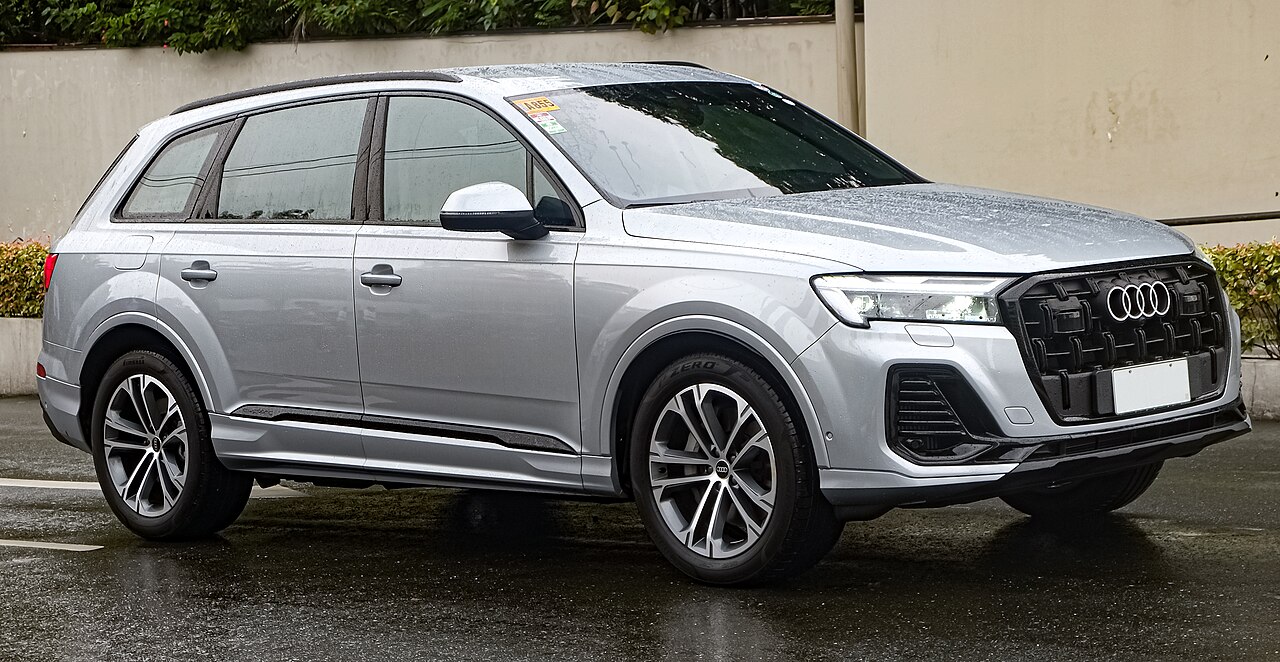 Licensed photo · Photo credit
Generations and technical specifications
Audi Q7 – Third generation2026
| Specification | Value |
|---|---|
| Model code | G8 |
| Production | 2026 (to commence) |
| Platform | Premium Platform Combustion |
| Engines | Petrol 2.9 L TFSI V6 4.0 L TFSI V8 Diesel 3.0 L TDI V6 |
| Transmissions | 8-speed automatic |
| Wheelbase | 2,995 mm |
| Length | 5,056 mm |
| Width | 2,010 mm |
| Height | 1,800 mm |
| Assembly | Slovakia: Bratislava (Volkswagen Bratislava Plant) |
Audi Q7 – Second generation2015–2026
| Specification | Value |
|---|---|
| Model code | 4M |
| Production | May 2015 – 2026 |
| Model years | 2016–2026 |
| Platform | Volkswagen Group MLB Evo |
| Engines | Petrol 2.0 L TFSI I4 3.0 L supercharged V6 3.0 L TFSI V6 4.0 L TFSI V8 Petrol plug-in hybrid 2.0 L TFSI I4 3.0 L TFSI V6 (Q7 e-tron TFSI) Diesel 3.0 L TDI V6 4.0 L TDI V8 Diesel plug-in hybrid 3.0 L TDI V6 (Q7 e-tron TDI) |
| Transmissions | 8-speed ZF 8HP automatic |
| Wheelbase | 2,994 mm |
| Length | 5,052 mm |
| Width | 1,968 mm |
| Height | 1,741 mm |
| Kerb weight | 1,910–2,445 kg |
| Assembly | Slovakia: Bratislava (Volkswagen Bratislava Plant) India: Aurangabad (Audi India) Russia: Kaluga (Volkswagen Group Rus) Malaysia: Pekan (HICOM) |
| Designer | Wolfgang Egger (2012, 2013) |
Audi Q7 – First generation2005–2015
| Specification | Value |
|---|---|
| Model code | 4L |
| Production | November 2005 – 2015 |
| Model years | 2006–2015 (Europe) 2007–2015 (North America) |
| Platform | Volkswagen Group PL71 platform |
| Engines | Petrol 3.0 L TFSI supercharged V6 3.6 L FSI VR6 4.2 L FSI V8 Diesel 3.0 L TDI V6 4.2 L TDI V8 6.0 L TDI V12 |
| Transmissions | 6-speed manual 6-speed Aisin/VW TR-60SN/09D automatic 8-speed TL-80SN/TR-82SD automatic |
| Wheelbase | 3,002 mm |
| Length | 5,085 mm |
| Width | 1,984 mm |
| Height | 1,737 mm |
| Kerb weight | 2,205–2,605 kg |
| Assembly | Slovakia: Bratislava (Volkswagen Bratislava Plant) India: Aurangabad (Audi India, CKD) Russia: Kaluga (Volkswagen Group Rus) |
| Designer | Satoshi Wada (concept design: 2002; production: 2003) |
Engines and transmissions
| Model years | Engine | Transmission | Drive | Fuel |
|---|---|---|---|---|
| 2017–2026 | 2.0 L, 4 cyl | 8-speed automatic | All-wheel drive | Petrol (premium) |
| 2020–2026 | 3.0 L, 6 cyl mild hybrid | 8-speed automatic | All-wheel drive | Petrol (premium) |
| 2011–2015, 2017–2019 | 3.0 L, 6 cyl | 8-speed automatic | All-wheel drive | Petrol (premium) |
| 2011–2015 | 3.0 L, 6 cyl | 8-speed automatic | All-wheel drive | Diesel |
| 2009–2010 | 3.0 L, 6 cyl | 6-speed automatic | All-wheel drive | Diesel |
| 2010 | 3.6 L, 6 cyl | 6-speed automatic | All-wheel drive | Petrol (premium) |
| 2010 | 4.2 L, 8 cyl | 6-speed automatic | All-wheel drive | Petrol (premium) |
| 2007–2009 | 3.6 L, 6 cyl | 6-speed automatic | Four-wheel or all-wheel drive | Petrol (premium) |
| 2007–2009 | 4.2 L, 8 cyl | 6-speed automatic | Four-wheel or all-wheel drive | Petrol (premium) |
Fuel economy (EPA)
| Model years | Configuration | Combined | City | Highway |
|---|---|---|---|---|
| 2017–2026 | 2.0 L, 4 cyl · 8-speed automatic · All-wheel drive | 10.7–11.2 L/100 km | 11.8–12.4 L/100 km | 9.0–10.2 L/100 km |
| 2020–2026 | 3.0 L, 6 cyl mild hybrid · 8-speed automatic · All-wheel drive | 11.2–13.1 L/100 km | 12.4–13.8 L/100 km | 9.8–11.2 L/100 km |
| 2011–2015, 2017–2019 | 3.0 L, 6 cyl · 8-speed automatic · All-wheel drive | 10.7–13.1 L/100 km | 12.4–14.7 L/100 km | 8.7–11.2 L/100 km |
| 2009–2010 | 3.0 L, 6 cyl · 6-speed automatic · All-wheel drive | 11.8 L/100 km | 13.8 L/100 km | 9.8 L/100 km |
| 2010 | 3.6 L, 6 cyl · 6-speed automatic · All-wheel drive | 14.7 L/100 km | 16.8 L/100 km | 12.4 L/100 km |
| 2010 | 4.2 L, 8 cyl · 6-speed automatic · All-wheel drive | 15.7 L/100 km | 18.1 L/100 km | 13.1 L/100 km |
| 2007–2009 | 3.6 L, 6 cyl · 6-speed automatic · Four-wheel or all-wheel drive | 14.7 L/100 km | 16.8 L/100 km | 11.8–13.1 L/100 km |
| 2007–2009 | 4.2 L, 8 cyl · 6-speed automatic · Four-wheel or all-wheel drive | 15.7–16.8 L/100 km | 18.1–19.6 L/100 km | 13.1–13.8 L/100 km |
Values are the official EPA label figures for each model year, shown as the lowest and highest value for the configuration. Electric models show energy use per 100 km. Real-world consumption depends on driving style, weather and load. Luggage and passenger volumes follow the EPA measuring method and can differ from the VDA figures used in Europe.
EU type-approval data
| Years | Powertrain | Engine | Power | Mass | CO₂ | Electric range |
|---|---|---|---|---|---|---|
| 2020–2025 | Petrol hybrid | 2995 cm³ | 250 kW (340 PS) | 2130–2215 kg | 233–245 g/km (WLTP) | – |
| 2020–2025 | Petrol plug-in hybrid | 2995 cm³ | 250 kW (340 PS) | 2450–2460 kg | 30–62 g/km (WLTP) | 53–83 km · 235–287 Wh/km |
| 2019–2025 | Diesel hybrid | 2967 cm³ | 170 kW (231 PS) | 2145–2255 kg | 208–224 g/km (WLTP) | – |
| 2019–2025 | Diesel hybrid | 2967 cm³ | 210 kW (286 PS) | 2175–2275 kg | 209–227 g/km (WLTP) | – |
| 2018–2021, 2023 | Diesel | 2967 cm³ | 210 kW (286 PS) | 2145–2240 kg | 217–228 g/km (WLTP) | – |
| 2018–2021 | Diesel | 2967 cm³ | 170 kW (231 PS) | 2145–2240 kg | 215–225 g/km (WLTP) | – |
| 2015–2019 | Diesel | 2967 cm³ | 160 kW (218 PS) | 2070–2135 kg | 144–157 g/km (NEDC) | – |
| 2015–2018 | Diesel | 2967 cm³ | 200 kW (272 PS) | 2070–2135 kg | 220–226 g/km (WLTP) | – |
| 2016–2018 | Diesel-electric | 2967 cm³ | 190 kW (258 PS) | 2520 kg | 48–50 g/km (NEDC) | 181–190 Wh/km |
| 2011–2012, 2015–2016 | Petrol | 2995 cm³ | 245 kW (333 PS) | 2045–2237 kg | 179–193 g/km (NEDC) | – |
| 2016 | Diesel-electric | 2967 cm³ | 60 kW (82 PS) | 2520 kg | 48–50 g/km (NEDC) | 181–190 Wh/km |
| 2011–2015 | Diesel | 2967 cm³ | 150 kW (204 PS) | 2370–2400 kg | 189 g/km (NEDC) | – |
| 2011–2015 | Diesel | 2967 cm³ | 180 kW (245 PS) | 2345–2395 kg | 248–368 g/km (WLTP) | – |
| 2011–2015 | Diesel | 4134 cm³ | 250 kW (340 PS) | 2485–2515 kg | 242 g/km (NEDC) | – |
| 2011–2012 | Diesel | 2967 cm³ | 176 kW (239 PS) | 2345–2400 kg | 195–219 g/km (NEDC) | – |
Years are registration years. Each range runs from the 10th to the 90th percentile of the values reported for new registrations; it is not an average. Mass is the mass in running order. For electric cars the power is the type-approval net power, which can be lower than the peak power in brochures.
Key specifications
| Specification | Value |
|---|---|
| EPA size class | Standard SUV, SUV |
| Model years in EPA data | 2007–2015, 2017–2026 |
| Powertrains | Petrol, Mild hybrid, Diesel |
| Engine displacement | 2.0–4.2 L |
| Cylinders | 4, 6, 8 |
| Transmission types | Automatic |
| Drive | All-wheel drive, Four-wheel or all-wheel drive |
| Fuel | Petrol (premium), Diesel |
| Configurations listed | 40 |
| Forced induction | Turbo- and supercharged (on some versions) |
| Start-stop system | On some versions |
| Powertrains (EU) | Petrol, Petrol plug-in hybrid, Diesel, Diesel hybrid, Diesel-electric |
| Engine displacement (EU) | 2,967–2,995 cm³ |
| Power (EU) | 60–250 kW (82–340 PS) |
| Mass in running order (EU) | 2,045–2,520 kg |
| Wheelbase (EU) | 2,996–3,013 mm |
Years and markets
| Specification | Value |
|---|---|
| Model years (US) | 2007–2015, 2017–2027 |
| New registrations (EU) | 2001, 2005–2026 |
Owner complaints (NHTSA)
| Component | Complaints | Most reported model years |
|---|---|---|
| Engine and cooling | 211 | 2017, 2018, 2021 |
| Electrical system | 197 | 2007, 2017, 2021 |
| Fuel and propulsion | 170 | 2007, 2008, 2017 |
| Lights | 167 | 2017, 2018, 2019 |
| Suspension | 66 | 2017, 2018, 2019 |
| Steering | 57 | 2017, 2018, 2019 |
| Brakes | 57 | 2017, 2018, 2021 |
| Visibility and wipers | 52 | 2007, 2011, 2013 |
| Transmission and drivetrain | 48 | 2013, 2017, 2018 |
| Driver assistance | 45 | 2019, 2021, 2025 |
Source: complaints filed by owners with the U.S. National Highway Traffic Safety Administration (NHTSA) for model years 2007–2015, 2017–2021, 2024–2025: 1011 complaints, 33 with a crash and 7 with a fire. Complaints are owner reports that NHTSA has not verified, and one complaint can name more than one component. More complaints can also mean more cars sold.