XM
BMW XM: official NHTSA recalls, fault code help and maintenance guides.
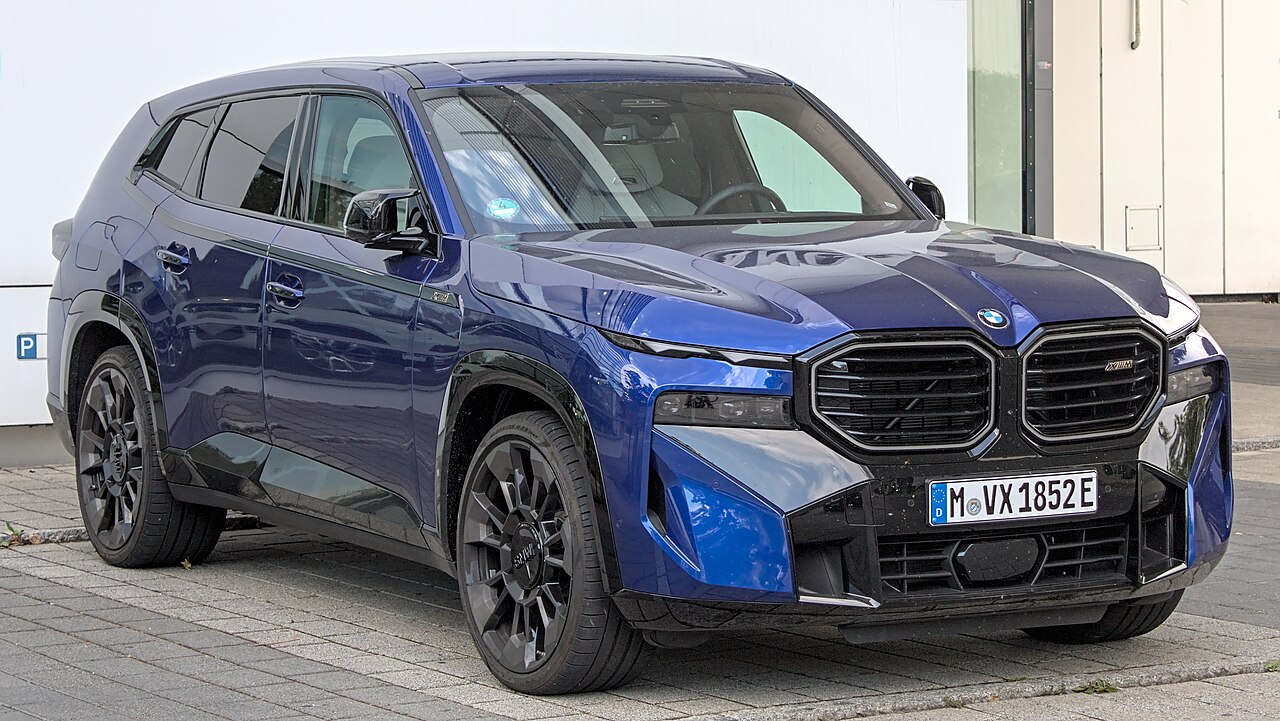 Licensed photo · Photo credit
Generations and technical specifications
BMW XM2022–present
| Specification | Value |
|---|---|
| Model code | G09 |
| Production | December 2022 – present |
| Body styles | 5-door crossover SUV |
| Layout | Front-engine, all-wheel drive (M xDrive) |
| Platform | Cluster Architecture (CLAR) |
| Engines | Petrol plug-in hybrid 3.0 L B58 turbocharged I6 4.4 L S68 twin-turbocharged V8 |
| Electric motor | Permanent magnet synchronous motor |
| Transmissions | 8-speed ZF 8HP automatic |
| Drivetrain | Plug-in hybrid |
| Battery | 29.5 kWh (gross), 25.7 kWh (net/usable) lithium-ion |
| Charging | 7.4 kW (AC) |
| Wheelbase | 3,105 mm |
| Length | 5,110 mm |
| Width | 2,005 mm |
| Height | 1,755 mm |
| Kerb weight | 2,749 kg |
| Class | Full-size luxury crossover SUV |
| Assembly | United States: Greer, South Carolina (Plant Spartanburg) |
| Designer | Marcus Syring, Hussein Al-Attar Boson Huang (exterior) Chris Lee (interior) |
Engines and transmissions
| Model years | Engine | Transmission | Drive | Fuel |
|---|---|---|---|---|
| 2023–2026 | 4.4 L, 8 cyl plug-in hybrid | 8-speed automatic | All-wheel drive | Petrol (premium) and electricity |
Fuel economy (EPA)
| Model years | Configuration | Combined | City | Highway | Electric range |
|---|---|---|---|---|---|
| 2023–2026 | 4.4 L, 8 cyl plug-in hybrid · 8-speed automatic · All-wheel drive | 16.8 L/100 km | 19.6 L/100 km | 13.8 L/100 km | 48–50 km |
Values are the official EPA label figures for each model year, shown as the lowest and highest value for the configuration. Electric models show energy use per 100 km. Real-world consumption depends on driving style, weather and load. Luggage and passenger volumes follow the EPA measuring method and can differ from the VDA figures used in Europe.
EU type-approval data
| Years | Powertrain | Engine | Power | Mass | CO₂ | Electric range |
|---|---|---|---|---|---|---|
| 2024–2025 | Petrol plug-in hybrid | 2998 cm³ | 230 kW (313 PS) | 2695 kg | 32–37 g/km (WLTP) | 78–83 km · 316–322 Wh/km |
| 2023–2025 | Petrol plug-in hybrid | 4395 cm³ | 360 kW (489 PS) | 2785 kg | 35–43 g/km (WLTP) | 76–85 km · 295–336 Wh/km |
| 2022–2025 | Petrol plug-in hybrid | 4395 cm³ | 430 kW (585 PS) | 2795 kg | 39–53 g/km (WLTP) | 76–80 km · 328–336 Wh/km |
| 2024 | Petrol hybrid | 2998 cm³ | 230 kW (313 PS) | 2695 kg | 245–251 g/km (WLTP) | – |
| 2023–2024 | Petrol hybrid | 4395 cm³ | 360 kW (489 PS) | 2785 kg | 112 g/km (WLTP) | – |
Years are registration years. Each range runs from the 10th to the 90th percentile of the values reported for new registrations; it is not an average. Mass is the mass in running order. For electric cars the power is the type-approval net power, which can be lower than the peak power in brochures.
Key specifications
| Specification | Value |
|---|---|
| EPA size class | Standard SUV |
| Model years in EPA data | 2023–2026 |
| Powertrains | Plug-in hybrid |
| Engine displacement | 4.4 L |
| Cylinders | 8 |
| Transmission types | Automatic |
| Drive | All-wheel drive |
| Fuel | Petrol (premium) and electricity |
| Configurations listed | 5 |
| Forced induction | Turbocharged |
| Start-stop system | Yes |
| Electric motor (EPA) | 145 kW PMSM |
| Powertrains (EU) | Petrol plug-in hybrid |
| Engine displacement (EU) | 2,998–4,395 cm³ |
| Power (EU) | 230–430 kW (313–585 PS) |
| Mass in running order (EU) | 2,695–2,795 kg |
Years and markets
| Specification | Value |
|---|---|
| Model years (US) | 2023–2027 |
| New registrations (EU) | 2021–2026 |
Owner complaints (NHTSA)
| Component | Complaints | Most reported model years |
|---|---|---|
| Brakes | 4 | 2023, 2024 |
| Wheels | 2 | 2024 |
| Steering | 2 | 2024 |
| Electrical system | 2 | 2024, 2025 |
| Transmission and drivetrain | 1 | 2023 |
| Stability and traction control | 1 | 2023 |
| Tyres | 1 | 2024 |
| Engine and cooling | 1 | 2024 |
| Suspension | 1 | 2024 |
| Fuel and propulsion | 1 | 2025 |
Source: complaints filed by owners with the U.S. National Highway Traffic Safety Administration (NHTSA) for model years 2023–2025: 11 complaints, 0 with a crash and 0 with a fire. Complaints are owner reports that NHTSA has not verified, and one complaint can name more than one component. More complaints can also mean more cars sold.