Chery
Tiggo 7
Chery Tiggo 7: years registered new in Europe, fault code help, warning lights and maintenance guides.
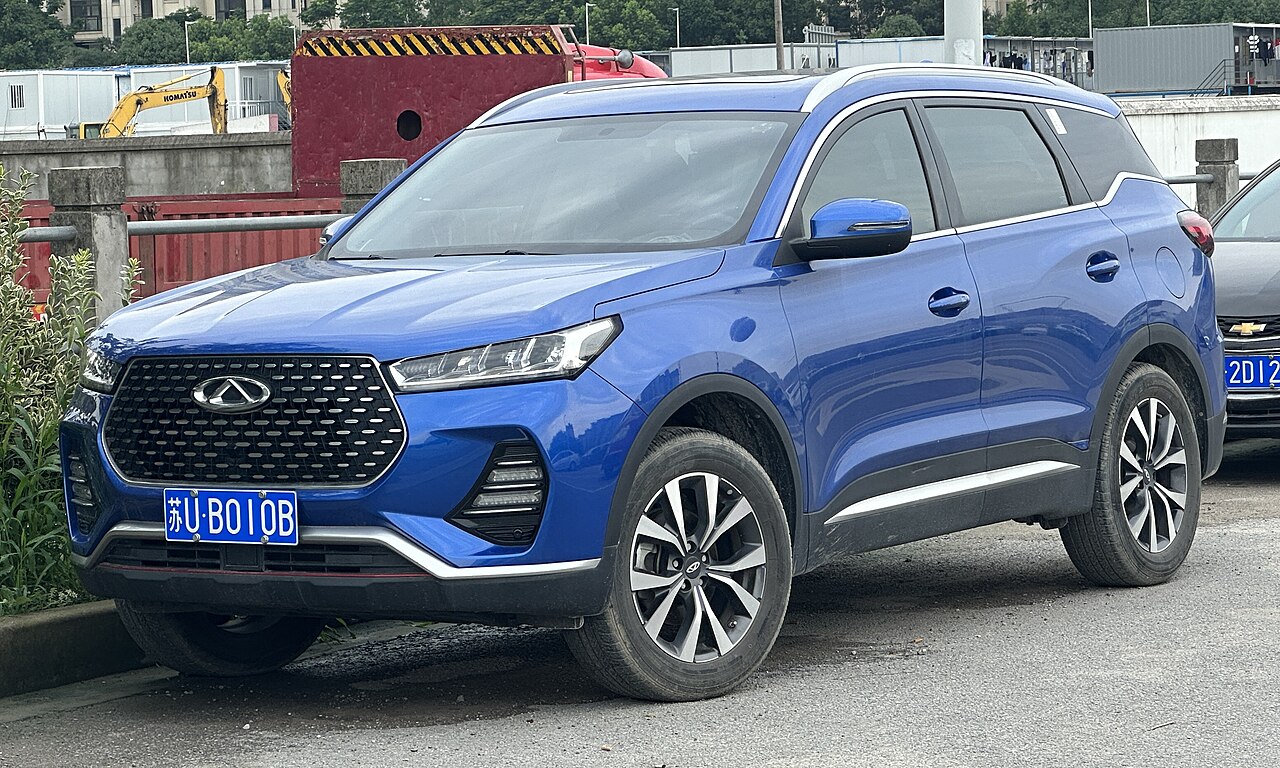 Licensed photo · Photo credit
MakeChery
New registrations (EU)2025–2026
Generations and technical specifications
Chery Tiggo 7 – Second generation2020–present
| Specification | Value |
|---|---|
| Model code | T1E |
| Production | 2020–present |
| Layout | Front-engine, front-wheel-drive Front-engine, all-wheel-drive |
| Platform | T1X |
| Engines | Petrol 1.5 L SQRE4T15C turbo I4 1.6 L SQRF4J16 turbo I4 Petrol mild hybrid 1.5 L ACTECO turbo I4 Petrol plug-in hybrid 1.5 L ACTECO turbo I4 |
| Electric motor | 48 V belt starter-generator (mild hybrid) Permanent magnet synchronous reluctance (PHEV) |
| Transmissions | Manual 6-speed manual Automatic 1-speed DHT (PHEV; export) 3-speed DHT (PHEV) 7-speed DCT CVT |
| Drivetrain | Mild hybrid Plug-in hybrid |
| Battery | 48 V lithium-ion (MHEV) 18.3 kWh LFP battery (PHEV) |
| Electric range | 93 km (PHEV) |
| Wheelbase | 2,670 mm |
| Length | 4,500 mm |
| Width | 1,842 mm |
| Height | 1,746 mm |
| Kerb weight | 1,465 kg |
| Assembly | China: Wuhu, Anhui Brazil: Anápolis (Caoa Chery) Indonesia: Bekasi, West Java (Handal Indonesia Motor) Malaysia: Kulim, Kedah (Inokom) Iran: Bam, Kerman Province (MVM) Russia: St. Petersburg (Lada Saint Petersburg, Xcite X-Cross 7) Spain: Barcelona (Ebro) Russia: Kaluga (AGR, Tenet T7) |
| Designer | Richard Koo |
Chery Tiggo 7 – First generation2016–2020
| Specification | Value |
|---|---|
| Model code | T15 |
| Production | 2016–2020 |
| Layout | Front-engine, front-wheel-drive Front-engine, all-wheel-drive |
| Platform | T1X |
| Engines | Petrol 1.5 L SQRE4T15 turbo I4 2.0 L SQR484F I4 |
| Transmissions | 6-speed manual 6-speed DCT CVT |
| Wheelbase | 2,670 mm |
| Length | 4,505 mm |
| Width | 1,837 mm |
| Height | 1,670 mm |
| Assembly | China: Wuhu, Anhui Brazil: Anápolis (Caoa Chery) Iran: Bam, Kerman Province (MVM) Egypt: Cairo (GB Corp) |
| Designer | James Hope |
EU type-approval data
| Years | Powertrain | Engine | Power | Mass | CO₂ | Electric range |
|---|---|---|---|---|---|---|
| 2025 | Petrol | 1499 cm³ | – | 1790 kg | 136 g/km (WLTP) | – |
| 2025 | Petrol | 1598 cm³ | 108 kW (147 PS) | 1593 kg | 159 g/km (WLTP) | – |
| 2025 | Petrol hybrid | 1499 cm³ | – | 1790 kg | 136 g/km (WLTP) | – |
| 2025 | Petrol plug-in hybrid | 1499 cm³ | 105 kW (143 PS) | 1865–1870 kg | 19–54 g/km (WLTP) | 90 km · 194–216 Wh/km |
| 2025 | Petrol plug-in hybrid | 1499 cm³ | 150 kW (204 PS) | 1865 kg | 23 g/km (WLTP) | 90 km · 194 Wh/km |
Years are registration years. Each range runs from the 10th to the 90th percentile of the values reported for new registrations; it is not an average. Mass is the mass in running order. For electric cars the power is the type-approval net power, which can be lower than the peak power in brochures.
Key specifications
| Specification | Value |
|---|---|
| Powertrains (EU) | Petrol, Petrol hybrid, Petrol plug-in hybrid |
| Engine displacement (EU) | 1,499–1,598 cm³ |
| Power (EU) | 105–150 kW (143–204 PS) |
| Mass in running order (EU) | 1,593–1,870 kg |
Years and markets
| Specification | Value |
|---|---|
| New registrations (EU) | 2025–2026 |