Ford
S-MAX
Ford S-MAX: years registered new in Europe, fault code help, warning lights and maintenance guides.
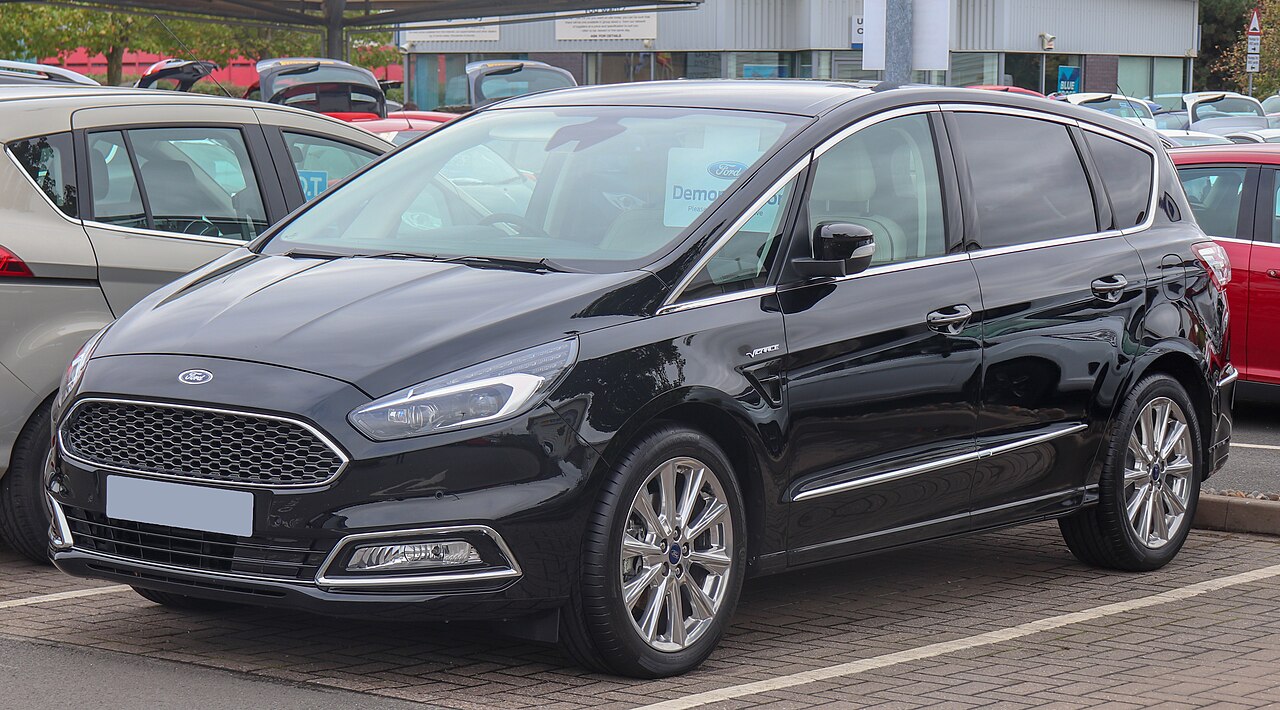 Licensed photo · Photo credit
MakeFord
New registrations (EU)2005–2025
Generations and technical specifications
Ford S-Max – Second generation2015–2023
| Specification | Value |
|---|---|
| Model code | CD539 |
| Production | 2015 – April 2023 |
| Platform | Ford CD4 platform |
| Engines | Petrol 1.5 L EcoBoost I4 2.0 L EcoBoost I4 Petrol hybrid 2.5 L Duratec iVCT Atkinson cycle I4 Diesel 2.0 L Duratorq I4 (2015–2019) 2.0 L EcoBlue I4 turbo (2019–2023) 2.0 L EcoBlue I4 twin-turbo (2019–2023) |
| Transmissions | 6-speed manual 6-speed 6F automatic 8-speed 8F automatic 6-speed PowerShift dual-clutch transmission CVT (hybrid) |
| Wheelbase | 2,850 mm |
| Length | 4,796–4,804 mm |
| Width | 1,916 mm |
| Height | 1,655–1,684 mm |
| Kerb weight | 1,645–1,872 kg |
| Assembly | Spain: Almussafes (Ford Valencia Plant) |
| Designer | Claudio Messale |
Ford S-Max – First generation2006–2014
| Specification | Value |
|---|---|
| Model code | CD340 |
| Production | May 2006 – 2014 (Belgium) 2007–2009 (China) 2012–2014 (Russia) |
| Platform | Ford EUCD platform |
| Wheelbase | 2,850 mm |
| Length | 4,770 mm |
| Width | 1,885 mm |
| Height | 1,660 mm |
| Kerb weight | 1,743 kg |
| Assembly | Belgium: Genk (GB&A) China: Chongqing (Changan Ford) Russia: Yelabuga (Ford Sollers) |
| Designer | David Hilton |
EU type-approval data
| Years | Powertrain | Engine | Power | Mass | CO₂ |
|---|---|---|---|---|---|
| 2021–2024 | Petrol hybrid | 2488 cm³ | 110 kW (150 PS) | 1845–1947 kg | 146–148 g/km (WLTP) |
| 2018–2022 | Diesel | 1995 cm³ | 110 kW (150 PS) | 1901–1905 kg | 158–173 g/km (WLTP) |
| 2018–2022 | Diesel | 1995 cm³ | 140 kW (190 PS) | 1905–1984 kg | 167–183 g/km (WLTP) |
| 2018–2020 | Petrol | 1498 cm³ | 121 kW (165 PS) | 1784 kg | 190–195 g/km (WLTP) |
| 2018–2020 | Diesel | 1995 cm³ | 177 kW (241 PS) | 1951 kg | 172–178 g/km (WLTP) |
| 2015–2018 | Petrol | 1498 cm³ | 118 kW (160 PS) | 1645 kg | 149 g/km (NEDC) |
| 2015–2018 | Petrol | 1999 cm³ | 177 kW (241 PS) | 1704 kg | 180 g/km (NEDC) |
| 2015–2018 | Diesel | 1997 cm³ | 110 kW (150 PS) | 1725–1733 kg | 160–203 g/km (WLTP) |
| 2015–2018 | Diesel | 1997 cm³ | 132 kW (179 PS) | 1726–1809 kg | 129–192 g/km (WLTP) |
| 2015–2018 | Diesel | 1997 cm³ | 155 kW (211 PS) | 1766 kg | 144 g/km (NEDC) |
| 2011–2015 | Petrol | 1596 cm³ | 118 kW (160 PS) | 1598–1602 kg | 159–164 g/km (NEDC) |
| 2011–2015 | Diesel | 1560 cm³ | 85 kW (116 PS) | 1703–1775 kg | 139 g/km (NEDC) |
| 2011–2015 | Diesel | 1997 cm³ | 100 kW (136 PS) | 1690–1765 kg | 139–159 g/km (NEDC) |
| 2011–2015 | Diesel | 1997 cm³ | 103 kW (140 PS) | 1689–1760 kg | 139–159 g/km (NEDC) |
| 2011–2015 | Diesel | 1997 cm³ | 120 kW (163 PS) | 1689–1760 kg | 139–159 g/km (NEDC) |
| 2011–2015 | Diesel | 2179 cm³ | 147 kW (200 PS) | 1733–1734 kg | 174–189 g/km (NEDC) |
| 2011–2014 | Petrol | 1999 cm³ | 149 kW (203 PS) | 1661–1676 kg | 188–189 g/km (NEDC) |
| 2010–2011 | Petrol | 1976 cm³ | – | 1676–1825 kg | 189 g/km (NEDC) |
Years are registration years. Each range runs from the 10th to the 90th percentile of the values reported for new registrations; it is not an average. Mass is the mass in running order. For electric cars the power is the type-approval net power, which can be lower than the peak power in brochures.
Key specifications
| Specification | Value |
|---|---|
| Powertrains (EU) | Petrol, Diesel |
| Engine displacement (EU) | 1,498–2,179 cm³ |
| Power (EU) | 85–147 kW (116–200 PS) |
| Mass in running order (EU) | 1,598–1,984 kg |
| Wheelbase (EU) | 2,850 mm |
Years and markets
| Specification | Value |
|---|---|
| New registrations (EU) | 2005–2025 |