G90
Genesis G90: official NHTSA recalls, fault code help and maintenance guides.
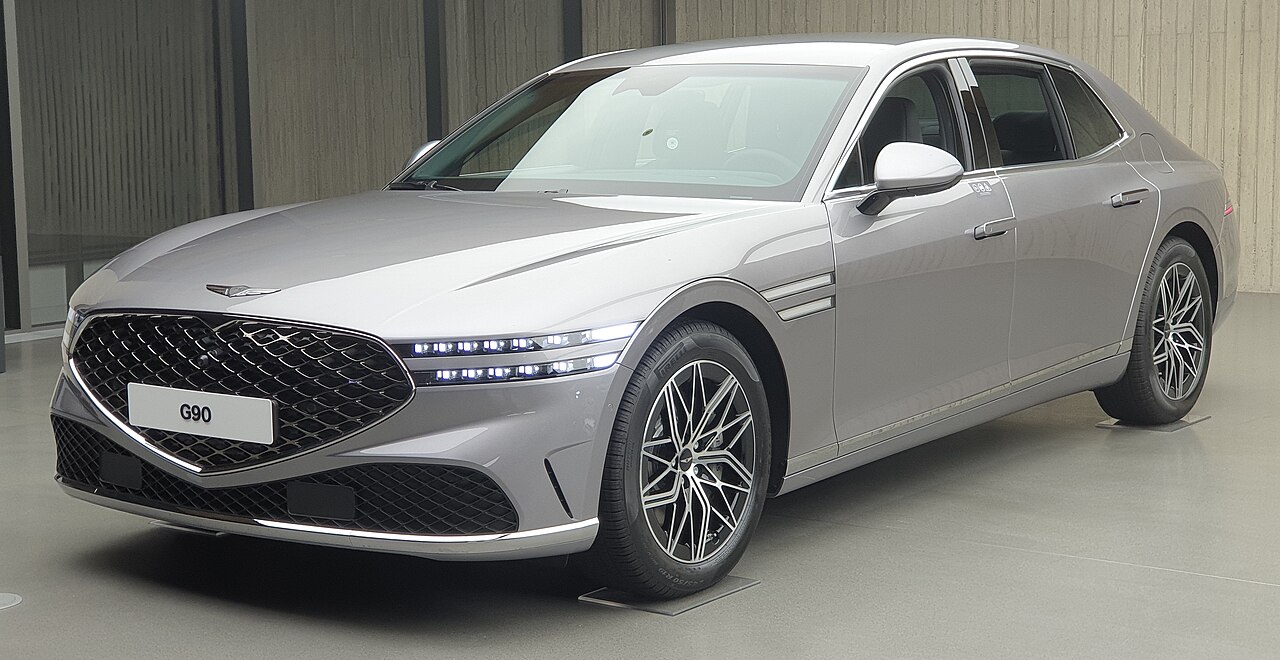 Licensed photo · Photo credit
Generations and technical specifications
Genesis G90 – Second generation2021–present
| Specification | Value |
|---|---|
| Model code | RS4 |
| Production | December 2021 – present |
| Model years | 2023–present |
| Platform | Hyundai M3 |
| Engines | Gasoline 3.5 L Smartstream G3.5 T-GDi V6 3.5 L Smartstream G3.5 T-GDi e-S/C V6 |
| Transmissions | 8-speed A8TR1 automatic |
| Wheelbase | 3,180 mm 3,370 mm (LWB) |
| Length | 5,275 mm 5,465 mm (LWB) |
| Width | 1,930 mm |
| Height | 1,490 mm |
| Kerb weight | 2,025–2,175 kg 2,295–2,345 kg (LWB) |
| Assembly | South Korea: Ulsan |
| Designer | Under the lead of Luc Donckerwolke |
Genesis G90 – First generation2015–2022
| Specification | Value |
|---|---|
| Model code | HI |
| Production | November 2015 – 2021 |
| Model years | 2017–2022 |
| Platform | Hyundai M2 |
| Engines | Gasoline 3.3 L Lambda II T-GDI V6 3.8 L Lambda II GDI V6 5.0 L Tau GDI V8 |
| Transmissions | 8-speed A8LR1/A8TR1 automatic |
| Wheelbase | 3,160 mm 3,450 mm (limousine) |
| Length | 5,205 mm 5,495 mm (limousine) |
| Width | 1,915 mm |
| Height | 1,495 mm 1,505 mm (limousine) |
| Kerb weight | 1,995–2,140 kg (3.8) 2,060–2,185 kg (3.3T) 2,215–2,245 kg (5.0) 2,270–2,290 kg (limousine) |
| Assembly | South Korea: Ulsan Russia: Kaliningrad (Avtotor) |
| Designer | Under the lead of Peter Schreyer (pre-facelift) Under the lead of Luc Donckerwolke (facelift) |
Engines and transmissions
| Model years | Engine | Transmission | Drive | Fuel |
|---|---|---|---|---|
| 2023–2026 | 3.5 L, 6 cyl | 8-speed automatic | All-wheel drive | Petrol (premium) |
| 2023–2026 | 3.5 L, 6 cyl mild hybrid | 8-speed automatic | All-wheel drive | Petrol (premium) |
| 2017–2022 | 3.3 L, 6 cyl | 8-speed automatic | All-wheel drive | Petrol (premium) |
| 2017–2022 | 3.3 L, 6 cyl | 8-speed automatic | Rear-wheel drive | Petrol (premium) |
| 2017–2022 | 5.0 L, 8 cyl | 8-speed automatic | All-wheel drive | Petrol (premium) |
| 2017–2022 | 5.0 L, 8 cyl | 8-speed automatic | Rear-wheel drive | Petrol (premium) |
Fuel economy (EPA)
| Model years | Configuration | Combined | City | Highway |
|---|---|---|---|---|
| 2023–2026 | 3.5 L, 6 cyl · 8-speed automatic · All-wheel drive | 11.2 L/100 km | 13.1 L/100 km | 9.0 L/100 km |
| 2023–2026 | 3.5 L, 6 cyl mild hybrid · 8-speed automatic · All-wheel drive | 11.8 L/100 km | 13.8 L/100 km | 9.8 L/100 km |
| 2017–2022 | 3.3 L, 6 cyl · 8-speed automatic · All-wheel drive | 11.8 L/100 km | 13.8 L/100 km | 9.4–9.8 L/100 km |
| 2017–2022 | 3.3 L, 6 cyl · 8-speed automatic · Rear-wheel drive | 11.8–12.4 L/100 km | 13.8 L/100 km | 9.4–9.8 L/100 km |
| 2017–2022 | 5.0 L, 8 cyl · 8-speed automatic · All-wheel drive | 13.1 L/100 km | 14.7–15.7 L/100 km | 10.2 L/100 km |
| 2017–2022 | 5.0 L, 8 cyl · 8-speed automatic · Rear-wheel drive | 12.4 L/100 km | 14.7 L/100 km | 9.8 L/100 km |
Values are the official EPA label figures for each model year, shown as the lowest and highest value for the configuration. Electric models show energy use per 100 km. Real-world consumption depends on driving style, weather and load. Luggage and passenger volumes follow the EPA measuring method and can differ from the VDA figures used in Europe.
Key specifications
| Specification | Value |
|---|---|
| EPA size class | Large car |
| Model years in EPA data | 2017–2026 |
| Powertrains | Petrol, Mild hybrid |
| Engine displacement | 3.3–5.0 L |
| Cylinders | 6, 8 |
| Transmission types | Automatic |
| Drive | All-wheel drive, Rear-wheel drive |
| Fuel | Petrol (premium) |
| Configurations listed | 32 |
| Forced induction | Turbo- and supercharged (on some versions) |
| Start-stop system | On some versions |
| Luggage volume (EPA) | 311–453 L |
| Passenger volume (EPA) | 3,087–3,200 L |
Years and markets
| Specification | Value |
|---|---|
| Model years (US) | 2017–2027 |
Owner complaints (NHTSA)
| Component | Complaints | Most reported model years |
|---|---|---|
| Electrical system | 19 | 2017, 2018, 2019 |
| Engine and cooling | 19 | 2017, 2018, 2019 |
| Fuel and propulsion | 8 | 2018, 2019, 2023 |
| Driver assistance | 7 | 2017, 2021, 2022 |
| Steering | 6 | 2017, 2019, 2020 |
| Transmission and drivetrain | 6 | 2017, 2018, 2023 |
| Wheels | 5 | 2017, 2020, 2025 |
| Brakes | 4 | 2017, 2024 |
| Tyres | 3 | 2017, 2018, 2021 |
| Airbags | 2 | 2017, 2018 |
Source: complaints filed by owners with the U.S. National Highway Traffic Safety Administration (NHTSA) for model years 2017–2025: 70 complaints, 7 with a crash and 0 with a fire. Complaints are owner reports that NHTSA has not verified, and one complaint can name more than one component. More complaints can also mean more cars sold.