Mazda
MX-30
Mazda MX-30: official NHTSA recalls, fault code help and maintenance guides.
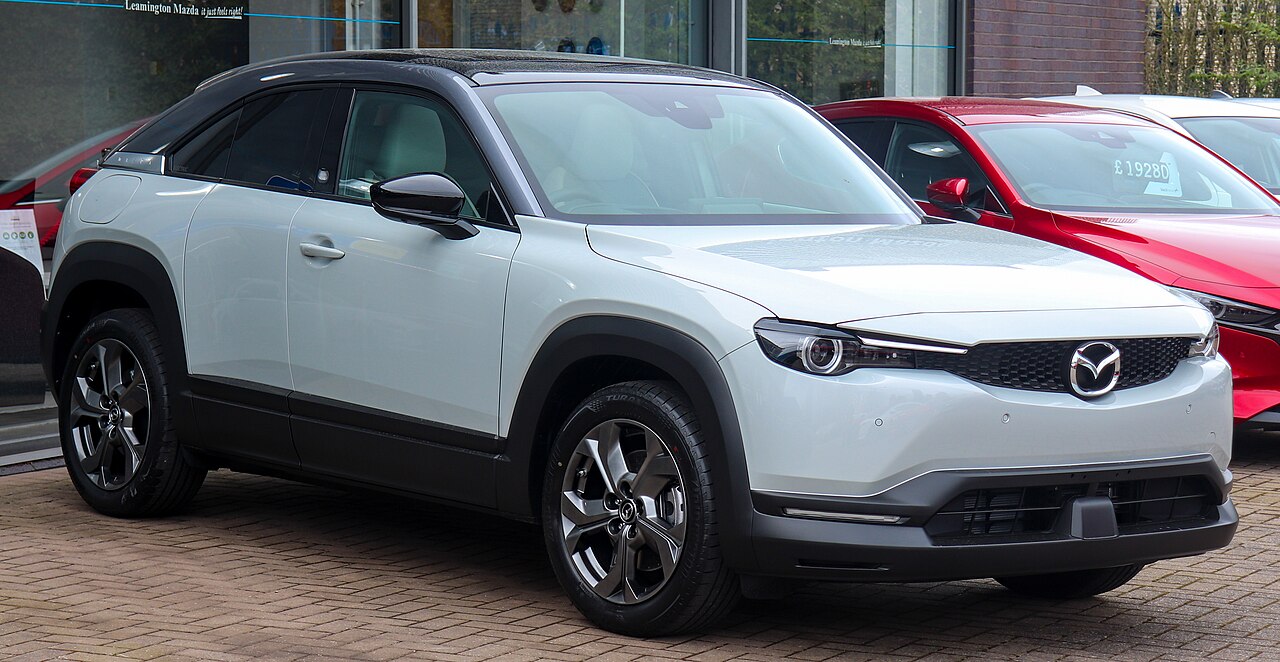 Licensed photo · Photo credit
MakeMazda
ClassMidsize car
Model years (US)2022–2026
New registrations (EU)2020–2025
Recall dataNHTSA (United States)
Generations and technical specifications
Mazda MX-302020–present
| Specification | Value |
|---|---|
| Model code | DR |
| Production | May 2020 – present |
| Model years | 2022–2023 (United States) 2022–2024 (Canada) 2022–2026 (Europe) |
| Body styles | 5-door SUV |
| Layout | Front-motor, front-wheel-drive (BEV, PHEV) Front-engine, all-wheel-drive (MHEV) |
| Platform | e-Skyactiv |
| Engines | 830 cc single-rotor Wankel rotary (generator only) (PHEV) 1997 cc e-Skyactiv-G I4 (MHEV) |
| Electric motor | e-Skyactiv Water-cooled synchronous AC motor 24-volt e-motor (e-Skyactiv-G) |
| Transmissions | Single-speed automatic transmission (BEV, PHEV) 6-speed Skyactiv-Drive automatic (MHEV) |
| Drivetrain | MHEV (e-Skyactiv-G) series plug-in hybrid or EREV (MX-30 PHEV) |
| Battery | 35.5 kWh prismatic lithium ion |
| Electric range | 200 km (WLTP) 161 km (EPA) |
| Charging | DC: 40 kW AC: 6.6 kW |
| Wheelbase | 2,655 mm |
| Length | 4,395 mm |
| Width | 1,795 mm |
| Height | 1,570 mm |
| Kerb weight | 1,645–1,778 kg |
| Class | Subcompact crossover SUV |
| Assembly | Japan: Hiroshima (Hiroshima Plant) |
| Designer | Yōichi Matsuda |
Engines and transmissions
| Model years | Engine | Transmission | Drive | Fuel |
|---|---|---|---|---|
| 2022–2023 | Electric motor | Single-speed | Front-wheel drive | Electricity |
Fuel economy (EPA)
| Model years | Configuration | Combined | City | Highway | Electric range |
|---|---|---|---|---|---|
| 2022–2023 | Electric motor · Single-speed · Front-wheel drive | 22.8 kWh/100 km | 21.4 kWh/100 km | 24.6 kWh/100 km | 161 km |
Values are the official EPA label figures for each model year, shown as the lowest and highest value for the configuration. Electric models show energy use per 100 km. Real-world consumption depends on driving style, weather and load. Luggage and passenger volumes follow the EPA measuring method and can differ from the VDA figures used in Europe.
EU type-approval data
| Years | Powertrain | Engine | Power | Mass | CO₂ | Electric range |
|---|---|---|---|---|---|---|
| 2023–2025 | Petrol plug-in hybrid | 1660 cm³ | 55 kW (75 PS) | 1853 kg | 21 g/km (WLTP) | 85 km · 175 Wh/km |
| 2023–2025 | Petrol plug-in hybrid | 1660 cm³ | 125 kW (170 PS) | 1853 kg | 21 g/km (WLTP) | 85 km · 175 Wh/km |
| 2020–2025 | Electric | – | 107 kW (145 PS) | 1720 kg | – | 200–237 km · 173–190 Wh/km |
| 2020–2022 | Electric | – | 80 kW (109 PS) | 1720 kg | – | 200–237 km · 173–190 Wh/km |
| 2020–2022 | Electric | – | 81 kW (110 PS) | 1720 kg | – | 200–237 km · 173 Wh/km |
Years are registration years. Each range runs from the 10th to the 90th percentile of the values reported for new registrations; it is not an average. Mass is the mass in running order. For electric cars the power is the type-approval net power, which can be lower than the peak power in brochures.
Key specifications
| Specification | Value |
|---|---|
| EPA size class | Midsize car |
| Model years in EPA data | 2022–2023 |
| Powertrains | Electric |
| Transmission types | Single-speed |
| Drive | Front-wheel drive |
| Fuel | Electricity |
| Configurations listed | 2 |
| Electric motor (EPA) | 81 kW AC PMSM |
| Luggage volume (EPA) | 595 L |
| Passenger volume (EPA) | 2,549 L |
| Electric range (EPA) | 161 km |
| Powertrains (EU) | Petrol plug-in hybrid, Electric |
| Engine displacement (EU) | 1,660 cm³ |
| Power (EU) | 55–107 kW (75–145 PS) |
| Mass in running order (EU) | 1,720–1,853 kg |
| Wheelbase (EU) | 2,655–2,660 mm |
Years and markets
| Specification | Value |
|---|---|
| Model years (US) | 2022–2026 |
| New registrations (EU) | 2020–2025 |