GLA-Class
Mercedes-Benz GLA-Class: official NHTSA recalls, fault code help and maintenance guides.
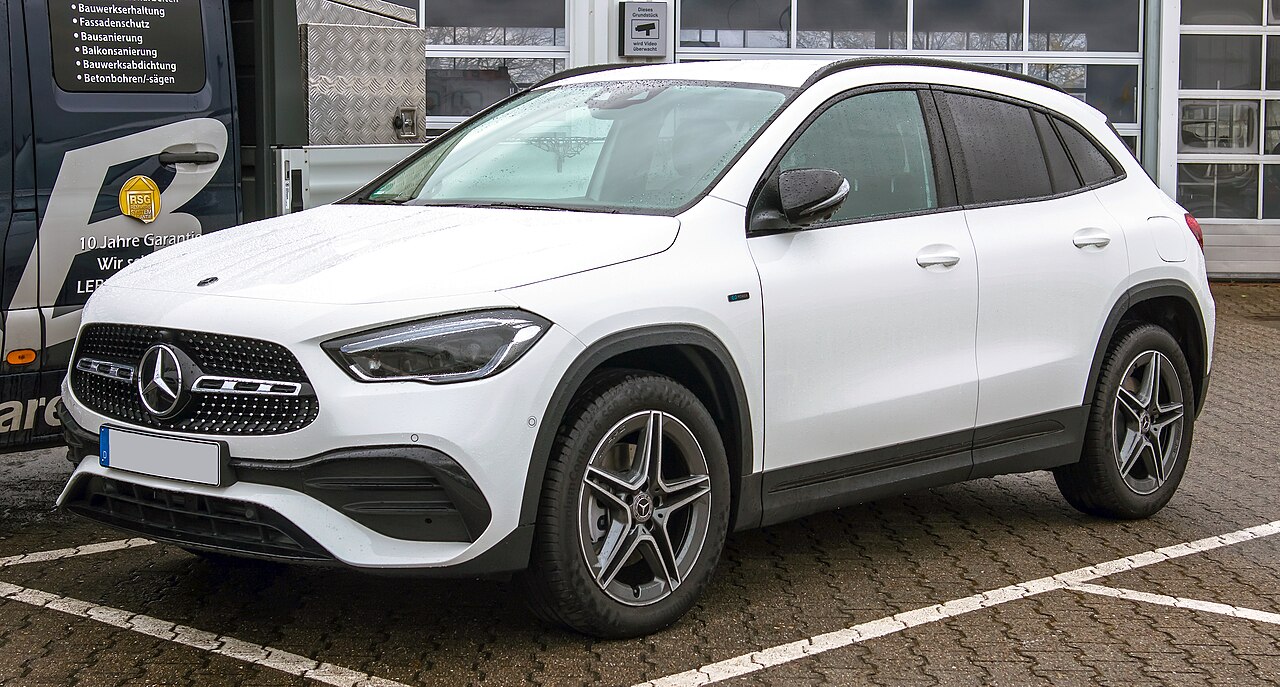 Licensed photo · Photo credit
Generations and technical specifications
Mercedes-Benz GLA – Third generation2026–present
| Specification | Value |
|---|---|
| Model code | H248 / H244 (EV) |
| Production | September 2026 – present |
| Model years | 2027 (North America) |
| Layout | Front-engine, front-wheel-drive (hybrid) Front-engine, all-wheel-drive (hybrid, 4matic) Rear-motor, rear-wheel-drive (EV) Dual-motor, all-wheel-drive (EV, 4matic) |
| Platform | Mercedes-Benz Modular Architecture (MMA) |
| Engines | 1.5L M252 turbo I4 (hybrid) |
| Electric motor | 27 PS permanent-magnet motor (hybrid) 1x or 2x Permanent magnet AC synchronous (EV) |
| Transmissions | 8-speed dual-clutch (hybrid) 2-speed automatic (EV) |
| Drivetrain | High-tech Hybrid |
| Battery | Lithium-ion 1.3 kWh 48V (hybrid) 58.0 kWh LFP (EV) 85.0 kWh Li-NMC (EV) |
| Charging | 320 kW (DC) |
| Wheelbase | 2,790 mm |
| Length | 4,565 mm |
| Width | 1,873 mm |
| Height | 1,590 mm |
| Assembly | Germany: Rastatt |
Mercedes-Benz GLA – Second generation2019–present
| Specification | Value |
|---|---|
| Model code | H247 |
| Production | December 2019 – present |
| Model years | 2020–present |
| Platform | MFA2 |
| Engines | Petrol 1.3 L M282 turbo I4 2.0 L M260 turbo I4 2.0 L M139 turbo I4 Petrol plug-in hybrid 1.3 L M282 turbo I4 Diesel 2.0 L OM654 turbo I4 |
| Transmissions | 7-speed DCT automatic 8-speed DCT automatic |
| Drivetrain | Plug-in hybrid (GLA 250 e) |
| Wheelbase | 2,729 mm |
| Length | 4,410 mm |
| Width | 1,834 mm |
| Height | 1,611 mm |
| Kerb weight | 1,505–1,585 kg |
| Assembly | Germany: Rastatt China: Beijing (Beijing Benz) India: Pune (MBI) Thailand: Samut Prakan (Thonburi Automotive Assembly Plant Co., Ltd.) Malaysia: Pekan (HICOM) Indonesia: Bogor (MBI / Inchcape Indomobil) |
| Designer | Balázs Filczer, Gabriel Nemeth |
Mercedes-Benz GLA – First generation2013–2020
| Specification | Value |
|---|---|
| Model code | X156 |
| Production | December 2013 – November 2019 |
| Model years | 2014–2020 |
| Platform | MFA |
| Engines | Petrol 1.6 L M270 turbo I4 2.0 L M270 turbo I4 2.0 L M133 turbo I4 Diesel 1.5 L OM607 turbo I4 2.1 L OM651 turbo I4 |
| Transmissions | 6-speed manual 7-speed DCT |
| Wheelbase | 2,699 mm |
| Length | 4,417 mm |
| Width | 1,804 mm |
| Height | 1,494 mm |
| Kerb weight | 1,505–1,585 kg |
| Assembly | Germany: Rastatt (Mercedes Benz Werk Rastatt) China: Beijing (Beijing Benz) India: Pune Thailand: Samut Prakan (Thonburi Automotive Assembly Plant Co., Ltd.) Brazil: Iracemápolis (Mercedes-Benz Iracemápolis) |
| Designer | Robert Lešnik, Michael Frei, Mark Fetherston |
Engines and transmissions
| Model years | Engine | Transmission | Drive | Fuel |
|---|---|---|---|---|
| 2024–2026 | 2.0 L, 4 cyl mild hybrid | 8-speed automated manual | All-wheel drive | Petrol (premium) |
| 2024–2026 | 2.0 L, 4 cyl mild hybrid | 8-speed automated manual | Front-wheel drive | Petrol (premium) |
| 2022–2023 | 2.0 L, 4 cyl | 8-speed automated manual | All-wheel drive | Petrol (premium) |
| 2021–2023 | 2.0 L, 4 cyl | 8-speed automated manual | Front-wheel drive | Petrol (premium) |
| 2021 | 2.0 L, 4 cyl | 8-speed automated manual | Four-wheel drive | Petrol (premium) |
| 2015–2020 | 2.0 L, 4 cyl | 7-speed automated manual | Four-wheel drive | Petrol (premium) |
| 2015–2020 | 2.0 L, 4 cyl | 7-speed automated manual | Front-wheel drive | Petrol (premium) |
| 2015–2019 | 2.0 L, 4 cyl | 7-speed automated manual | Four-wheel drive | Petrol (premium) or E85 |
| 2018–2019 | 2.0 L, 4 cyl | 7-speed automated manual | Part-time four-wheel drive | Petrol (premium) |
Fuel economy (EPA)
| Model years | Configuration | Combined | City | Highway |
|---|---|---|---|---|
| 2024–2026 | 2.0 L, 4 cyl mild hybrid · 8-speed automated manual · All-wheel drive | 8.4–9.8 L/100 km | 9.4–10.7 L/100 km | 7.1–8.4 L/100 km |
| 2024–2026 | 2.0 L, 4 cyl mild hybrid · 8-speed automated manual · Front-wheel drive | 8.1–8.4 L/100 km | 9.0–9.4 L/100 km | 6.9 L/100 km |
| 2022–2023 | 2.0 L, 4 cyl · 8-speed automated manual · All-wheel drive | 9.0–10.7 L/100 km | 10.2–12.4 L/100 km | 7.4–9.4 L/100 km |
| 2021–2023 | 2.0 L, 4 cyl · 8-speed automated manual · Front-wheel drive | 8.4 L/100 km | 9.4–9.8 L/100 km | 6.9 L/100 km |
| 2021 | 2.0 L, 4 cyl · 8-speed automated manual · Four-wheel drive | 8.7–10.2 L/100 km | 9.8–11.8 L/100 km | 7.1–8.7 L/100 km |
| 2015–2020 | 2.0 L, 4 cyl · 7-speed automated manual · Four-wheel drive | 8.7–9.4 L/100 km | 9.8–10.7 L/100 km | 7.6–8.4 L/100 km |
| 2015–2020 | 2.0 L, 4 cyl · 7-speed automated manual · Front-wheel drive | 8.4–8.7 L/100 km | 9.4–9.8 L/100 km | 6.9–7.1 L/100 km |
| 2018–2019 | 2.0 L, 4 cyl · 7-speed automated manual · Part-time four-wheel drive | 9.0 L/100 km | 10.2 L/100 km | 7.6 L/100 km |
Values are the official EPA label figures for each model year, shown as the lowest and highest value for the configuration. Electric models show energy use per 100 km. Real-world consumption depends on driving style, weather and load. Luggage and passenger volumes follow the EPA measuring method and can differ from the VDA figures used in Europe.
EU type-approval data
| Years | Powertrain | Engine | Power | Mass | CO₂ | Electric range |
|---|---|---|---|---|---|---|
| 2023–2025 | Petrol hybrid | 1332 cm³ | 100 kW (136 PS) | 1570 kg | 148–156 g/km (WLTP) | – |
| 2023–2025 | Petrol hybrid | 1332 cm³ | 120 kW (163 PS) | 1570 kg | 150–156 g/km (WLTP) | – |
| 2023–2025 | Petrol plug-in hybrid | 1332 cm³ | 120 kW (163 PS) | 1800–1810 kg | 24–28 g/km (WLTP) | 68–73 km · 192–205 Wh/km |
| 2020–2025 | Diesel | 1950 cm³ | 85 kW (116 PS) | 1615–1660 kg | 140–144 g/km (WLTP) | – |
| 2020–2025 | Diesel | 1950 cm³ | 110 kW (150 PS) | 1615–1670 kg | 140–148 g/km (WLTP) | – |
| 2020–2025 | Diesel | 1950 cm³ | 140 kW (190 PS) | 1615–1725 kg | 144–157 g/km (WLTP) | – |
| 2020–2023 | Petrol | 1332 cm³ | 100 kW (136 PS) | 1480–1500 kg | 150–155 g/km (WLTP) | – |
| 2020–2023 | Petrol | 1332 cm³ | 120 kW (163 PS) | 1485–1500 kg | 151–161 g/km (WLTP) | – |
| 2020–2023 | Petrol | 1991 cm³ | 165 kW (224 PS) | 1540–1600 kg | 172–184 g/km (WLTP) | – |
| 2020–2023 | Petrol plug-in hybrid | 1332 cm³ | 118 kW (160 PS) | 1770–1780 kg | 30–35 g/km (WLTP) | 59–69 km · 169–230 Wh/km |
| 2015–2020 | Petrol | 1595 cm³ | 90 kW (122 PS) | 1395–1435 kg | 165–173 g/km (WLTP) | – |
| 2014–2020 | Petrol | 1595 cm³ | 115 kW (156 PS) | 1395–1435 kg | 168–179 g/km (WLTP) | – |
| 2017–2020 | Petrol | 1991 cm³ | 135 kW (184 PS) | 1505–1515 kg | 185–190 g/km (WLTP) | – |
| 2014–2020 | Petrol | 1991 cm³ | 155 kW (211 PS) | 1455–1515 kg | 182–192 g/km (WLTP) | – |
| 2014–2019 | Diesel | 2143 cm³ | 100 kW (136 PS) | 1505–1595 kg | 164–172 g/km (WLTP) | – |
| 2014–2016, 2018–2019 | Diesel | 2143 cm³ | 125 kW (170 PS) | 1535–1595 kg | 161–178 g/km (WLTP) | – |
| 2014–2018 | Diesel | 1461 cm³ | 80 kW (109 PS) | 1440–1470 kg | 103–109 g/km (NEDC) | – |
| 2015–2018 | Diesel | 2143 cm³ | 130 kW (177 PS) | 1535–1595 kg | 110–130 g/km (NEDC) | – |
Years are registration years. Each range runs from the 10th to the 90th percentile of the values reported for new registrations; it is not an average. Mass is the mass in running order. For electric cars the power is the type-approval net power, which can be lower than the peak power in brochures.
Key specifications
| Specification | Value |
|---|---|
| EPA size class | Small estate, Special purpose vehicle, Small SUV, Midsize estate |
| Model years in EPA data | 2015–2026 |
| Powertrains | Mild hybrid, Petrol, Flex-fuel |
| Engine displacement | 2.0 L |
| Cylinders | 4 |
| Transmission types | Automated manual |
| Drive | All-wheel drive, Front-wheel drive, Four-wheel drive, Part-time four-wheel drive |
| Fuel | Petrol (premium), Petrol (premium) or E85 |
| Configurations listed | 43 |
| Forced induction | Turbocharged |
| Start-stop system | Yes |
| Luggage volume (EPA) | 255–1,189 L |
| Passenger volume (EPA) | 2,577–2,888 L |
| Powertrains (EU) | Petrol, Petrol hybrid, Petrol plug-in hybrid, Diesel |
| Engine displacement (EU) | 1,332–2,143 cm³ |
| Power (EU) | 80–155 kW (109–211 PS) |
| Mass in running order (EU) | 1,395–1,810 kg |
| Wheelbase (EU) | 2,699–2,729 mm |
Years and markets
| Specification | Value |
|---|---|
| Model years (US) | 2015–2026 |
| New registrations (EU) | 2013–2026 |
Owner complaints (NHTSA)
| Component | Complaints | Most reported model years |
|---|---|---|
| Engine and cooling | 88 | 2015, 2016, 2018 |
| Electrical system | 48 | 2015, 2017, 2018 |
| Transmission and drivetrain | 47 | 2015, 2018, 2019 |
| Fuel and propulsion | 37 | 2015, 2016, 2018 |
| Airbags | 36 | 2015, 2016, 2018 |
| Driver assistance | 23 | 2015, 2016, 2018 |
| Body and structure | 22 | 2015, 2018, 2019 |
| Visibility and wipers | 21 | 2015, 2016, 2018 |
| Brakes | 17 | 2015, 2016, 2019 |
| Steering | 14 | 2015, 2016, 2019 |
Source: complaints filed by owners with the U.S. National Highway Traffic Safety Administration (NHTSA) for model years 2015–2023: 314 complaints, 12 with a crash and 3 with a fire. Complaints are owner reports that NHTSA has not verified, and one complaint can name more than one component. More complaints can also mean more cars sold.