Taycan
Porsche Taycan: official NHTSA recalls, fault code help and maintenance guides.
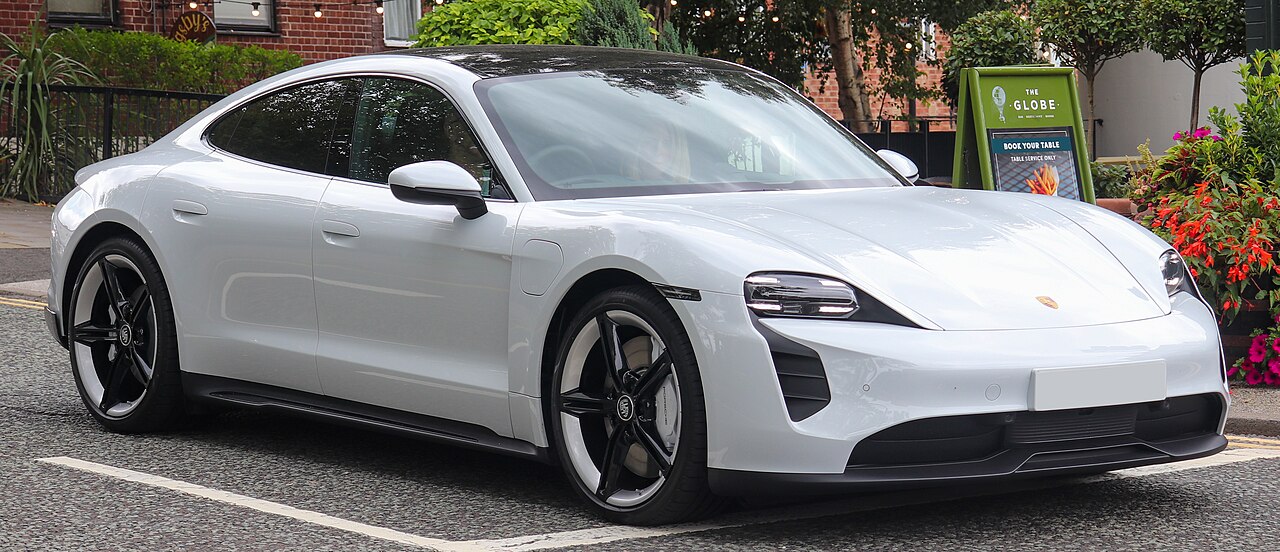 Licensed photo · Photo credit
Generations and technical specifications
Porsche Taycan2019–present
| Specification | Value |
|---|---|
| Model code | Type 9J1 I (2019–2024) / Type 9J1 II (2024–present) |
| Production | 2019–present |
| Body styles | 4-door sedan/saloon 5-door shooting brake (Taycan Cross Turismo / Taycan Sport Turismo) |
| Layout | Rear-motor, rear-wheel-drive (Taycan) Dual-motor, all-wheel-drive (Taycan 4, 4S, GTS, Turbo & Turbo S) |
| Platform | Volkswagen Group J1 |
| Engines | 2× AC synchronous electric motors |
| Transmissions | 1-speed direct-drive (front 8.05:1) 2-speed automatic (rear; 16:1 and 8.05:1) |
| Battery | 2024–present 89 kWh (82.3 kWh net battery energy content) liquid-cooled lithium-ion or 105 kWh (97 kWh net battery energy content) liquid-cooled lithium-ion "Performance Battery Plus" 2019–2024 79.2 kWh (71.0 kWh usable) liquid-cooled lithium-ion or 93.4 kWh (83.7 kWh usable) liquid-cooled lithium-ion "Performance Battery Plus" |
| Electric range | 2024–present (WLTP combined) 2019–2024 (WLTP combined), 323 km (EPA) |
| Charging | 270 kW (800 volt) DC 150 kW (400 volt) DC using onboard step-up converter 22 kW (400 volt 3 phase) AC using onboard rectifier 19.2 kW (240 volt single phase) AC using onboard rectifier |
| Wheelbase | 2,900 mm |
| Length | 4,963 mm |
| Width | 1,966 mm |
| Height | 1,378–1,381 mm |
| Kerb weight | 2,140–2,305 kg |
| Class | Executive car (E) |
| Assembly | Germany: Stuttgart |
| Designer | Emiel Burki and Mitja Borkert under Michael Mauer |
Engines and transmissions
| Model years | Engine | Transmission | Drive | Fuel |
|---|---|---|---|---|
| 2020–2026 | Electric motor | 2-speed automatic | All-wheel drive | Electricity |
| 2021–2026 | Electric motor | 2-speed automatic | Rear-wheel drive | Electricity |
Fuel economy (EPA)
| Model years | Configuration | Combined | City | Highway | Electric range |
|---|---|---|---|---|---|
| 2020–2026 | Electric motor · 2-speed automatic · All-wheel drive | 22.5–31.0 kWh/100 km | 22.2–31.3 kWh/100 km | 22.7–30.7 kWh/100 km | 309–510 km |
| 2021–2026 | Electric motor · 2-speed automatic · Rear-wheel drive | 22.7–27.9 kWh/100 km | 22.2–29.4 kWh/100 km | 23.4–26.2 kWh/100 km | 322–512 km |
Values are the official EPA label figures for each model year, shown as the lowest and highest value for the configuration. Electric models show energy use per 100 km. Real-world consumption depends on driving style, weather and load. Luggage and passenger volumes follow the EPA measuring method and can differ from the VDA figures used in Europe.
EU type-approval data
| Years | Powertrain | Power | Mass | Electric range |
|---|---|---|---|---|
| 2020, 2024–2025 | Electric | 150 kW (204 PS) | 2245–2270 kg | 623–670 km · 173–187 Wh/km |
| 2024–2025 | Electric | 163 kW (222 PS) | 2325–2370 kg | 580–625 km · 183–198 Wh/km |
| 2020–2021, 2023–2025 | Electric | 320 kW (435 PS) | 2215–2355 kg | 406–652 km · 177–248 Wh/km |
| 2022–2025 | Electric | 380 kW (517 PS) | 2370–2385 kg | 449–495 km · 208–260 Wh/km |
| 2024–2025 | Electric | 440 kW (598 PS) | 2325–2355 kg | 580–630 km · 182–198 Wh/km |
| 2025 | Electric | 515 kW (700 PS) | 2360–2385 kg | 578–621 km · 183–198 Wh/km |
| 2021–2024 | Electric | 120 kW (163 PS) | 2125–2205 kg | 410–482 km · 254–287 Wh/km |
| 2020–2024 | Electric | 140 kW (190 PS) | 2295–2320 kg | 414–458 km · 256–281 Wh/km |
| 2020–2024 | Electric | 142 kW (193 PS) | 2370–2395 kg | 405–441 km · 252–285 Wh/km |
| 2019–2024 | Electric | 175 kW (238 PS) | 2295–2395 kg | 413–480 km · 218–270 Wh/km |
| 2019–2024 | Electric | 190 kW (258 PS) | 2370–2493 kg | 402–549 km · 233–270 Wh/km |
| 2021–2024 | Electric | 240 kW (326 PS) | 2125–2155 kg | 369–443 km · 196–264 Wh/km |
| 2021–2024 | Electric | 280 kW (381 PS) | 2205–2320 kg | 434–498 km · 207–281 Wh/km |
| 2020–2024 | Electric | 360 kW (489 PS) | 2295–2325 kg | 414–481 km · 219–270 Wh/km |
| 2020–2024 | Electric | 460 kW (625 PS) | 2370–2395 kg | 405–474 km · 225–280 Wh/km |
| 2020–2022 | Electric | 80 kW (109 PS) | 2215–2380 kg | 319–379 km · 263–275 Wh/km |
| 2020–2022 | Electric | 113 kW (154 PS) | 2215 kg | 365–406 km · 246–262 Wh/km |
| 2020–2022 | Electric | 335 kW (455 PS) | 2370–2395 kg | 402–444 km · 229–255 Wh/km |
Years are registration years. Each range runs from the 10th to the 90th percentile of the values reported for new registrations; it is not an average. Mass is the mass in running order. For electric cars the power is the type-approval net power, which can be lower than the peak power in brochures.
Key specifications
| Specification | Value |
|---|---|
| EPA size class | Midsize car, Compact car, Large car |
| Model years in EPA data | 2020–2026 |
| Powertrains | Electric |
| Transmission types | Automatic |
| Drive | All-wheel drive, Rear-wheel drive |
| Fuel | Electricity |
| Configurations listed | 84 |
| Electric motor (EPA) | 175 and 254 kW ACPM; 175 and 503 kW ACPM; 201 and 503 kW ACPM; 150 and 201 kW ACPM |
| Luggage volume (EPA) | 311–680 L |
| Passenger volume (EPA) | 2,492–3,058 L |
| Electric range (EPA) | 309–512 km |
| Powertrains (EU) | Electric |
| Power (EU) | 120–460 kW (163–625 PS) |
| Mass in running order (EU) | 2,125–2,395 kg |
| Wheelbase (EU) | 2,900–2,904 mm |
Years and markets
| Specification | Value |
|---|---|
| Model years (US) | 2020–2027 |
| New registrations (EU) | 2019–2026 |
Owner complaints (NHTSA)
| Component | Complaints | Most reported model years |
|---|---|---|
| Electrical system | 142 | 2020, 2021, 2022 |
| Engine and cooling | 52 | 2020, 2021, 2022 |
| Transmission and drivetrain | 46 | 2020, 2021, 2022 |
| Brakes | 30 | 2020, 2021, 2023 |
| Driver assistance | 30 | 2020, 2021, 2022 |
| Fuel and propulsion | 22 | 2020, 2021, 2022 |
| Visibility and wipers | 13 | 2020, 2021, 2022 |
| Speed control and cruise | 12 | 2020, 2021, 2022 |
| Steering | 11 | 2020, 2021, 2022 |
| Body and structure | 4 | 2020, 2022, 2023 |
Source: complaints filed by owners with the U.S. National Highway Traffic Safety Administration (NHTSA) for model years 2020–2024: 271 complaints, 11 with a crash and 5 with a fire. Complaints are owner reports that NHTSA has not verified, and one complaint can name more than one component. More complaints can also mean more cars sold.