Cayenne
Porsche Cayenne: official NHTSA recalls, fault code help and maintenance guides.
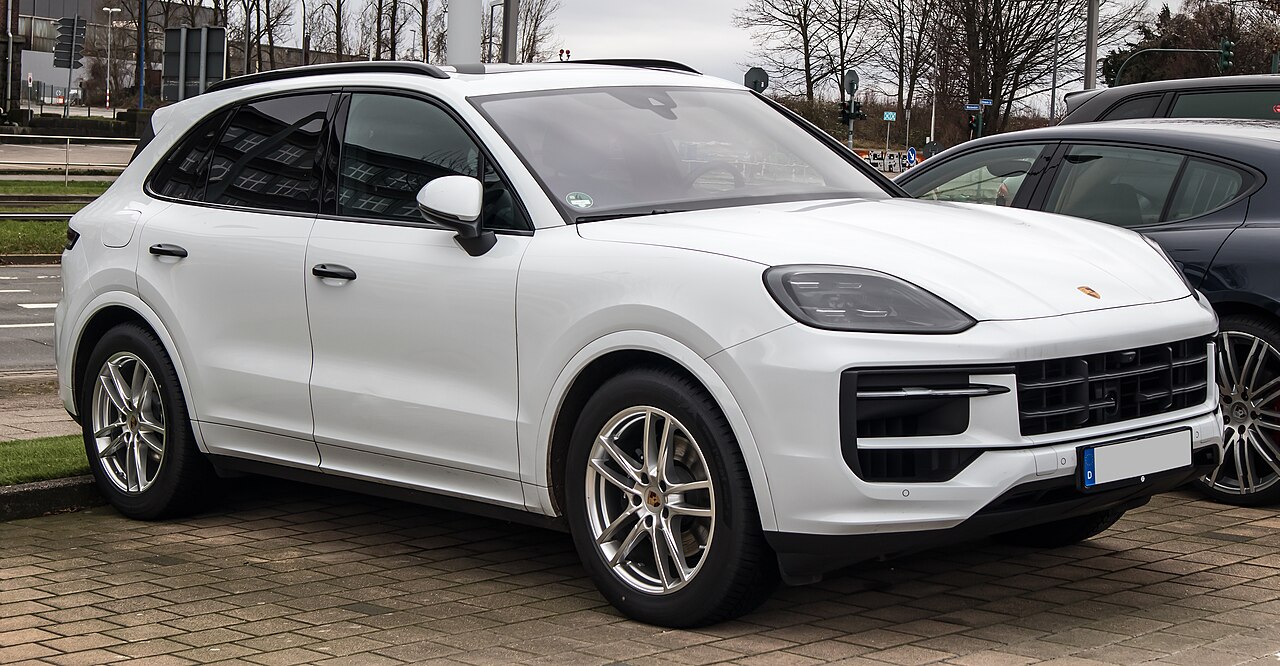 Licensed photo · Photo credit
Generations and technical specifications
Porsche Cayenne – Fourth generation2026–present
| Specification | Value |
|---|---|
| Model code | X1A / X1B |
| Production | February 2026 – present |
| Body styles | 5-door crossover SUV 5-door coupe crossover SUV |
| Platform | Premium Platform Electric (PPE) |
| Electric motor | 2× PMSM |
| Battery | 113 kWh LG Energy Solution 800 V lithium nickel cobalt manganese aluminium (Li-NCMA) |
| Charging | 400 kW |
| Wheelbase | 3,024 mm |
| Length | 4,985 mm |
| Width | 1,980 mm |
| Height | 1,674 mm |
| Kerb weight | 2,645 kg |
| Assembly | Slovakia: Bratislava (Volkswagen Bratislava Plant) |
| Designer | Fabian Schmõlz |
Porsche Cayenne – Third generation2017–present
| Specification | Value |
|---|---|
| Model code | 9YA / 9YB |
| Production | August 2017 – present |
| Model years | 2019–present |
| Body styles | 5-door crossover SUV (9Y0) 5-door coupe crossover SUV (9Y3 Coupé) |
| Platform | Volkswagen Group MLB Evo |
| Engines | Petrol 2.9 L EA839TT V6 twin-turbo 3.0 L EA839T V6 turbo 4.0 L EA825TT V8 twin-turbo Petrol plug-in hybrid 3.0 L EA839 V6 turbo 4.0 L EA825TT V8 twin-turbo |
| Electric motor | 100 kW integrated electric motor (E-Hybrid) |
| Transmissions | 8-speed ZF 8HP automatic (Tiptronic S) |
| Battery | 14.1 kWh lithium-ion (2018–2020) 17.9 kWh lithium-ion (2021–2022) 25.9 kWh lithium-ion (2023–present) |
| Wheelbase | 2,895 mm |
| Length | 4,918–4,929 mm 4,931–4,942 mm (Coupé) |
| Width | 1,983–1,995 mm |
| Height | 1,673–1,696 mm 1,636–1,676 mm (Coupé) |
| Kerb weight | 2,083–2,643 kg |
| Assembly | Slovakia: Bratislava (Volkswagen Bratislava Plant) Malaysia: Kulim, Kedah (Sime Darby: 2022–present, 3.0-litre only) |
| Designer | Ingo Scheinhutte under Michael Mauer |
Porsche Cayenne – Second generation2010–2018
| Specification | Value |
|---|---|
| Model code | 92A |
| Production | April 2010 – August 2017 |
| Model years | 2011–2018 |
| Body styles | 5-door crossover SUV 5-door coupe crossover SUV |
| Platform | Volkswagen Group PL72 platform |
| Engines | Petrol 3.0 L EA837 V6 supercharged 3.6 L EA390 VR6 4.8 L M4801 V8 4.8 L M4851 V8 twin-turbo Petrol hybrid 3.0 L EA837 V6 supercharged Petrol plug-in hybrid 3.0 L EA837 V6 supercharged (E-Hybrid) Diesel 3.0 L CNR/CRC/CVV V6 turbo diesel 4.2 L CUD V8 twin-turbo diesel |
| Electric motor | 35 kW 1NM AC synchronous (Cayenne S hybrid) 61 kW 1NM AC synchronous (Cayenne S E-Hybrid) |
| Transmissions | 8-speed TL-80SN/TR-82SD automatic (Tiptronic S) 6-speed manual (2011–2014 V6 base model only) |
| Drivetrain | Power-split hybrid (Cayenne S hybrid) Plug-in hybrid (Cayenne S E-Hybrid) |
| Battery | Nickel-metal hydride (Cayenne S hybrid) Lithium-ion (Cayenne S E-Hybrid) |
| Wheelbase | 2,895 mm |
| Length | 4,846 mm (2010–2014) 4,855 mm (2014–2017) |
| Width | 1,938 mm (2010–2014) 1,939 mm (2014–2017) |
| Height | 1,705 mm |
| Kerb weight | 2,085–2,215 kg |
| Assembly | Slovakia: Bratislava (Volkswagen Bratislava Plant: body assembly, paint, engine, gearbox, drivetrain, under chassis, wheels) Germany: Leipzig (Porsche Leipzig GmbH: interior, finishing, inspection) Germany: Osnabrück (Volkswagen Osnabrück Plant: interior, finishing, inspection; 2015–2017) |
| Designer | Mitja Borkert |
Porsche Cayenne – First generation2002–2010
| Specification | Value |
|---|---|
| Model code | 9PA |
| Production | August 2002 – December 2009 |
| Model years | 2003–2010 |
| Body styles | 5-door crossover SUV |
| Platform | Volkswagen Group PL71 platform |
| Engines | Petrol 3.2 L EA390 VR6 3.6 L EA390 VR6 4.5 L M4800 V8 (S) 4.5 L M4850 TT V8 (Turbo/Turbo S) 4.8 L M4801 V8 (S/GTS) 4.8 L M4851 TT V8 (Turbo/Turbo S) Diesel 3.0 L CNR/CRC/CVV turbodiesel V6 |
| Transmissions | 6-speed Aisin/VW TR-60SN/09D automatic (Tiptronic S) 6-speed manual (VR6, S and GTS) |
| Wheelbase | 2,855 mm |
| Length | 955 Cayenne: 4,782 mm 955 Turbo: 4,786 mm 957 Cayenne: 4,798 mm 957 GTS/Turbo: 4,795 mm |
| Width | 1,928 mm 957 GTS/Turbo S: 1,957 mm |
| Height | 1,699 mm 957 GTS: 1,675 mm 957 Turbo: 1,696 mm |
| Assembly | Slovakia: Bratislava (Volkswagen Bratislava Plant: body assembly, paint, engine, gearbox, drivetrain, under chassis, wheels) Germany: Leipzig (Porsche Leipzig GmbH: interior, finishing, inspection) |
| Designer | Steve Murkett Michael Mauer (facelift) |
Engines and transmissions
| Model years | Engine | Transmission | Drive | Fuel |
|---|---|---|---|---|
| 2019–2026 | 3.0 L, 6 cyl | 8-speed automatic | All-wheel drive | Petrol (premium) |
| 2019–2026 | 4.0 L, 8 cyl | 8-speed automatic | All-wheel drive | Petrol (premium) |
| 2021–2022, 2025 | 3.0 L, 6 cyl plug-in hybrid | 8-speed automatic | All-wheel drive | Petrol (premium) and electricity |
| 2021–2023, 2025 | 4.0 L, 8 cyl plug-in hybrid | 8-speed automatic | All-wheel drive | Petrol (premium) and electricity |
| 2019–2023 | 2.9 L, 6 cyl | 8-speed automatic | All-wheel drive | Petrol (premium) |
| 2019–2020 | 3.0 L, 6 cyl plug-in hybrid | 8-speed automatic | All-wheel drive | Petrol (premium) or electricity |
| 2020 | 4.0 L, 8 cyl plug-in hybrid | 8-speed automatic | All-wheel drive | Petrol (premium) or electricity |
| 2015–2018 | 3.0 L, 6 cyl plug-in hybrid | 8-speed automated manual | All-wheel drive | Petrol (premium) or electricity |
| 2011–2018 | 3.6 L, 6 cyl | 8-speed automatic | All-wheel drive | Petrol (premium) |
| 2011–2018 | 4.8 L, 8 cyl | 8-speed automatic | All-wheel drive | Petrol (premium) |
| 2013–2016 | 3.0 L, 6 cyl | 8-speed automatic | All-wheel drive | Diesel |
| 2011–2014 | 3.0 L, 6 cyl hybrid | 8-speed automatic | All-wheel drive | Petrol (premium) |
| +11 more configurations |
Fuel economy (EPA)
| Model years | Configuration | Combined | City | Highway | Electric range |
|---|---|---|---|---|---|
| 2013–2016, 2019–2026 | 3.0 L, 6 cyl · 8-speed automatic · All-wheel drive | 9.8–12.4 L/100 km | 11.2–13.8 L/100 km | 8.1–10.7 L/100 km | – |
| 2019–2026 | 4.0 L, 8 cyl · 8-speed automatic · All-wheel drive | 13.1–14.7 L/100 km | 14.7–16.8 L/100 km | 10.7–12.4 L/100 km | – |
| 2019–2022, 2025 | 3.0 L, 6 cyl plug-in hybrid · 8-speed automatic · All-wheel drive | 10.7–11.2 L/100 km | 11.2–11.8 L/100 km | 10.2–10.7 L/100 km | 21–47 km |
| 2020–2023, 2025 | 4.0 L, 8 cyl plug-in hybrid · 8-speed automatic · All-wheel drive | 10.7–13.1 L/100 km | 11.2–14.7 L/100 km | 10.2–11.8 L/100 km | 19–39 km |
| 2019–2023 | 2.9 L, 6 cyl · 8-speed automatic · All-wheel drive | 11.8–13.1 L/100 km | 13.1–14.7 L/100 km | 10.2–11.2 L/100 km | – |
| 2015–2018 | 3.0 L, 6 cyl plug-in hybrid · 8-speed automated manual · All-wheel drive | 10.7 L/100 km | 11.2 L/100 km | 9.8 L/100 km | 23 km |
| 2011–2018 | 3.6 L, 6 cyl · 8-speed automatic · All-wheel drive | 11.8–13.1 L/100 km | 13.1–14.7 L/100 km | 9.8–10.7 L/100 km | – |
| 2011–2018 | 4.8 L, 8 cyl · 8-speed automatic · All-wheel drive | 13.1–15.7 L/100 km | 14.7–18.1 L/100 km | 10.7–11.8 L/100 km | – |
| 2011–2014 | 3.0 L, 6 cyl hybrid · 8-speed automatic · All-wheel drive | 11.2 L/100 km | 11.8 L/100 km | 9.8 L/100 km | – |
| 2010–2014 | 3.6 L, 6 cyl · 6-speed manual · All-wheel drive | 13.1–14.7 L/100 km | 15.7–16.8 L/100 km | 10.7–11.8 L/100 km | – |
| 2010 | 3.6 L, 6 cyl · 6-speed automatic · All-wheel drive | 14.7 L/100 km | 16.8 L/100 km | 11.8 L/100 km | – |
| 2010 | 4.8 L, 8 cyl · 6-speed automatic · All-wheel drive | 15.7–16.8 L/100 km | 18.1–19.6 L/100 km | 12.4–13.1 L/100 km | – |
| +8 more configurations |
Values are the official EPA label figures for each model year, shown as the lowest and highest value for the configuration. Electric models show energy use per 100 km. Real-world consumption depends on driving style, weather and load. Luggage and passenger volumes follow the EPA measuring method and can differ from the VDA figures used in Europe.
EU type-approval data
| Years | Powertrain | Engine | Power | Mass | CO₂ | Electric range |
|---|---|---|---|---|---|---|
| 2024–2025 | Petrol | 2995 cm³ | 260 kW (354 PS) | 2130–2160 kg | 246–257 g/km (WLTP) | – |
| 2024–2025 | Petrol | 3996 cm³ | 349 kW (475 PS) | 2235–2265 kg | 283–291 g/km (WLTP) | – |
| 2024–2025 | Petrol | 3996 cm³ | 368 kW (500 PS) | 2265–2295 kg | 282–295 g/km (WLTP) | – |
| 2023–2025 | Petrol plug-in hybrid | 2995 cm³ | 224 kW (305 PS) | 2500–2530 kg | 33–91 g/km (WLTP) | 69–80 km · 196–296 Wh/km |
| 2024–2025 | Petrol plug-in hybrid | 2995 cm³ | 260 kW (354 PS) | 2485–2515 kg | 32–94 g/km (WLTP) | 73–79 km · 197–306 Wh/km |
| 2024–2025 | Petrol plug-in hybrid | 3996 cm³ | 441 kW (600 PS) | 2570–2670 kg | 40–44 g/km (WLTP) | 70–73 km · 299–309 Wh/km |
| 2019–2023 | Petrol plug-in hybrid | 2995 cm³ | 250 kW (340 PS) | 2370–2435 kg | 71–93 g/km (WLTP) | 36–44 km · 187–237 Wh/km |
| 2017–2022 | Petrol | 2995 cm³ | 250 kW (340 PS) | 2060–2105 kg | 92–272 g/km (WLTP) | – |
| 2017–2021 | Petrol | 2894 cm³ | 324 kW (441 PS) | 2095–2125 kg | 266–277 g/km (WLTP) | – |
| 2019–2020 | Petrol plug-in hybrid | 2995 cm³ | 60 kW (82 PS) | 2370–2435 kg | 76–94 g/km (WLTP) | 42–54 km · 177–236 Wh/km |
| 2014–2018 | Petrol | 3604 cm³ | – | 2160–2450 kg | 223–234 g/km (NEDC) | – |
| 2018 | Petrol-electric | 2995 cm³ | 250 kW (340 PS) | 2370 kg | 72 g/km (NEDC) | 206–209 Wh/km |
| 2014–2018 | Diesel | 2967 cm³ | 184 kW (250 PS) | 2185 kg | 173–179 g/km (NEDC) | – |
| 2014–2018 | Diesel | 2967 cm³ | 193 kW (262 PS) | 2185 kg | 173–179 g/km (NEDC) | – |
| 2014–2017 | Petrol-electric | 2995 cm³ | 245 kW (333 PS) | 2425 kg | 75–79 g/km (NEDC) | 186–208 Wh/km |
| 2011–2017 | Diesel | 2967 cm³ | 155 kW (211 PS) | 2155–2175 kg | 189–195 g/km (NEDC) | – |
| 2011, 2016–2017 | Diesel | 2967 cm³ | 176 kW (239 PS) | 2175 kg | 195 g/km (NEDC) | – |
| 2014–2017 | Diesel | 4134 cm³ | 283 kW (385 PS) | 2290–2335 kg | 209–215 g/km (NEDC) | – |
| 2011–2015 | Petrol | 3598 cm³ | 220 kW (299 PS) | 2105 kg | 236 g/km (NEDC) | – |
| 2011–2014 | Petrol | 2995 cm³ | 245 kW (333 PS) | 2315 kg | 193 g/km (NEDC) | – |
| 2012–2014 | Petrol | 4806 cm³ | 309 kW (420 PS) | 2160 kg | 251 g/km (NEDC) | – |
| 2011–2014 | Petrol | 4806 cm³ | 368 kW (500 PS) | 2245 kg | 270 g/km (NEDC) | – |
| 2011–2014 | Diesel | 2967 cm³ | 180 kW (245 PS) | 2155 kg | 189 g/km (NEDC) | – |
| 2012–2014 | Diesel | 4134 cm³ | 281 kW (382 PS) | 2270 kg | 218 g/km (NEDC) | – |
| 2011–2013 | Petrol | 4806 cm³ | 294 kW (400 PS) | 2140 kg | 245 g/km (NEDC) | – |
Years are registration years. Each range runs from the 10th to the 90th percentile of the values reported for new registrations; it is not an average. Mass is the mass in running order. For electric cars the power is the type-approval net power, which can be lower than the peak power in brochures.
Key specifications
| Specification | Value |
|---|---|
| EPA size class | Standard SUV, SUV, Special purpose vehicle |
| Model years in EPA data | 2003–2026 |
| Powertrains | Petrol, Plug-in hybrid, Diesel, Hybrid |
| Engine displacement | 2.9–4.8 L |
| Cylinders | 6, 8 |
| Transmission types | Automatic, Automated manual, Manual |
| Drive | All-wheel drive, Four-wheel or all-wheel drive |
| Fuel | Petrol (premium), Petrol (premium) and electricity, Petrol (premium) or electricity, Diesel |
| Configurations listed | 161 |
| Forced induction | Turbo- and supercharged (on some versions) |
| Start-stop system | On some versions |
| Electric motor (EPA) | 130 kW DC Brushless; 99 kW DC Brushless; 70 kW DC Brushless |
| Powertrains (EU) | Petrol, Petrol plug-in hybrid, Petrol-electric, Diesel |
| Engine displacement (EU) | 2,967–4,806 cm³ |
| Power (EU) | 176–441 kW (239–600 PS) |
| Mass in running order (EU) | 2,060–2,670 kg |
| Wheelbase (EU) | 2,895 mm |
Years and markets
| Specification | Value |
|---|---|
| Model years (US) | 2003–2027 |
| New registrations (EU) | 2002–2026 |
Owner complaints (NHTSA)
| Component | Complaints | Most reported model years |
|---|---|---|
| Engine and cooling | 152 | 2004, 2008, 2011 |
| Transmission and drivetrain | 148 | 2004, 2011, 2012 |
| Fuel and propulsion | 97 | 2004, 2005, 2006 |
| Electrical system | 93 | 2004, 2006, 2019 |
| Airbags | 70 | 2014, 2016, 2019 |
| Lights | 41 | 2004, 2014, 2016 |
| Speed control and cruise | 31 | 2004, 2014, 2019 |
| Brakes | 28 | 2004, 2019, 2020 |
| Driver assistance | 25 | 2019, 2020, 2026 |
| Body and structure | 17 | 2004, 2005, 2014 |
Source: complaints filed by owners with the U.S. National Highway Traffic Safety Administration (NHTSA) for model years 2003–2006, 2008–2024, 2026: 642 complaints, 17 with a crash and 8 with a fire. Complaints are owner reports that NHTSA has not verified, and one complaint can name more than one component. More complaints can also mean more cars sold.