Yaris
Toyota Yaris: official NHTSA recalls, fault code help and maintenance guides.
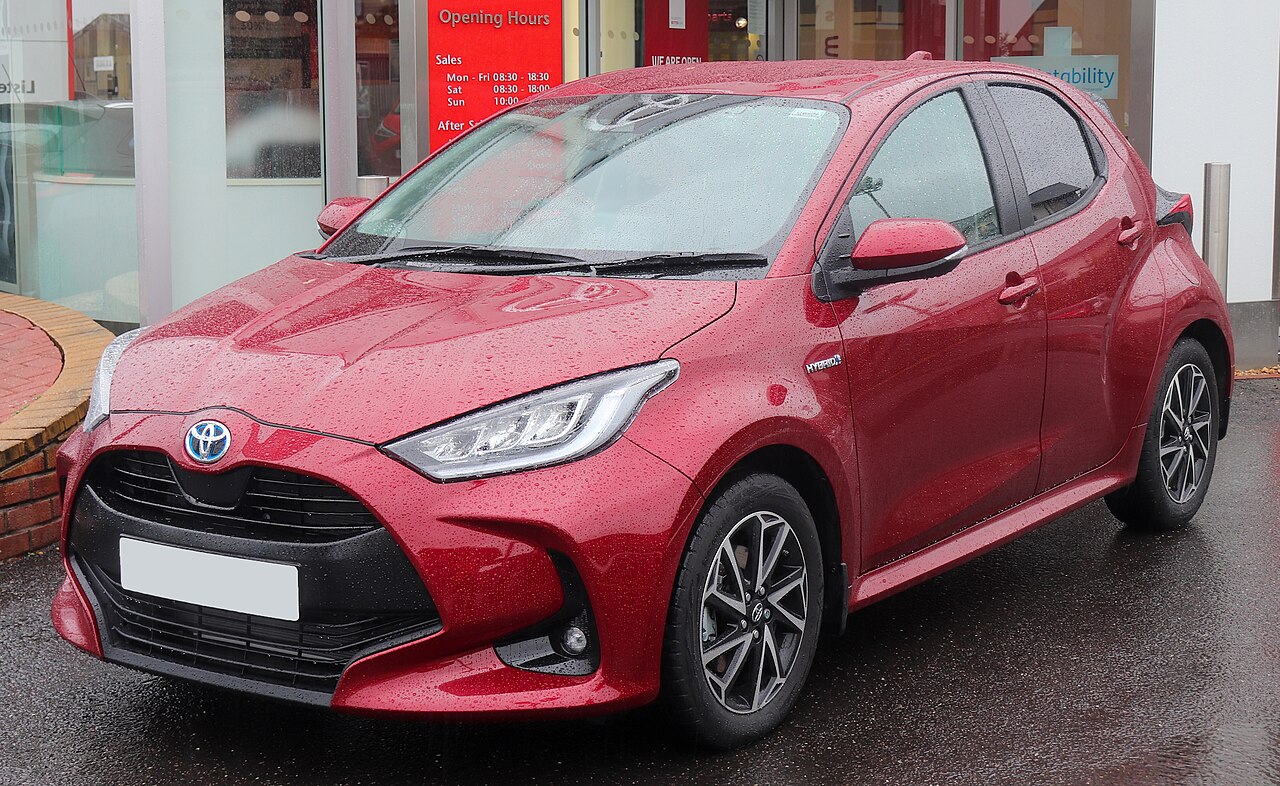 Licensed photo · Photo credit
Generations and technical specifications
Toyota Yaris (XP210)2020–present
| Specification | Value |
|---|---|
| Model code | XP210 |
| Production | February 2020 – present |
| Body styles | 5-door hatchback |
| Layout | Front-engine, front-wheel-drive Front-engine, four-wheel-drive (Japan) |
| Platform | TNGA: GA-B |
| Engines | Petrol 996 cc 1KR-FE VVT-i I3 (KSP210) 1490 cc M15A-FKS I3 (MXPA10, MXPA11, MXPA15) Petrol hybrid 1490 cc M15A-FXE I3 (MXPH11, MXPH14, MXPH17) |
| Electric motor | 1NM AC synchronous (front, hybrid) 1MM AC synchronous (rear, hybrid) |
| Transmissions | 5-speed manual 6-speed manual K120 CVT with physical first gear eCVT (hybrid models only) |
| Drivetrain | Power-split |
| Battery | 177.6 V lithium-ion (hybrid) |
| Wheelbase | 2,550 mm (Japan and Australasia) 2,560 mm (Europe) |
| Length | 3,940 mm |
| Width | 1,695 mm (Japan and Australasia) 1,745 mm (Europe) |
| Height | 1,500–1,515 mm (Japan and Australasia) 1,470–1,500 mm (Europe) |
| Kerb weight | 940–1,180 kg (Japan) |
| Class | Subcompact car / Supermini (B) |
| Assembly | Japan: Kanegasaki, Iwate (TMEJ) France: Onnaing (TMMF) Czech Republic: Kolín (TMMCZ) |
| Designer | Mario Majdandžić |
Toyota Yaris (XP150)2013–present
| Specification | Value |
|---|---|
| Production | April 2013 – present |
| Body styles | 5-door hatchback 4-door sedan |
| Layout | Front-engine, front-wheel-drive |
| Platform | Toyota new EFC platform |
| Engines | Petrol 1.2 L 3NR-FE I4 (NSP152; Thailand only) 1.2 L 3NR-FKE I4 (NSP152; Thailand only, 2019–present) 1.3 L 2NZ-FE I4 (NCP151) 1.3 L 1NR-FE I4 (NSP150) 1.3 L 6NR-FE I4 (NSP150; China only) 1.5 L 1NZ-FE I4 (NCP150; 2013–2016) 1.5 L 2NR-FE I4 (NSP151; 2016–present) 1.5 L 2NR-FBE I4 (NSP151; Brazil only) 1.5 L 7NR-FE I4 (NSP151; China only) |
| Transmissions | 5/6-speed manual 4-speed automatic Aisin K411 Super CVT-i |
| Wheelbase | 2,550 mm |
| Length | 4,115–4,145 mm 4,420–4,440 mm (sedan) |
| Width | 1,700–1,730 mm |
| Height | 1,475–1,500 mm |
| Kerb weight | 1,010–1,095 kg 1,035–1,150 kg (sedan) |
| Class | Subcompact car (B) |
| Assembly | Thailand: Chachoengsao (TMT) Indonesia: Karawang (TMMIN) Malaysia: Bukit Raja (UMW) Philippines: Santa Rosa (TMP, sedan only) China: Guangzhou (GAC Toyota) Taiwan: Guanyin (Kuozui Motors) Brazil: Sorocaba India: Bidadi, Karnataka (TKM, sedan only) Pakistan: Karachi (IMC, sedan only) |
| Designer | Kiyotaka Yoshida, Noriyuki Nakamura and Tetsuya Nakagawa (hatchback) Hideyuki Numata, Hiroaki Suzuki, Kazuhiko Isawa and Makoto Takahashi (sedan) Donny Adhi Yuwono and Akbar Juniarto (Yaris TRD Sportivo – 2016 minor update, Heykers and 2018 facelift) Yukihiro Koide and Takuya Watabe (2018 facelift) Hisatoshi Katsukawa and Yoshikazu Shoji (2020 facelift) Jing-qi Zhao and Yun Yang (Chinese-market Vios, 2020 facelift) |
Engines and transmissions
| Model years | Engine | Transmission | Drive | Fuel |
|---|---|---|---|---|
| 2017–2020 | 1.5 L, 4 cyl | 6-speed automatic | Front-wheel drive | Petrol (regular) |
| 2017–2020 | 1.5 L, 4 cyl | 6-speed manual | Front-wheel drive | Petrol (regular) |
| 2007–2019 | 1.5 L, 4 cyl | 4-speed automatic | Front-wheel drive | Petrol (regular) |
| 2007–2018 | 1.5 L, 4 cyl | 5-speed manual | Front-wheel drive | Petrol (regular) |
Fuel economy (EPA)
| Model years | Configuration | Combined | City | Highway |
|---|---|---|---|---|
| 2017–2020 | 1.5 L, 4 cyl · 6-speed automatic · Front-wheel drive | 6.7 L/100 km | 7.4 L/100 km | 5.9 L/100 km |
| 2017–2020 | 1.5 L, 4 cyl · 6-speed manual · Front-wheel drive | 6.9 L/100 km | 7.8 L/100 km | 6.0 L/100 km |
| 2007–2019 | 1.5 L, 4 cyl · 4-speed automatic · Front-wheel drive | 7.4–7.6 L/100 km | 7.8–8.1 L/100 km | 6.7–6.9 L/100 km |
| 2007–2018 | 1.5 L, 4 cyl · 5-speed manual · Front-wheel drive | 7.1–7.6 L/100 km | 7.8–8.1 L/100 km | 6.5–6.7 L/100 km |
Values are the official EPA label figures for each model year, shown as the lowest and highest value for the configuration. Electric models show energy use per 100 km. Real-world consumption depends on driving style, weather and load. Luggage and passenger volumes follow the EPA measuring method and can differ from the VDA figures used in Europe.
EU type-approval data
| Years | Powertrain | Engine | Power | Mass | CO₂ |
|---|---|---|---|---|---|
| 2020–2025 | Petrol hybrid | 1490 cm³ | 68 kW (92 PS) | 1160–1165 kg | 87–97 g/km (WLTP) |
| 2020–2024 | Petrol | 1490 cm³ | 92 kW (125 PS) | 1115–1150 kg | 118–126 g/km (WLTP) |
| 2018–2023 | Petrol | 998 cm³ | 53 kW (72 PS) | 1035–1060 kg | 127–131 g/km (WLTP) |
| 2017–2020 | Petrol | 1496 cm³ | 82 kW (111 PS) | 1120–1140 kg | 135–141 g/km (WLTP) |
| 2015–2020 | Petrol | 1497 cm³ | 54 kW (73 PS) | 1150–1175 kg | 108–112 g/km (WLTP) |
| 2019–2020 | Petrol hybrid | 1497 cm³ | 54 kW (73 PS) | 1150–1175 kg | 108–113 g/km (WLTP) |
| 2011–2018 | Petrol | 998 cm³ | 51 kW (69 PS) | 1055–1100 kg | 135 g/km (WLTP) |
| 2011–2018 | Diesel | 1364 cm³ | 66 kW (90 PS) | 1140–1190 kg | 91–108 g/km (NEDC) |
| 2011–2017 | Petrol | 1329 cm³ | 73 kW (99 PS) | 1100–1140 kg | 114–123 g/km (NEDC) |
| 2012–2015 | Petrol | 1497 cm³ | 55 kW (75 PS) | 1160–1195 kg | 75–85 g/km (NEDC) |
| 2012–2014 | Petrol-electric | 1497 cm³ | 55 kW (75 PS) | 1160–1170 kg | 75–85 g/km (NEDC) |
Years are registration years. Each range runs from the 10th to the 90th percentile of the values reported for new registrations; it is not an average. Mass is the mass in running order. For electric cars the power is the type-approval net power, which can be lower than the peak power in brochures.
Key specifications
| Specification | Value |
|---|---|
| EPA size class | Compact car, Subcompact car |
| Model years in EPA data | 2007–2020 |
| Powertrains | Petrol |
| Engine displacement | 1.5 L |
| Cylinders | 4 |
| Transmission types | Manual, Automatic |
| Drive | Front-wheel drive |
| Fuel | Petrol (regular) |
| Configurations listed | 33 |
| Luggage volume (EPA) | 368–453 L |
| Passenger volume (EPA) | 2,407–2,464 L |
| Powertrains (EU) | Petrol, Petrol hybrid, Diesel |
| Engine displacement (EU) | 998–1,497 cm³ |
| Power (EU) | 51–92 kW (69–125 PS) |
| Mass in running order (EU) | 1,035–1,195 kg |
| Wheelbase (EU) | 2,510–2,560 mm |
Years and markets
| Specification | Value |
|---|---|
| Model years (US) | 2007–2026 |
| New registrations (EU) | 2000–2026 |
Owner complaints (NHTSA)
| Component | Complaints | Most reported model years |
|---|---|---|
| Airbags | 387 | 2007, 2008, 2009 |
| Brakes | 106 | 2007, 2008, 2009 |
| Speed control and cruise | 77 | 2007, 2008, 2009 |
| Electrical system | 73 | 2007, 2008, 2009 |
| Engine and cooling | 60 | 2007, 2008, 2019 |
| Body and structure | 57 | 2007, 2008, 2009 |
| Suspension | 56 | 2007, 2008, 2009 |
| Steering | 41 | 2007, 2008, 2010 |
| Seats | 40 | 2007, 2008, 2009 |
| Fuel and propulsion | 39 | 2007, 2008, 2019 |
Source: complaints filed by owners with the U.S. National Highway Traffic Safety Administration (NHTSA) for model years 2007–2020: 854 complaints, 166 with a crash and 14 with a fire. Complaints are owner reports that NHTSA has not verified, and one complaint can name more than one component. More complaints can also mean more cars sold.