LS
Lexus LS: official NHTSA recalls, fault code help and maintenance guides.
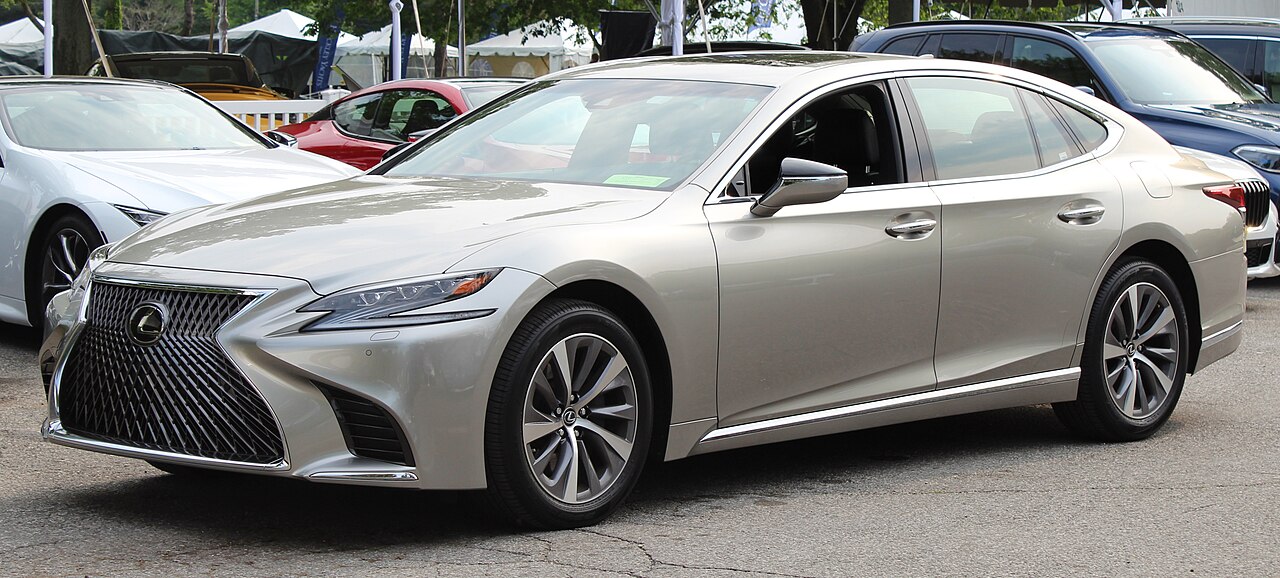 Licensed photo · Photo credit
Generations and technical specifications
Lexus LS – Fifth generation2017–present
| Specification | Value |
|---|---|
| Model code | XF50 |
| Production | December 2017 – present |
| Model years | 2018–present |
| Layout | Front-engine, rear-wheel-drive Front-engine, all-wheel-drive |
| Platform | TNGA: GA-L |
| Engines | Petrol 3,444 cm³ V35A-FTS twin-turbo V6 (LS 500) 3,456 cm³ 2GR-FKS/8GR-FKS V6 (LS 350) Hybrid 3,456 cm³ 8GR-FXS V6 (LS 500h) |
| Electric motor | 2x 132 kW 2NM AC Permanent Magnet synchronous motors |
| Transmissions | 10-speed Aisin AWR10L65 "Direct Shift-10A" automatic (LS 350 & LS 500) 10-speed Aisin AWRHM50 / L310/f "Multi Stage Electronically controlled Hybrid System" automatic (LS 500h) |
| Drivetrain | Lexus Multi Stage Hybrid System (LS 500h) |
| Battery | 310.8V high-voltage Lithium-ion |
| Wheelbase | 3,125 mm |
| Length | 5,235 mm |
| Width | 1,900 mm |
| Height | 1,450–1,460 mm |
| Kerb weight | 2,030–2,350 kg |
| Designer | 2013 Yoshio Kanesugi (exterior) Yamamoto Rei (interior) Koichi Suga (chief designer) |
Lexus LS (XF40)2006–2017
| Specification | Value |
|---|---|
| Production | August 2006 – October 2017 |
| Model years | 2007–2017 |
| Body styles | 4-door sedan |
| Layout | Front-engine, rear-wheel-drive Front-engine, all-wheel-drive |
| Platform | Toyota N platform |
| Engines | 4.6 L 1UR-FE V8 4.6 L 1UR-FSE V8 5.0 L 2UR-FSE V8 (hybrid) |
| Electric motor | 1KM AC synchronous |
| Transmissions | 8-speed AA80E RWD automatic 8-speed AA80F AWD automatic Hybrid Synergy Drive L110F AWD automatic |
| Drivetrain | Hybrid Synergy Drive L110F |
| Wheelbase | SWB: 2,969 mm LWB: 3,091 mm |
| Length | 2006–2009 SWB: 5,029 mm LWB: 5,151 mm 2009–2017 SWB: 5,060 mm LWB: 5,179 mm |
| Width | 1,875 mm |
| Height | 1,476 mm 1,481 mm (hybrid) 1,466 mm (air suspension) |
| Kerb weight | SWB: 1,950–2,320 kg LWB: 2,040–2,380 kg |
| Class | Full-size luxury car |
| Assembly | Japan: Tahara, Aichi (Tahara plant) |
| Designer | Yo Hiruta (2003, 2004) |
Lexus LS – Fourth generation2006–2017
| Specification | Value |
|---|---|
| Model code | XF40 |
| Production | September 2006 – October 2017 |
| Model years | 2007–2017 |
| Layout | Front-engine, rear-wheel-drive Front-engine, all-wheel-drive |
| Platform | Toyota N platform |
| Engines | 4,608 cm³ 1UR-FE V8 4,608 cm³ 1UR-FSE V8 4,969 cm³ 2UR-FSE V8 hybrid (LS 600h) |
| Transmissions | 8-speed AA80E RWD automatic 8-speed AA80F AWD automatic Power-split Hybrid L110f (LS 600h) |
| Wheelbase | 2,969 mm (2007–2012; SWB) 3,090 mm (2007–2012; LWB) 3,020 mm (2012–2017; SWB) 3,120 mm (2012–2017; LWB) |
| Length | 5,029 mm (2007–2012; SWB) 5,151 mm (2007–2012; LWB) 5,060 mm (2012–2017; SWB) 5,179 mm (2012–2017; LWB) |
| Width | 1,875 mm |
| Height | 1,466–1,481 mm |
| Kerb weight | 1,925–1,965 kg |
| Designer | 2003, hybrid 2004: Yo Hiruta |
Lexus LS – Third generation2000–2006
| Specification | Value |
|---|---|
| Model code | XF30 |
| Production | July 2000 – August 2006 |
| Model years | 2001–2006 |
| Layout | Front-engine, rear-wheel-drive |
| Engines | 4,292 cm³ 3UZ-FE V8 |
| Transmissions | 5-speed A650E automatic 6-speed A761E automatic |
| Wheelbase | 2,926 mm |
| Length | 5,010–5,014 mm |
| Width | 1,829 mm |
| Height | 1,491 mm |
| Kerb weight | 1,810–1,812 kg |
| Designer | 1997 Akihiro Nagaya Makoto Oshima (chief designer) 2002 facelift Machio Nakamura |
Lexus LS – Second generation1994–2000
| Specification | Value |
|---|---|
| Model code | XF20 |
| Production | October 1994 – June 2000 |
| Model years | 1995–2000 |
| Layout | Front-engine, rear-wheel-drive |
| Engines | 3,968 cm³ 1UZ-FE V8 |
| Transmissions | 4-speed A340E automatic 5-speed A650E automatic |
| Wheelbase | 2,850 mm |
| Length | 4,996 mm |
| Width | 1,829 mm |
| Height | 1,420–1,435 mm |
| Kerb weight | 1,659–1,764 kg |
| Designer | 1991 Kunihiro Uchida (Chief Exterior) Makoto Oshima (Exterior) 1996 facelift Hiroaki Shinoda |
Engines and transmissions
| Model years | Engine | Transmission | Drive | Fuel |
|---|---|---|---|---|
| 2018–2026 | 3.4 L, 6 cyl | 10-speed automatic | All-wheel drive | Petrol (premium) |
| 2018–2025 | 3.4 L, 6 cyl | 10-speed automatic | Rear-wheel drive | Petrol (premium) |
| 2018–2025 | 3.5 L, 6 cyl hybrid | CVT (continuously variable) | All-wheel drive | Petrol (premium) |
| 2018–2021, 2023 | 3.5 L, 6 cyl hybrid | CVT (continuously variable) | Rear-wheel drive | Petrol (premium) |
| 2010–2017 | 4.6 L, 8 cyl | 8-speed automatic | All-wheel drive | Petrol (premium) |
| 2007–2017 | 4.6 L, 8 cyl | 8-speed automatic | Rear-wheel drive | Petrol (premium) |
| 2010–2016 | 5.0 L, 8 cyl hybrid | CVT (continuously variable) | All-wheel drive | Petrol (premium) |
| 2009 | 4.6 L, 8 cyl | 8-speed automatic | Four-wheel or all-wheel drive | Petrol (premium) |
| 2008–2009 | 5.0 L, 8 cyl hybrid | 8-speed automatic | Four-wheel or all-wheel drive | Petrol (premium) |
| 2004–2006 | 4.3 L, 8 cyl | 6-speed automatic | Rear-wheel drive | Petrol (premium) |
| 2001–2003 | 4.3 L, 8 cyl | 5-speed automatic | Rear-wheel drive | Petrol (premium) |
| 2000 | 4.0 L, 8 cyl | 5-speed automatic | Rear-wheel drive | Petrol (premium) |
Fuel economy (EPA)
| Model years | Configuration | Combined | City | Highway |
|---|---|---|---|---|
| 2018–2026 | 3.4 L, 6 cyl · 10-speed automatic · All-wheel drive | 11.2 L/100 km | 13.1–13.8 L/100 km | 8.7 L/100 km |
| 2018–2025 | 3.4 L, 6 cyl · 10-speed automatic · Rear-wheel drive | 10.2–10.7 L/100 km | 12.4–13.1 L/100 km | 7.8–8.1 L/100 km |
| 2018–2025 | 3.5 L, 6 cyl hybrid · CVT (continuously variable) · All-wheel drive | 9.0–9.4 L/100 km | 10.2–10.7 L/100 km | 7.6–8.1 L/100 km |
| 2018–2021, 2023 | 3.5 L, 6 cyl hybrid · CVT (continuously variable) · Rear-wheel drive | 8.4–9.4 L/100 km | 9.4–10.7 L/100 km | 7.1–8.1 L/100 km |
| 2010–2017 | 4.6 L, 8 cyl · 8-speed automatic · All-wheel drive | 13.1 L/100 km | 14.7 L/100 km | 10.2 L/100 km |
| 2007–2017 | 4.6 L, 8 cyl · 8-speed automatic · Rear-wheel drive | 11.8–12.4 L/100 km | 13.8–14.7 L/100 km | 9.4–9.8 L/100 km |
| 2010–2016 | 5.0 L, 8 cyl hybrid · CVT (continuously variable) · All-wheel drive | 11.2–11.8 L/100 km | 11.8–12.4 L/100 km | 10.2–10.7 L/100 km |
| 2009 | 4.6 L, 8 cyl · 8-speed automatic · Four-wheel or all-wheel drive | 13.1 L/100 km | 14.7 L/100 km | 10.2 L/100 km |
| 2008–2009 | 5.0 L, 8 cyl hybrid · 8-speed automatic · Four-wheel or all-wheel drive | 11.2 L/100 km | 11.8 L/100 km | 10.7 L/100 km |
| 2004–2006 | 4.3 L, 8 cyl · 6-speed automatic · Rear-wheel drive | 12.4–13.1 L/100 km | 14.7 L/100 km | 10.2 L/100 km |
| 2001–2003 | 4.3 L, 8 cyl · 5-speed automatic · Rear-wheel drive | 12.4 L/100 km | 13.8–14.7 L/100 km | 10.2 L/100 km |
| 2000 | 4.0 L, 8 cyl · 5-speed automatic · Rear-wheel drive | 12.4 L/100 km | 14.7 L/100 km | 10.2 L/100 km |
Values are the official EPA label figures for each model year, shown as the lowest and highest value for the configuration. Electric models show energy use per 100 km. Real-world consumption depends on driving style, weather and load. Luggage and passenger volumes follow the EPA measuring method and can differ from the VDA figures used in Europe.
EU type-approval data
| Years | Powertrain | Engine | Power | Mass | CO₂ |
|---|---|---|---|---|---|
| 2019–2025 | Petrol hybrid | 3456 cm³ | 220 kW (299 PS) | 2340–2455 kg | 206–216 g/km (WLTP) |
| 2017–2021 | Petrol | 3456 cm³ | 220 kW (299 PS) | 2345–2455 kg | 204–215 g/km (WLTP) |
| 2018–2020 | Petrol | 3445 cm³ | 307 kW (417 PS) | 2320–2410 kg | 250 g/km (WLTP) |
| 2017 | Petrol | 3456 cm³ | 330 kW (449 PS) | 2415–2500 kg | 161 g/km (NEDC) |
| 2011–2017 | Petrol | 4969 cm³ | 290 kW (394 PS) | 2305–2485 kg | 199–218 g/km (NEDC) |
| 2012–2016 | Petrol | 4608 cm³ | 272 kW (370 PS) | 2155–2275 kg | 263 g/km (NEDC) |
| 2013, 2015 | Petrol | 4608 cm³ | 285 kW (387 PS) | 2015–2155 kg | 249 g/km (NEDC) |
| 2014–2015 | Petrol-electric | 4969 cm³ | 290 kW (394 PS) | 2305–2485 kg | 199 g/km (NEDC) |
| 2011–2012 | Petrol | 4608 cm³ | 270 kW (367 PS) | 2160 kg | 274 g/km (NEDC) |
Years are registration years. Each range runs from the 10th to the 90th percentile of the values reported for new registrations; it is not an average. Mass is the mass in running order. For electric cars the power is the type-approval net power, which can be lower than the peak power in brochures.
Key specifications
| Specification | Value |
|---|---|
| EPA size class | Midsize car, Large car |
| Model years in EPA data | 2000–2026 |
| Powertrains | Petrol, Hybrid |
| Engine displacement | 3.4–5.0 L |
| Cylinders | 6, 8 |
| Transmission types | Automatic, CVT |
| Drive | All-wheel drive, Rear-wheel drive, Four-wheel or all-wheel drive |
| Fuel | Petrol (premium) |
| Configurations listed | 89 |
| Forced induction | Turbocharged (on some versions) |
| Start-stop system | On some versions |
| Luggage volume (EPA) | 283–453 L |
| Passenger volume (EPA) | 2,803–3,030 L |
| Powertrains (EU) | Petrol, Petrol hybrid |
| Engine displacement (EU) | 3,445–4,969 cm³ |
| Power (EU) | 220–330 kW (299–449 PS) |
| Mass in running order (EU) | 2,155–2,500 kg |
| Wheelbase (EU) | 2,445–3,125 mm |
Years and markets
| Specification | Value |
|---|---|
| Model years (US) | 2000–2027 |
| New registrations (EU) | 2000–2025 |
Owner complaints (NHTSA)
| Component | Complaints | Most reported model years |
|---|---|---|
| Brakes | 10 | 2013, 2014, 2015 |
| Electrical system | 5 | 2000, 2001, 2018 |
| Driver assistance | 4 | 2013, 2015, 2018 |
| Engine and cooling | 4 | 2013, 2014, 2019 |
| Wheels | 4 | 2018, 2021 |
| Tyres | 2 | 2018, 2021 |
| Body and structure | 1 | 2001 |
| Latches and locks | 1 | 2001 |
| Seats | 1 | 2018 |
| Fuel and propulsion | 1 | 2018 |
Source: complaints filed by owners with the U.S. National Highway Traffic Safety Administration (NHTSA) for model years 2000–2001, 2013–2015, 2018–2019, 2021: 32 complaints, 0 with a crash and 0 with a fire. Complaints are owner reports that NHTSA has not verified, and one complaint can name more than one component. More complaints can also mean more cars sold.