Lexus
UX
Lexus UX: official NHTSA recalls, fault code help and maintenance guides.
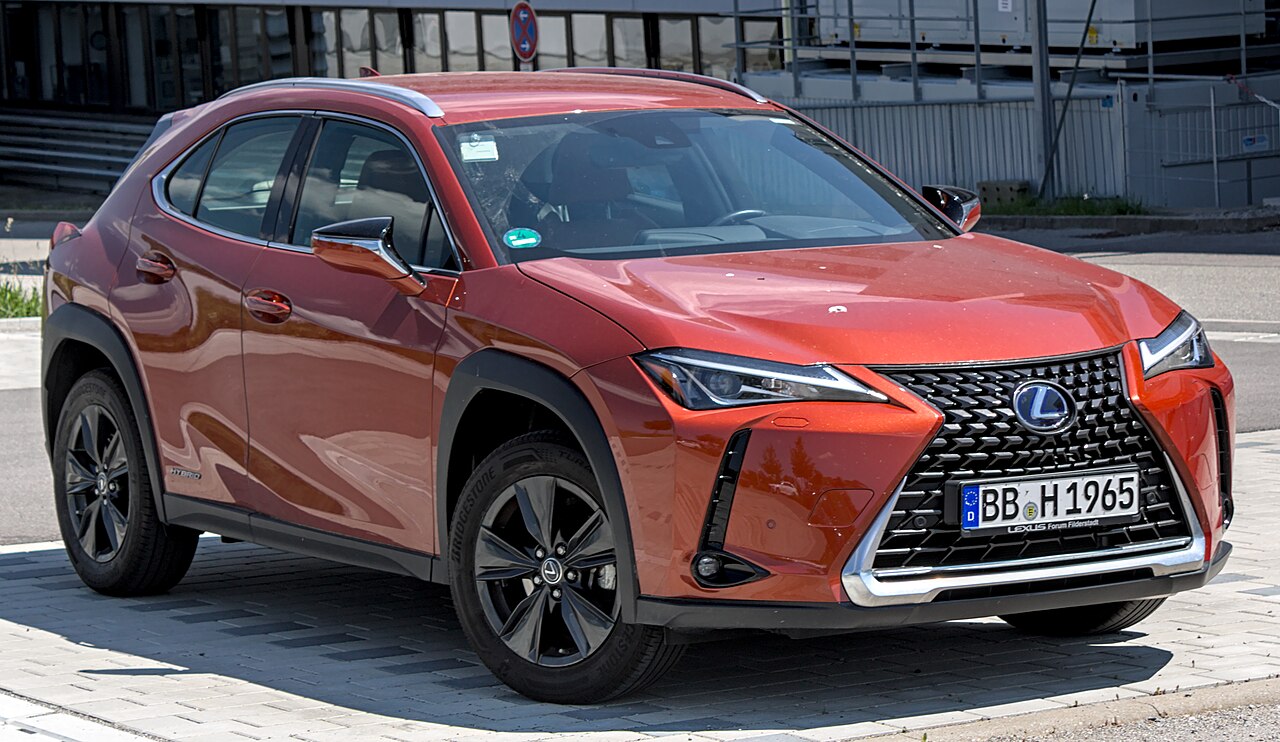 Licensed photo · Photo credit
MakeLexus
ClassCompact car
Model years (US)2019–2027
New registrations (EU)2019–2026
Recall dataNHTSA (United States)
Generations and technical specifications
Lexus UX2018–present
| Specification | Value |
|---|---|
| Model code | ZA10 |
| Production | December 2018 – present |
| Model years | 2019–present |
| Body styles | 5-door SUV |
| Layout | Front-engine, front-wheel-drive Front-engine, four-wheel-drive Front-motor, front-wheel-drive (UX 300e) |
| Platform | TNGA: GA-C |
| Engines | Petrol 2.0 L M20A-FKS I4 (UX 200; MZAA10) Petrol hybrid 2.0 L M20A-FXS I4 (UX 250h/260h; MZAH10/15) |
| Electric motor | 80 kW 3NM synchronous (UX 250h/260h) 150 kW 4KM synchronous (UX 300e; KMA10) |
| Transmissions | K120 CVT with physical first gear (UX 200) eCVT (UX 250h/260h) Single-speed automatic (UX 300e) |
| Drivetrain | Power-split hybrid (UX 250h/260h) |
| Battery | 1.4 kWh, 216 V sealed Nickel-metal hydride (UX 250h/260h) 54.3–72.8 kWh, 355.2 V lithium-ion (UX 300e) |
| Electric range | 400 km (UX 300e, NEDC) 299 km (UX 300e, WLTP) |
| Charging | 6.6 kW AC, 50 kW DC (UX 300e) |
| Wheelbase | 2,640 mm |
| Length | 4,495 mm |
| Width | 1,840 mm |
| Kerb weight | 1,470–1,540 kg (UX 200) 1,550–1,640 kg (UX 250h/260h) 1,900 kg (UX 300e) |
| Class | Subcompact luxury crossover SUV |
| Assembly | Japan: Miyawaka, Fukuoka (Toyota Motor Kyushu) |
| Designer | Tetsuo Miki, Hideaki Iida, Nobuyuki Tomatsu, Shunsuke Sudo and Tatsuya Iwai |
Engines and transmissions
| Model years | Engine | Transmission | Drive | Fuel |
|---|---|---|---|---|
| 2019, 2021–2023, 2025–2026 | 2.0 L, 4 cyl hybrid | CVT (continuously variable) | All-wheel drive | Petrol (regular) |
| 2019, 2021–2023, 2025–2026 | 2.0 L, 4 cyl hybrid | CVT (continuously variable) | Front-wheel drive | Petrol (regular) |
| 2020, 2024 | 2.0 L, 4 cyl mild hybrid | CVT (continuously variable) | All-wheel drive | Petrol (regular) |
| 2020, 2024 | 2.0 L, 4 cyl mild hybrid | CVT (continuously variable) | Front-wheel drive | Petrol (regular) |
| 2019–2022 | 2.0 L, 4 cyl | CVT (continuously variable) | Front-wheel drive | Petrol (regular) |
Fuel economy (EPA)
| Model years | Configuration | Combined | City | Highway |
|---|---|---|---|---|
| 2019, 2021–2023, 2025–2026 | 2.0 L, 4 cyl hybrid · CVT (continuously variable) · All-wheel drive | 5.6–6.0 L/100 km | 5.3–5.7 L/100 km | 5.9–6.2 L/100 km |
| 2019, 2021–2023, 2025–2026 | 2.0 L, 4 cyl hybrid · CVT (continuously variable) · Front-wheel drive | 5.5–5.6 L/100 km | 5.2–5.5 L/100 km | 5.7 L/100 km |
| 2020, 2024 | 2.0 L, 4 cyl mild hybrid · CVT (continuously variable) · All-wheel drive | 6.0 L/100 km | 5.7 L/100 km | 6.2 L/100 km |
| 2020, 2024 | 2.0 L, 4 cyl mild hybrid · CVT (continuously variable) · Front-wheel drive | 5.6 L/100 km | 5.5 L/100 km | 5.7 L/100 km |
| 2019–2022 | 2.0 L, 4 cyl · CVT (continuously variable) · Front-wheel drive | 7.1–7.4 L/100 km | 8.1 L/100 km | 6.4 L/100 km |
Values are the official EPA label figures for each model year, shown as the lowest and highest value for the configuration. Electric models show energy use per 100 km. Real-world consumption depends on driving style, weather and load. Luggage and passenger volumes follow the EPA measuring method and can differ from the VDA figures used in Europe.
EU type-approval data
| Years | Powertrain | Engine | Power | Mass | CO₂ | Electric range |
|---|---|---|---|---|---|---|
| 2019–2025 | Petrol hybrid | 1987 cm³ | 112 kW (152 PS) | 1615–1675 kg | 120–134 g/km (WLTP) | – |
| 2020–2025 | Electric | – | 150 kW (204 PS) | 1850–1875 kg | – | 309–451 km · 167–170 Wh/km |
| 2019–2024 | Petrol | 1987 cm³ | 127 kW (173 PS) | 1535–1583 kg | 150–155 g/km (WLTP) | – |
| 2019–2022 | Petrol | 1987 cm³ | 112 kW (152 PS) | 1615–1642 kg | 120–127 g/km (WLTP) | – |
| 2020–2022 | Electric | – | 57 kW (77 PS) | 1860 kg | – | 306–313 km · 169–170 Wh/km |
Years are registration years. Each range runs from the 10th to the 90th percentile of the values reported for new registrations; it is not an average. Mass is the mass in running order. For electric cars the power is the type-approval net power, which can be lower than the peak power in brochures.
Key specifications
| Specification | Value |
|---|---|
| EPA size class | Compact car, Midsize car |
| Model years in EPA data | 2019–2026 |
| Powertrains | Hybrid, Mild hybrid, Petrol |
| Engine displacement | 2.0 L |
| Cylinders | 4 |
| Transmission types | CVT |
| Drive | Front-wheel drive, All-wheel drive |
| Fuel | Petrol (regular) |
| Configurations listed | 24 |
| Start-stop system | On some versions |
| Luggage volume (EPA) | 481–623 L |
| Passenger volume (EPA) | 2,549 L |
| Powertrains (EU) | Petrol, Petrol hybrid, Electric |
| Engine displacement (EU) | 1,987 cm³ |
| Power (EU) | 112–150 kW (152–204 PS) |
| Mass in running order (EU) | 1,535–1,875 kg |
| Wheelbase (EU) | 2,640 mm |
Years and markets
| Specification | Value |
|---|---|
| Model years (US) | 2019–2027 |
| New registrations (EU) | 2019–2026 |