Renault
Captur
Renault Captur: years registered new in Europe, fault code help, warning lights and maintenance guides.
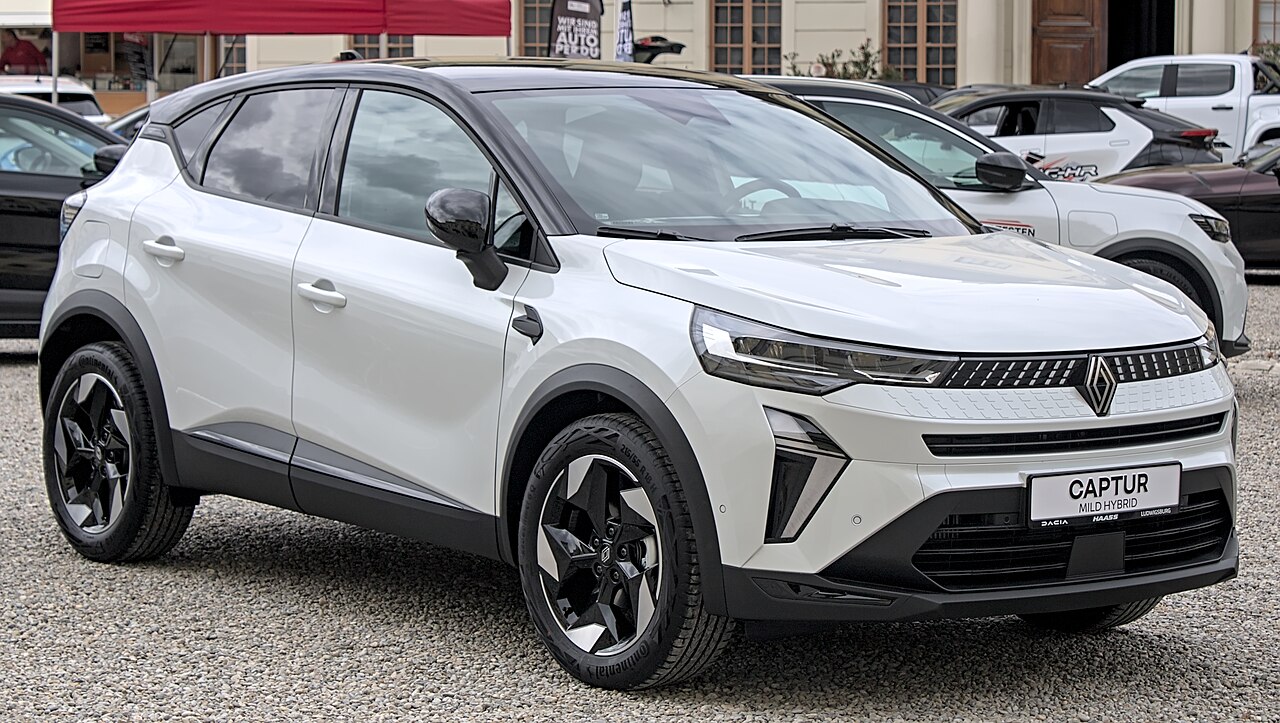 Licensed photo · Photo credit
MakeRenault
New registrations (EU)2013–2026
Generations and technical specifications
Renault Captur – Second generation2019–present
| Specification | Value |
|---|---|
| Model code | XJB * HJB * HJE |
| Production | 2019–present |
| Layout | Front-engine, front-wheel-drive |
| Platform | Renault–Nissan CMF-B HS platform |
| Engines | Petrol 1.0 L H4Bt tCe I3 1.2 L HR12 tCe I3 1.3 L H5Ht tCe I4 Petrol hybrid 1.6 L H4M I4 (E-Tech Hybrid; 2020–2024) 1.8 L Horse HR18 HEV I4 (E-Tech Hybrid; 2025–present) Diesel 1.5 L K9K Blue dCi turbo I4 (2019–2020) Petrol plug-in hybrid 1.6 L H4M I4 (E-Tech Plug-In Hybrid; 2020–2022) |
| Electric motor | 2x PMSM's (E-Tech Hybrid & E-Tech PHEV) |
| Transmissions | 6-speed manual 7-speed Getrag EDC automatic Jatco CVT automatic 6-speed clutchless automatic (E-Tech) E-TECH multi-mode automatic transmission with 15 combinations (E-Tech PHEV) |
| Drivetrain | Power-split hybrid Plug-in hybrid |
| Battery | 1.3 kWh Li-ion (E-Tech hybrid until 2024) 1.3 kWh Li-ion (E-Tech hybrid 2025–present) 10.5 kWh Li-ion (PHEV) |
| Wheelbase | 2,639 mm |
| Length | 4,228 mm |
| Width | 1,797 mm |
| Height | 1,566 mm |
| Assembly | Spain: Valladolid (Renault Spain) China: Wuhan (Dongfeng Renault until 2020) |
| Designer | Pierre Sabas (exterior; 2018) Under the lead of Laurens van den Acker |
Renault Captur – First generation (Global Access)2016–2023
| Specification | Value |
|---|---|
| Production | 2017–2023 (Brazil) 2017–2020 (India) 2016–2022 (Russia) 2021–2022 (Kazakhstan) |
| Layout | Front-engine, front-wheel-drive or four-wheel-drive |
| Platform | Renault/Dacia B0 platform Renault/Dacia B0+ platform (facelift) |
| Engines | Petrol 1.3 L H5Ht turbo I4 1.5 L H4K I4 1.6 L K4M 606 / K4M Hi-Flex I4 2.0 L F4R / F4R Hi-Flex I4 Diesel 1.5 L K9K I4 |
| Transmissions | 5-speed manual 6-speed manual 4-speed automatic Jatco CVT7 CVT Jatco CVT8 CVT |
| Wheelbase | 2,673 mm |
| Width | 1,813 mm |
| Assembly | Brazil: São José dos Pinhais (Renault Brazil) Russia: Moscow (Renault Russia) India: Chennai (Renault Nissan India) Kazakhstan: Kostanay (SaryarkaAvtoProm) |
Renault Captur – First generation2013–2019
| Specification | Value |
|---|---|
| Model code | J87 |
| Production | 2013–2019 |
| Layout | Front-engine, front-wheel-drive |
| Platform | Renault-Nissan B platform |
| Engines | Petrol 0.9 L Nissan H4Bt Energy tCe I3 1.2 L Renault-Nissan H5Ft Energy tCe I4 1.3 L Renault-Nissan H5Ht Energy tCe I4 Diesel 1.5 L K9K Energy dCi I4 (turbo) |
| Transmissions | 5-speed manual 6-speed Getrag EDC automatic |
| Wheelbase | 2,606 mm |
| Length | 4,122 mm |
| Width | 1,778 mm |
| Height | 1,567 mm |
| Assembly | Spain: Valladolid (Renault Spain) Malaysia: Kuala Lumpur (TCMA) |
| Designer | Under the lead of Laurens van den Acker |
EU type-approval data
| Years | Powertrain | Engine | Power | Mass | CO₂ | Electric range |
|---|---|---|---|---|---|---|
| 2021–2025 | Petrol | 999 cm³ | 67 kW (91 PS) | 1274–1298 kg | 131–134 g/km (WLTP) | – |
| 2021–2025 | Petrol hybrid | 1332 cm³ | 103 kW (140 PS) | 1320–1373 kg | 131–136 g/km (WLTP) | – |
| 2021–2025 | Petrol hybrid | 1332 cm³ | 116 kW (158 PS) | 1372–1373 kg | 133–135 g/km (WLTP) | – |
| 2021–2025 | Petrol hybrid | 1598 cm³ | 69 kW (94 PS) | 1436–1445 kg | 104–113 g/km (WLTP) | – |
| 2021–2025 | LPG (bi-fuel) | 999 cm³ | 67 kW (91 PS) | 1332–1355 kg | 118–121 g/km (WLTP) | – |
| 2020–2022, 2025 | LPG (bi-fuel) | 999 cm³ | 74 kW (101 PS) | 1316–1355 kg | 118–128 g/km (WLTP) | – |
| 2024 | Petrol hybrid | 1598 cm³ | 51 kW (69 PS) | 1436–1445 kg | 105–107 g/km (WLTP) | – |
| 2020–2023 | Petrol plug-in hybrid | 1598 cm³ | 68 kW (92 PS) | 1616–1639 kg | 30–35 g/km (WLTP) | 49–56 km · 133–178 Wh/km |
| 2019–2021 | Petrol | 999 cm³ | 74 kW (101 PS) | 1265 kg | 135–140 g/km (WLTP) | – |
| 2019–2021 | Petrol | 1332 cm³ | 96 kW (131 PS) | 1309–1334 kg | 142–147 g/km (WLTP) | – |
| 2020–2021 | Diesel | 1461 cm³ | 70 kW (95 PS) | 1370 kg | 124–129 g/km (WLTP) | – |
| 2019–2021 | Diesel | 1461 cm³ | 85 kW (116 PS) | 1378–1402 kg | 124–130 g/km (WLTP) | – |
| 2013–2020 | Petrol | 898 cm³ | 66 kW (90 PS) | 1176–1248 kg | 140–146 g/km (WLTP) | – |
| 2018–2020 | Petrol | 1332 cm³ | 110 kW (150 PS) | 1326–1348 kg | 145–148 g/km (WLTP) | – |
| 2013–2019 | Diesel | 1461 cm³ | 66 kW (90 PS) | 1245–1323 kg | 139–140 g/km (WLTP) | – |
| 2015–2018 | Petrol | 1197 cm³ | 87 kW (118 PS) | 1259–1277 kg | 125–165 g/km (WLTP) | – |
| 2015–2018 | Diesel | 1461 cm³ | 81 kW (110 PS) | 1265–1280 kg | 98–101 g/km (NEDC) | – |
| 2013–2015 | Petrol | 1197 cm³ | 88 kW (120 PS) | 1255 kg | 125–127 g/km (NEDC) | – |
Years are registration years. Each range runs from the 10th to the 90th percentile of the values reported for new registrations; it is not an average. Mass is the mass in running order. For electric cars the power is the type-approval net power, which can be lower than the peak power in brochures.
Key specifications
| Specification | Value |
|---|---|
| Powertrains (EU) | Petrol, Petrol hybrid, Petrol plug-in hybrid, Diesel, LPG (bi-fuel) |
| Engine displacement (EU) | 898–1,598 cm³ |
| Power (EU) | 66–110 kW (90–150 PS) |
| Mass in running order (EU) | 1,176–1,639 kg |
| Wheelbase (EU) | 2,606–2,639 mm |
Years and markets
| Specification | Value |
|---|---|
| New registrations (EU) | 2013–2026 |