Toyota
Mirai
Toyota Mirai: official NHTSA recalls, fault code help and maintenance guides.
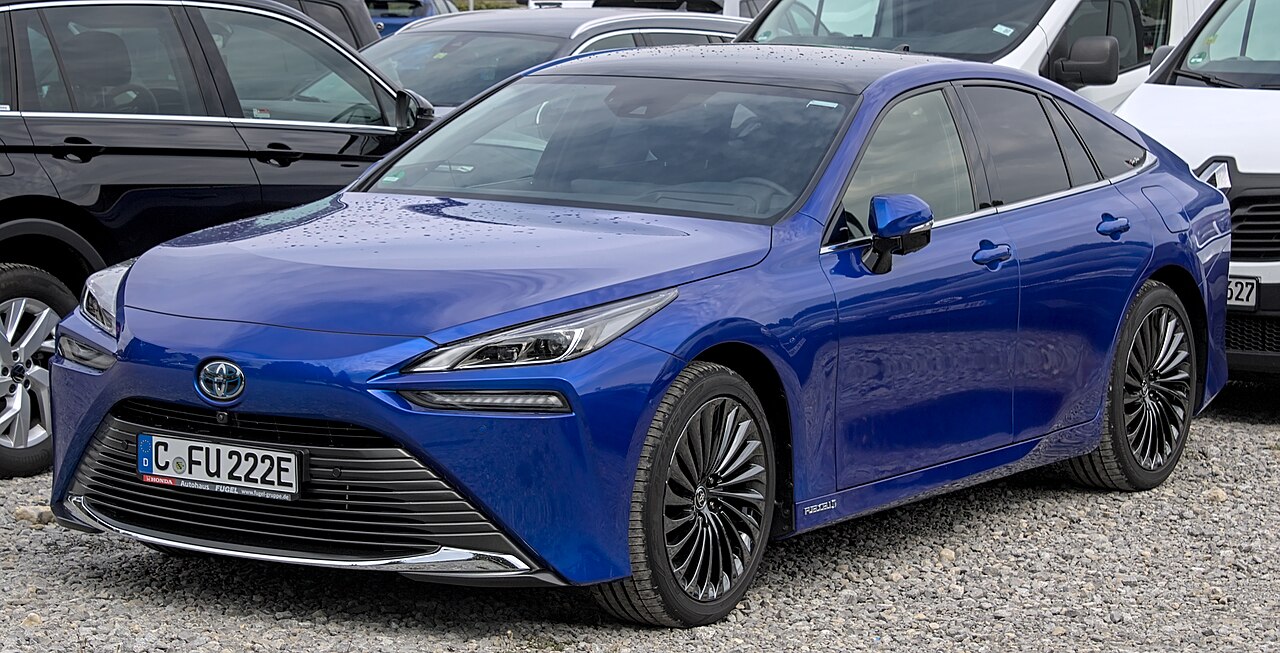 Licensed photo · Photo credit
MakeToyota
ClassCompact car
Model years (US)2016–2027
New registrations (EU)2015–2025
Recall dataNHTSA (United States)
Generations and technical specifications
Toyota Mirai – Second generation2020–present
| Specification | Value |
|---|---|
| Model code | JPD20 |
| Production | December 2020 – present |
| Model years | 2021–present |
| Layout | Rear-motor, rear-wheel-drive |
| Platform | TNGA: GA-N |
| Electric motor | 4JM fuel cell-powered 182 hp, 300 Nm |
| Transmissions | 1-speed |
| Battery | 1.2 kWh lithium-ion |
| Electric range | 647 km (EPA) 141 liters (3 x hydrogen tanks) |
| Wheelbase | 2,920 mm |
| Length | 4,975 mm |
| Width | 1,885 mm |
| Height | 1,470 mm |
| Kerb weight | 1,920–1,950 kg |
Toyota Mirai – First generation2014–2020
| Specification | Value |
|---|---|
| Model code | JPD10 |
| Production | December 2014 – 2020 |
| Model years | 2015–2020 |
| Layout | Front-motor, front-wheel-drive |
| Electric motor | 4JM Fuel cell-powered 113 kW 335 Nm |
| Transmissions | 1-speed |
| Battery | 1.6 kWh Nickel-metal hydride |
| Electric range | 502 km (EPA) 122 liters (2 x hydrogen tanks) |
| Wheelbase | 2,780 mm |
| Length | 4,890 mm |
| Width | 1,815 mm |
| Height | 1,535 mm |
| Kerb weight | 1,850 kg |
Engines and transmissions
| Model years | Engine | Transmission | Drive | Fuel |
|---|---|---|---|---|
| 2021–2026 | Hydrogen fuel cell | CVT (continuously variable) | Rear-wheel drive | Hydrogen |
| 2016–2020 | Hydrogen fuel cell | CVT (continuously variable) | Front-wheel drive | Hydrogen |
EU type-approval data
| Years | Powertrain | Power | Mass | CO₂ | Electric range |
|---|---|---|---|---|---|
| 2021–2022, 2025 | Hydrogen | 48 kW (65 PS) | 1995 kg | 0 g/km (WLTP) | – |
| 2021–2025 | Hydrogen | 134 kW (182 PS) | 1995 kg | 0 g/km (WLTP) | – |
| 2016–2022 | Hydrogen | 55 kW (75 PS) | 1925 kg | 0 g/km (WLTP) | 167 Wh/km |
| 2016–2021 | Hydrogen | 113 kW (154 PS) | 1925 kg | 0 g/km (WLTP) | – |
| 2021 | Electric | 48 kW (65 PS) | 1975–1995 kg | – | – |
| 2016–2020 | Electric | 55 kW (75 PS) | 1925 kg | – | 167–168 Wh/km |
Years are registration years. Each range runs from the 10th to the 90th percentile of the values reported for new registrations; it is not an average. Mass is the mass in running order. For electric cars the power is the type-approval net power, which can be lower than the peak power in brochures.
Key specifications
| Specification | Value |
|---|---|
| EPA size class | Compact car, Subcompact car |
| Model years in EPA data | 2016–2026 |
| Powertrains | Hydrogen fuel cell |
| Transmission types | CVT |
| Drive | Rear-wheel drive, Front-wheel drive |
| Fuel | Hydrogen |
| Configurations listed | 17 |
| Luggage volume (EPA) | 255–283 L |
| Passenger volume (EPA) | 2,435–2,633 L |
| Powertrains (EU) | Hydrogen, Electric |
| Power (EU) | 48–134 kW (65–182 PS) |
| Mass in running order (EU) | 1,925–1,995 kg |
| Wheelbase (EU) | 2,780–2,920 mm |
Years and markets
| Specification | Value |
|---|---|
| Model years (US) | 2016–2027 |
| New registrations (EU) | 2015–2025 |
Owner complaints (NHTSA)
| Component | Complaints | Most reported model years |
|---|---|---|
| Driver assistance | 11 | 2017, 2022, 2023 |
| Fuel and propulsion | 10 | 2016, 2022, 2023 |
| Speed control and cruise | 6 | 2016, 2019, 2022 |
| Electrical system | 4 | 2022, 2023 |
| Brakes | 3 | 2017, 2018, 2019 |
| Engine and cooling | 3 | 2022, 2023 |
| Airbags | 2 | 2019 |
| Transmission and drivetrain | 2 | 2023 |
| Visibility and wipers | 1 | 2017 |
| Seat belts | 1 | 2017 |
Source: complaints filed by owners with the U.S. National Highway Traffic Safety Administration (NHTSA) for model years 2016–2023: 30 complaints, 4 with a crash and 0 with a fire. Complaints are owner reports that NHTSA has not verified, and one complaint can name more than one component. More complaints can also mean more cars sold.