Prius
Toyota Prius: official NHTSA recalls, fault code help and maintenance guides.
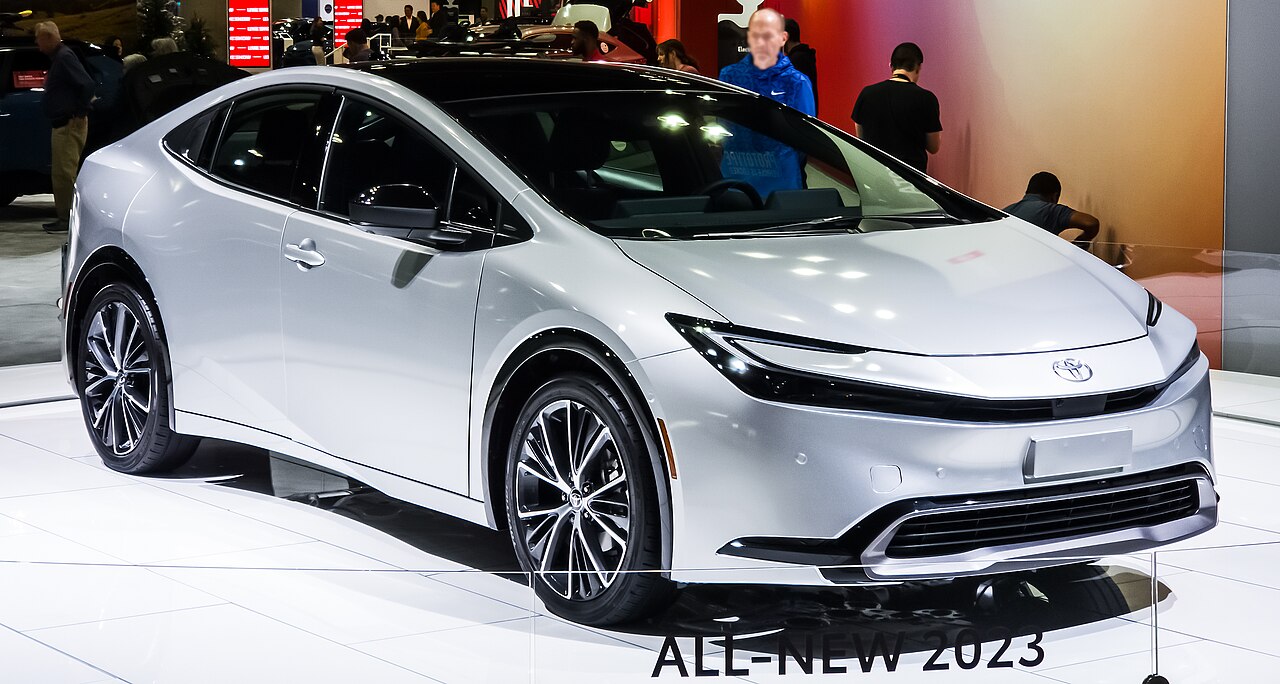 Licensed photo · Photo credit
Generations and technical specifications
Toyota Prius – Fifth generation2022–present
| Specification | Value |
|---|---|
| Model code | XW60 |
| Production | December 2022 – present |
| Model years | 2023–present (North America) |
| Layout | Front-engine, front-wheel-drive Front-engine, four-wheel-drive (E-Four) |
| Platform | TNGA: GA-C |
| Engines | Petrol hybrid 1.8 L 2ZR-FXE I4 (ZVW60/65) 2.0 L M20A-FXS I4 (MXWH60/65) |
| Electric motor | AC synchronous 1VM (front); 1WM (rear) |
| Transmissions | eCVT |
| Drivetrain | Power-split |
| Battery | 4.08 Ah lithium-ion |
| Wheelbase | 2,750 mm |
| Length | 4,600 mm |
| Width | 1,780 mm |
| Height | 1,420–1,430 mm |
| Kerb weight | 1,350–1,480 kg |
| Assembly | Japan: Toyota, Aichi (Tsutsumi plant) |
| Designer | Yuji Fujiwara (project chief designer) Manabu Hirokawa, Hideaki Iida and Mario Majdandžić (exterior) Tsuyoshi Oba and Yuta Nozaki (interior) |
Toyota Prius (XW50)2015–2022
| Specification | Value |
|---|---|
| Production | November 2015 – 2022 |
| Model years | 2016–2022 |
| Body styles | 5-door liftback |
| Layout | Front-engine, front-wheel-drive Front-engine, all-wheel-drive (AWD-e) |
| Platform | TNGA: GA-C |
| Engines | 1.8 L 2ZR-FXE I4 (gasoline hybrid) |
| Electric motor | Dual motor–generator (MG) system MG1 (model 1SM): 23 kW MG2 (model 1NM): 53 kW Rear: 5 kW (AWD-e) |
| Transmissions | eCVT |
| Drivetrain | Power-split (Hybrid Synergy Drive) |
| Battery | 0.75 kWh lithium-ion (FWD) 1.2 kWh nickel-metal hydride (AWD-e) |
| Wheelbase | 2,700 mm |
| Length | 4,572 mm |
| Width | 1,760 mm |
| Height | 1,471 mm |
| Class | Compact car (C) |
| Assembly | Japan: Toyota, Aichi (Tsutsumi plant) |
| Designer | Shunsaku Kodama (2012) |
Toyota Prius (XW30)2009–2016
| Specification | Value |
|---|---|
| Production | March 2009 – 2016 December 2011 – 2015 (China) |
| Model years | 2010–2015 |
| Body styles | 5-door fastback/liftback |
| Layout | Front-engine, front-wheel-drive |
| Platform | Toyota New MC platform |
| Engines | Toyota Hybrid System Gasoline engine 1.8 L 2ZR-FXE I4 VVT-i (Atkinson cycle) Power: 98 hp at 5200 rpm Torque: 142 Nm at 4000 rpm Electric Motors Power: 80 hp Hybrid system total: 134 hp |
| Transmissions | 1-speed planetary gear |
| Drivetrain | Power-split Hybrid |
| Battery | 1.3 kWh Nickel-metal hydride |
| Wheelbase | 2,700 mm |
| Length | 2010-2011: 4,460 mm 2011–2015: 4,481 mm |
| Width | 1,745 mm |
| Height | 2010-2011: 1,480 mm 2011–2015: 1,491 mm |
| Kerb weight | 1,379 kg |
| Class | Compact car (C) |
| Assembly | Japan: Toyota, Aichi (Tsutsumi plant) Thailand: Chachoengsao (Gateway plant) China: Changchun, Jilin (SFTM) |
Toyota Prius (XW20)2003–2012
| Specification | Value |
|---|---|
| Production | 2003–2012 (Japan) 2005–2009 (China) |
| Model years | 2004–2009 (North America) |
| Body styles | 5-door liftback |
| Layout | Front-engine, front-wheel-drive |
| Platform | Toyota MC platform |
| Engines | Toyota Hybrid System II Gasoline 1.5 L Atkinson Cycle 1NZ-FXE DOHC I4 VVT-i 57 kW (76 hp) @ 5000 rpm 115 N·m (85 lb·ft) @ 4200 rpm Electric 50 kW (67 hp) @ 1200 rpm 400 N·m (295 lb·ft) @ 0 rpm AT-PZEV Hybrid system net horsepower: 110 hp (82 kW) |
| Transmissions | 1-speed planetary gear |
| Drivetrain | Power-split hybrid |
| Wheelbase | 2,700 mm |
| Length | 4,450 mm |
| Width | 1,725 mm |
| Height | 1,490 mm |
| Kerb weight | 1,317 kg |
| Class | Compact car |
| Assembly | Japan: Toyota, Aichi (Tsutsumi plant); Kariya, Aichi (Fujimatsu plant) China: Changchun, Jilin (SFTM) |
| Designer | Hiroshi Okamoto (2001) |
Toyota Prius (XW10)1997–2003
| Specification | Value |
|---|---|
| Production | 1997–2001 (NHW10) September 2000–2003 (NHW11) |
| Model years | 2001–2003 |
| Body styles | 4-door sedan |
| Layout | Front-engine, front-wheel-drive |
| Platform | Toyota MC platform |
| Engines | NHW10 Toyota Hybrid System Gasoline: 1.5 L 1NZ-FXE DOHC I4 13.5:1 compression 43 kW (58 hp) @ 4000 rpm 102 N·m (75 lb·ft) @ 4000 rpm Electric: 288 V motor 30 kW (40 hp) @ 940 rpm 305 N·m (225 lb·ft) @ 0 rpm NHW11 Toyota Hybrid System Gasoline: 1.5 L 1NZ-FXE DOHC I4 VVT-i 13.0:1 compression 52 kW (70 hp) @ 4500 rpm +5 more |
| Transmissions | 1-speed planetary gear |
| Drivetrain | Power-split Hybrid |
| Battery | 1.78 kWh, Ni-MH, 273.6 V, 6.5 Ah |
| Wheelbase | 2,550 mm |
| Length | NHW10: 4,275 mm NHW11: 4,308 mm |
| Width | 1,695 mm |
| Height | NHW10: 1,491 mm NHW11: 1,463 mm |
| Kerb weight | NHW11: 1,254 kg |
| Class | Subcompact car |
| Assembly | Toyota, Aichi, Japan (Takaoka Plant, later Motomachi plant) |
| Designer | Risuke Kubochi |
Engines and transmissions
| Model years | Engine | Transmission | Drive | Fuel |
|---|---|---|---|---|
| 2026–2027 | 2.0 L, 4 cyl hybrid | CVT (continuously variable) | All-wheel drive | Petrol (regular) |
| 2023–2027 | 2.0 L, 4 cyl hybrid | CVT (continuously variable) | Front-wheel drive | Petrol (regular) |
| 2023–2025 | 2.0 L, 4 cyl hybrid | CVT (continuously variable) | Part-time four-wheel drive | Petrol (regular) |
| 2010–2022 | 1.8 L, 4 cyl hybrid | CVT (continuously variable) | Front-wheel drive | Petrol (regular) |
| 2019–2022 | 1.8 L, 4 cyl hybrid | CVT (continuously variable) | Part-time four-wheel drive | Petrol (regular) |
| 2001–2009, 2012–2020 | 1.5 L, 4 cyl hybrid | CVT (continuously variable) | Front-wheel drive | Petrol (regular) |
| 2012–2015 | 1.8 L, 4 cyl plug-in hybrid | CVT (continuously variable) | Front-wheel drive | Petrol (regular) and electricity |
Fuel economy (EPA)
| Model years | Configuration | Combined | City | Highway | Electric range |
|---|---|---|---|---|---|
| 2026–2027 | 2.0 L, 4 cyl hybrid · CVT (continuously variable) · All-wheel drive | 4.4–4.9 L/100 km | 4.2–4.8 L/100 km | 4.4–5.2 L/100 km | – |
| 2023–2027 | 2.0 L, 4 cyl hybrid · CVT (continuously variable) · Front-wheel drive | 4.1–4.6 L/100 km | 4.0–4.5 L/100 km | 4.2–5.1 L/100 km | – |
| 2023–2025 | 2.0 L, 4 cyl hybrid · CVT (continuously variable) · Part-time four-wheel drive | 4.4–4.8 L/100 km | 4.4–4.8 L/100 km | 4.4–4.7 L/100 km | – |
| 2010–2022 | 1.8 L, 4 cyl hybrid · CVT (continuously variable) · Front-wheel drive | 4.2–5.7 L/100 km | 4.1–5.5 L/100 km | 4.4–6.0 L/100 km | – |
| 2019–2022 | 1.8 L, 4 cyl hybrid · CVT (continuously variable) · Part-time four-wheel drive | 4.7–4.8 L/100 km | 4.5–4.6 L/100 km | 4.9–5.0 L/100 km | – |
| 2001–2009, 2012–2020 | 1.5 L, 4 cyl hybrid · CVT (continuously variable) · Front-wheel drive | 4.7–5.7 L/100 km | 4.4–5.6 L/100 km | 5.1–5.7 L/100 km | – |
| 2012–2015 | 1.8 L, 4 cyl plug-in hybrid · CVT (continuously variable) · Front-wheel drive | 4.7 L/100 km | 4.6 L/100 km | 4.8 L/100 km | 18 km |
Values are the official EPA label figures for each model year, shown as the lowest and highest value for the configuration. Electric models show energy use per 100 km. Real-world consumption depends on driving style, weather and load. Luggage and passenger volumes follow the EPA measuring method and can differ from the VDA figures used in Europe.
EU type-approval data
| Years | Powertrain | Engine | Power | Mass | CO₂ | Electric range |
|---|---|---|---|---|---|---|
| 2023–2025 | Petrol plug-in hybrid | 1987 cm³ | 111 kW (151 PS) | 1620–1630 kg | 12–17 g/km (WLTP) | 71–86 km · 114–133 Wh/km |
| 2019–2022 | Petrol hybrid | 1798 cm³ | 72 kW (98 PS) | 1450–1515 kg | 94–109 g/km (WLTP) | – |
| 2019–2022 | Petrol plug-in hybrid | 1798 cm³ | 72 kW (98 PS) | 1605 kg | 28–99 g/km (WLTP) | 45 km · 99–100 Wh/km |
| 2011–2021 | Petrol | 1798 cm³ | 73 kW (99 PS) | 1440–1605 kg | 132–136 g/km (WLTP) | – |
| 2019–2021 | Petrol hybrid | 1798 cm³ | 73 kW (99 PS) | 1575 kg | 131–136 g/km (WLTP) | – |
| 2016–2019 | Petrol | 1798 cm³ | 72 kW (98 PS) | 1450 kg | 99–108 g/km (WLTP) | – |
| 2016–2018 | Petrol-electric | 1798 cm³ | 72 kW (98 PS) | 1605–1615 kg | 28–99 g/km (WLTP) | 72–75 Wh/km |
| 2013, 2016 | Petrol-electric | 1798 cm³ | 18 kW (24 PS) | 1500 kg | 49 g/km (NEDC) | – |
| 2012–2016 | Petrol-electric | 1798 cm³ | 73 kW (99 PS) | 1460–1605 kg | 49–95 g/km (NEDC) | – |
| 2011–2012 | Electric | – | 73 kW (99 PS) | 1470–1495 kg | – | – |
Years are registration years. Each range runs from the 10th to the 90th percentile of the values reported for new registrations; it is not an average. Mass is the mass in running order. For electric cars the power is the type-approval net power, which can be lower than the peak power in brochures.
Key specifications
| Specification | Value |
|---|---|
| EPA size class | Midsize car, Compact car, Midsize estate |
| Model years in EPA data | 2001–2027 |
| Powertrains | Hybrid, Plug-in hybrid |
| Engine displacement | 1.5–2.0 L |
| Cylinders | 4 |
| Transmission types | CVT |
| Drive | All-wheel drive, Front-wheel drive, Part-time four-wheel drive |
| Fuel | Petrol (regular), Petrol (regular) and electricity |
| Configurations listed | 72 |
| Start-stop system | Yes |
| Electric motor (EPA) | 18 kW AC Induction; 18 kW |
| Luggage volume (EPA) | 340–963 L |
| Passenger volume (EPA) | 2,464–2,747 L |
| Powertrains (EU) | Petrol, Petrol hybrid, Petrol plug-in hybrid, Petrol-electric |
| Engine displacement (EU) | 1,798–1,987 cm³ |
| Power (EU) | 18–111 kW (24–151 PS) |
| Mass in running order (EU) | 1,440–1,630 kg |
| Wheelbase (EU) | 2,700–2,780 mm |
Years and markets
| Specification | Value |
|---|---|
| Model years (US) | 2001–2027 |
| New registrations (EU) | 2000–2026 |
Owner complaints (NHTSA)
| Component | Complaints | Most reported model years |
|---|---|---|
| Brakes | 4622 | 2008, 2010, 2012 |
| Lights | 3520 | 2006, 2007, 2008 |
| Electrical system | 1643 | 2007, 2008, 2010 |
| Speed control and cruise | 1079 | 2007, 2008, 2010 |
| Engine and cooling | 831 | 2004, 2005, 2010 |
| Airbags | 449 | 2007, 2010, 2011 |
| Body and structure | 439 | 2007, 2008, 2010 |
| Transmission and drivetrain | 437 | 2005, 2008, 2010 |
| Stability and traction control | 417 | 2007, 2008, 2010 |
| Steering | 394 | 2001, 2002, 2003 |
Source: complaints filed by owners with the U.S. National Highway Traffic Safety Administration (NHTSA) for model years 2001–2025: 12873 complaints, 1040 with a crash and 69 with a fire. Complaints are owner reports that NHTSA has not verified, and one complaint can name more than one component. More complaints can also mean more cars sold.