Dacia
Duster
Dacia Duster: anni di prima immatricolazione in Europa, aiuto sui codici di errore, spie e guide alla manutenzione.
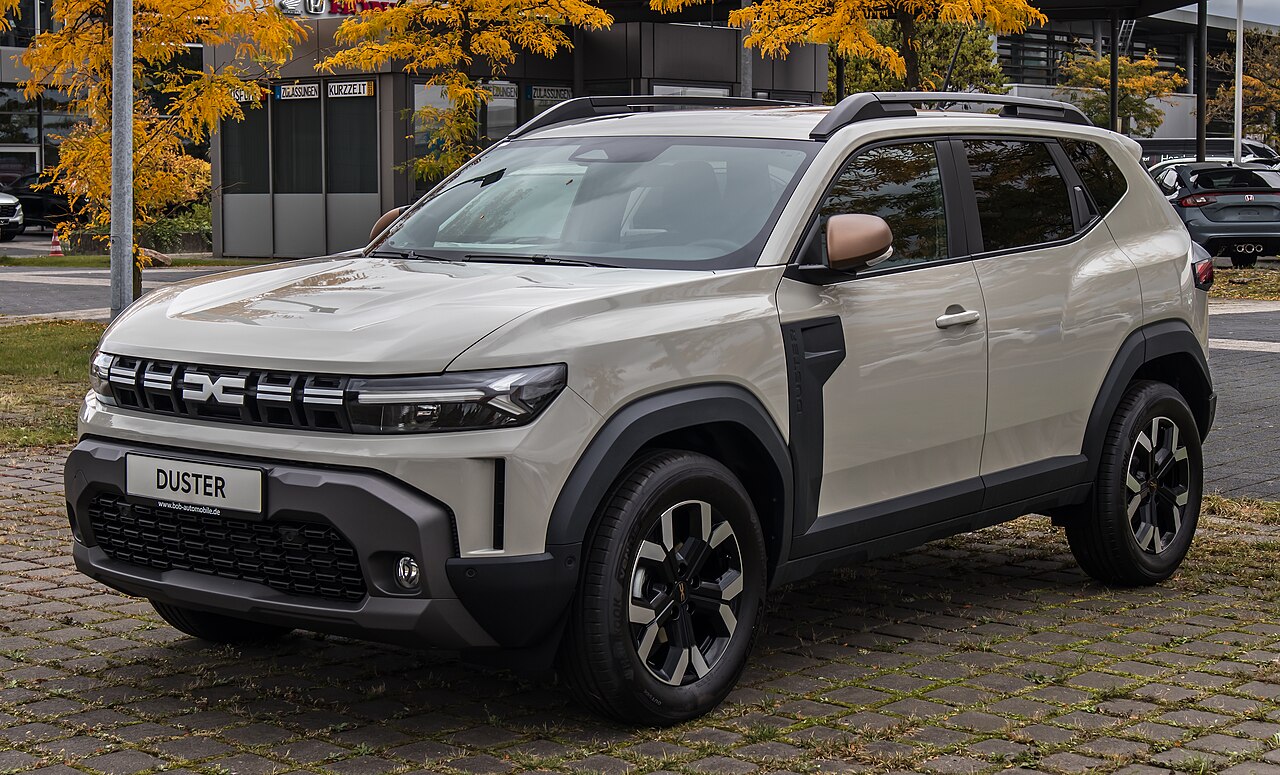 Foto con licenza · Crediti
MarcaDacia
Nuove immatricolazioni (UE)2010–2026
Generazioni e specifiche tecniche
Dacia Duster – 3ª generazione2023–oggi
| Caratteristica | Valore |
|---|---|
| Codice modello | P1310 |
| Produzione | dicembre 2023 – oggi (Romania) novembre 2024 – oggi (Turchia) marzo 2026 – oggi (India) |
| Carrozzerie | 5 porte crossover SUV |
| Piattaforma | Renault–Nissan CMF-B LS RGMP (Renault Group Modular Platform (India) |
| Motori | Benzina / LPG 1,0 L ECO-G I3 turbo Benzina ibrido 1,2 L HR12DDV I3 turbo (mild hybrid) 1,3 L H5Ht I4 turbo 1,6 L H4M I4 (Ibrido 140) 1,8 L Horse HR18 HEV I4 (Ibrido 155) Benzina 1,0L Turbo 100 I3 turbo 1,3L Turbo 160 I4 turbo Diesel 1,5 L K9K I4 |
| Cambi | 7 marce EDC 6 marce manuale EDC 4 marce automatico (Ibrido 140) |
| Batteria | 0,9 kWh (TCe 130) 1,2 kWh lithium-ion (Ibrido 140) |
| Passo | 2.657 mm |
| Lunghezza | 4.343 mm |
| Larghezza | 1.829 mm |
| Altezza | 1.660 mm |
| Assemblaggio | Romania: Mioveni Turchia: Bursa (Oyak-Renault) India: Chennai (Renault Nissan India) |
| Designer | Eduard Grigoroiu (head of the design team) David Durand (design director) |
Dacia Duster – 2ª generazione2017–oggi
| Caratteristica | Valore |
|---|---|
| Codice modello | HM |
| Produzione | 2017–2024 (Europa) 2020–oggi (Brasile) 2021–oggi (Colombia) 2021–oggi (Nigeria) 2021–2022 (Russia) |
| Carrozzerie | 5 porte crossover SUV 2 porte pickup |
| Piattaforma | Dacia B0+ platform |
| Motori | Benzina 1,0 L H5D I3 turbo 1,2 L H5Ft I4 turbo 1,3 L H5Ht I4 turbo 1,6 L H4M I4 2,0 L F4R I4 Diesel 1,5 L K9K I4 |
| Cambi | 5 marce manuale 6 marce manuale 6 marce EDC CVT |
| Passo | 2.673 mm |
| Lunghezza | 4.320 mm 4.341 mm (pick-up) |
| Larghezza | 1.822 mm |
| Altezza | 1.630–1.700 mm |
| Assemblaggio | Romania: Mioveni Brasile: São José dos Pinhais (Renault Brazil) Colombia: Envigado (SOFASA) Russia: Moscow (Renault Russia) Nigeria: Lagos (Coscharis) |
| Designer | Renault Technocentre & Renault Technologie Roumanie Erde Tungaa (exterior) Emmanuel Klissarov (exterior) |
Dacia Duster – 1ª generazione2010–2022
| Caratteristica | Valore |
|---|---|
| Codice modello | HS |
| Produzione | 2010–2017 2012–2020 (Brasile) 2012–2021 (Colombia) 2011–2021 (Russia) 2012–2022 (India) |
| Carrozzerie | 5 porte crossover SUV 4 porte pick-up |
| Piattaforma | Dacia B0 platform |
| Motori | Benzina 1,2 L H5Ft I4 turbo 1,3 L H5Ht I4 turbo 1,5 L H4K I4 1,6 L K4M I4 1,6 L K4M I4 (ethanol) 1,6 L K4M I4 (LPG) 2,0 L F4R I4 2,0 L F4R I4 (ethanol) Diesel 1,5 L K9K I4 turbo |
| Cambi | 5 marce manuale 6 marce manuale 4 marce automatico 6 marce automated manuale 6 marce EDC CVT |
| Passo | 2.673 mm |
| Lunghezza | 4.315 mm |
| Larghezza | 1.822 mm |
| Altezza | 1.630–1.690 mm |
| Peso a vuoto | 1.160–1.294 kg |
| Assemblaggio | Romania: Mioveni Brasile: São José dos Pinhais (Renault Brazil) Colombia: Envigado (SOFASA) Russia: Moscow (Avtoframos/Renault Russia) India: Chennai (Renault Nissan India) Indonesia: East Jakarta (National Assemblers) |
| Designer | Renault Design Central Europe Erde Tungaa (exterior) |
Dati di omologazione UE
| Anni | Alimentazione | Motore | Potenza | Massa | CO₂ |
|---|---|---|---|---|---|
| 2021–2025 | Benzina | 999 cm³ | 67 kW (91 CV) | 1264–1300 kg | 139–141 g/km (WLTP) |
| 2024–2025 | Ibrida benzina | 1199 cm³ | 96 kW (131 CV) | 1379–1465 kg | 124–137 g/km (WLTP) |
| 2024–2025 | Ibrida benzina | 1598 cm³ | 69 kW (94 CV) | 1455 kg | 112–114 g/km (WLTP) |
| 2021–2025 | GPL (bifuel) | 999 cm³ | 67 kW (91 CV) | 1351–1372 kg | 126–130 g/km (WLTP) |
| 2020–2022, 2025 | GPL (bifuel) | 999 cm³ | 74 kW (101 CV) | 1327–1372 kg | 126–133 g/km (WLTP) |
| 2019–2024 | Benzina | 1332 cm³ | 96 kW (131 CV) | 1309–1406 kg | 141–162 g/km (WLTP) |
| 2019–2024 | Benzina | 1332 cm³ | 110 kW (150 CV) | 1309–1406 kg | 141–162 g/km (WLTP) |
| 2024 | Ibrida benzina | 1199 cm³ | 12 kW (16 CV) | 1379–1465 kg | 124–137 g/km (WLTP) |
| 2024 | Ibrida benzina | 1598 cm³ | 51 kW (69 CV) | 1455 kg | 114 g/km (WLTP) |
| 2021–2024 | Diesel | 1461 cm³ | 84 kW (114 CV) | 1514–1518 kg | 140–145 g/km (WLTP) |
| 2018–2024 | Diesel | 1461 cm³ | 85 kW (116 CV) | 1395–1480 kg | 127–150 g/km (WLTP) |
| 2019–2021 | Benzina | 999 cm³ | 74 kW (101 CV) | 1266–1305 kg | 140–150 g/km (WLTP) |
| 2016–2020 | GPL (bifuel) | 1598 cm³ | 84 kW (114 CV) | 1280–1315 kg | 163–182 g/km (WLTP) |
| 2015–2019 | Benzina | 1598 cm³ | 84 kW (114 CV) | 1165–1351 kg | 176–190 g/km (WLTP) |
| 2014–2018 | Benzina | 1197 cm³ | 92 kW (125 CV) | 1275–1387 kg | 138–173 g/km (WLTP) |
| 2011–2018 | Diesel | 1461 cm³ | 66 kW (90 CV) | 1265–1373 kg | 140 g/km (WLTP) |
| 2013–2018 | Diesel | 1461 cm³ | 80 kW (109 CV) | 1280–1395 kg | 116–168 g/km (WLTP) |
| 2011–2015 | Benzina | 1598 cm³ | 77 kW (105 CV) | 1235–1417 kg | 165–185 g/km (NEDC) |
| 2011–2015 | GPL (bifuel) | 1598 cm³ | 77 kW (105 CV) | 1280–1328 kg | 145–165 g/km (NEDC) |
| 2011–2014 | Diesel | 1461 cm³ | 79 kW (107 CV) | 1280–1376 kg | 130–139 g/km (NEDC) |
| 2011–2014 | Diesel | 1461 cm³ | 81 kW (110 CV) | 1369–1461 kg | 135–145 g/km (NEDC) |
Gli anni sono anni di immatricolazione. Ogni intervallo va dal 10° al 90° percentile dei valori dichiarati per le nuove immatricolazioni; non è una media. La massa è la massa in ordine di marcia. Per le auto elettriche la potenza è la potenza netta di omologazione, che può essere inferiore alla potenza massima dichiarata.
Caratteristiche principali
| Caratteristica | Valore |
|---|---|
| Motorizzazioni (UE) | Benzina, Diesel, GPL (bifuel) |
| Cilindrata (UE) | 999–1.598 cm³ |
| Potenza (UE) | 66–110 kW (90–150 CV) |
| Massa in ordine di marcia (UE) | 1.165–1.518 kg |
| Passo (UE) | 2.673 mm |
Anni e mercati
| Caratteristica | Valore |
|---|---|
| Nuove immatricolazioni (UE) | 2010–2026 |